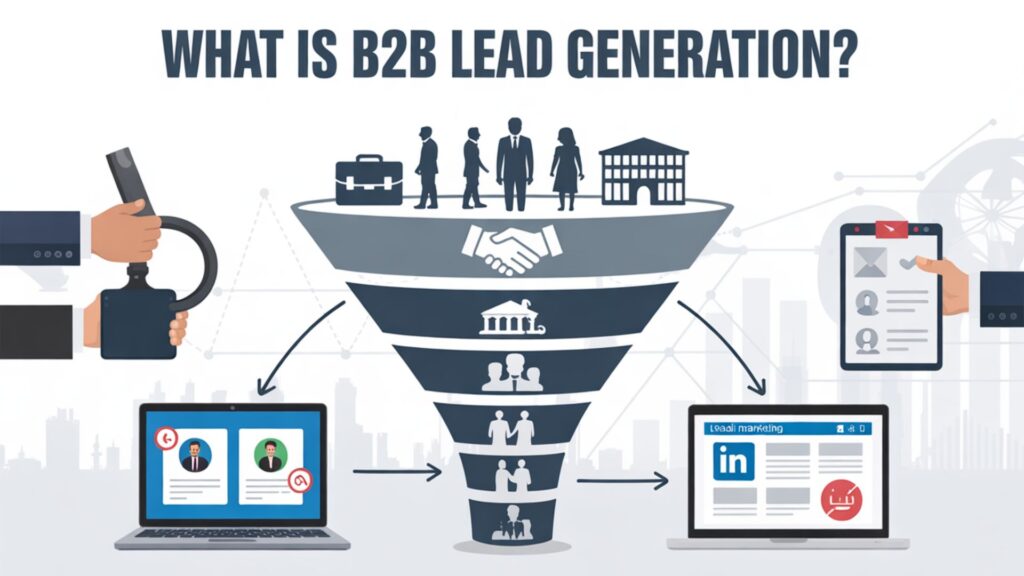
B2B lead generation is the process of identifying and attracting business customers who are most likely to purchase your products or services. Unlike consumer-focused strategies, B2B marketing involves longer sales cycles and multiple stakeholders, making it more complex and strategic.
Companies rely on business-to-business marketing to build a steady sales pipeline and generate qualified leads that can turn into loyal clients. Effective B2B lead generation combines targeted content marketing, content creation for B2B, and personalized outreach to ensure potential customers engage with your brand. By nurturing these leads strategically, businesses can improve conversion rates and achieve sustainable growth.
Understanding B2B Lead Generation
B2B lead generation is more than collecting names or emails. It is about finding companies that are ready to buy and building relationships with them. By using inbound marketing techniques like blogs, webinars, and whitepapers, you can identify potential business customers before your competitors. Combining these with outbound marketing like cold emails and direct outreach ensures that your sales pipeline remains active and full of high-quality leads.
Companies must focus on personalized marketing approaches to stand out. Each prospect has unique challenges, so creating targeted content marketing and tailored solutions helps convert leads faster. Integrating CRM integration tools and lead tracking systems ensures every interaction is recorded and analyzed. This way, businesses can optimize lead generation campaigns and improve the ROI of lead generation consistently.
Types of B2B Leads
There are different types of B2B leads, each requiring a different approach. Marketing-qualified leads (MQLs) are prospects who show interest through actions like downloading webinars and whitepapers. These leads need nurturing through email follow-up and content until they are ready to talk to sales. Sales-qualified leads (SQLs) are ready to buy and often require immediate attention from the sales team.

Other leads include cold leads, warm leads, and product-qualified leads. Tracking and segmenting these leads using lead scoring helps prioritize efforts. Businesses can combine lead nurturing with personalized marketing strategies to guide leads along the sales pipeline. Proper lead tracking ensures no potential client slips through the cracks.
Why B2B Lead Generation is Important
B2B lead generation drives growth by attracting business customers who can become long-term clients. Without a steady stream of qualified leads, even the best sales teams struggle. Effective lead generation allows companies to focus on customer acquisition, shorten the longer sales cycles, and maintain a strong sales pipeline.
A strong strategy also ensures better conversion rates. Businesses that use digital marketing strategies and personalized marketing approaches can increase the chances of turning a prospect into a paying customer. Tracking results with data-driven marketing and analytics helps refine approaches and optimize lead generation campaigns over time.
Who Performs B2B Lead Generation?
Lead generation is a team effort. The sales team focuses on closing qualified leads, while the marketing team works to identify potential business customers and attract them through content creation for B2B. Some companies also hire external agencies to support workflow automation and lead capture.
Coordination is critical because longer sales cycles and multiple decision makers can complicate the process. Using CRM integration and lead tracking, both teams can share insights. Effective lead nurturing from marketing combined with timely follow-ups from sales ensures prospects move efficiently through the sales pipeline.
B2B Lead Generation Strategies
Successful B2B lead generation blends inbound marketing and outbound marketing. Inbound strategies include blogs, webinars and whitepapers, and SEO content that helps attract business customers. Outbound strategies involve cold emails, calls, and personalized marketing approaches targeting specific accounts.
Account-Based Marketing (ABM) is increasingly popular. It focuses on high-value companies and uses targeted content marketing to provide tailored solutions. Combining ABM with digital marketing strategies increases engagement and conversion. Businesses can also run A/B testing for leads to refine messaging and identify the most effective approach.
Lead Capture Techniques
Capturing lead information is essential to identify potential business customers. Lead capture forms on landing pages or websites collect valuable data like email, company size, and job title. Using progressive profiling, companies gather more details over time, helping personalized marketing approaches.
Offering valuable content, such as eBooks, case studies, and webinars and whitepapers, motivates prospects to provide their information. Integrating CRM integration ensures every lead is stored and ready for lead tracking and effective lead nurturing. Optimizing forms can significantly improve conversion rates and reduce friction for users.
Lead Qualification and Follow-Up
Not all leads are ready to buy. Lead qualification helps identify qualified leads who are most likely to convert. Using lead scoring, businesses assign points based on engagement, company size, and interest level. This prioritizes efforts and improves efficiency.
Follow-up is just as crucial. Timely email follow-up, calls, or even in-person meetings ensure prospects stay engaged. Effective lead nurturing with personalized marketing approaches guides leads along the sales pipeline. Consistency in follow-up increases the likelihood of conversion and strengthens customer relationship management.
Marketing Automation in Lead Generation
Marketing automation streamlines the lead generation process. Tools like HubSpot or Salesforce allow for workflow automation, lead tracking, and timely email follow-up. Automation reduces manual work and ensures no lead is ignored.
Automation also enables data-driven marketing. By analyzing user behavior, businesses can send personalized content and target prospects effectively. Automated scoring and nurturing can hand off qualified leads to sales at the perfect moment, improving ROI of lead generation and shortening longer sales cycles.
Measuring and Optimizing Your Lead Generation
Tracking results is essential to optimize lead generation campaigns. Key metrics include conversion rates, cost per lead, and overall ROI of lead generation. Companies can use dashboards to monitor progress and identify gaps in their sales pipeline.
Continuous improvement comes from A/B testing for leads and analyzing which digital marketing strategies work best. Using data-driven marketing, businesses can adjust targeted content marketing and personalized marketing approaches to maximize customer acquisition and overall performance.
Common Challenges in B2B Lead Generation
B2B lead generation faces many hurdles. Poor lead quality, longer sales cycles, and multiple decision makers make conversion difficult. Misalignment between sales and marketing can also hinder results.
Other B2B marketing challenges include ineffective lead nurturing, lack of workflow automation, and weak CRM integration. Businesses that monitor their processes and invest in data-driven marketing tools can overcome these challenges and maintain a steady flow of qualified leads.
Conclusion
Understanding what is B2B lead generation is critical for USA-based companies seeking growth. Combining content creation for B2B, lead nurturing, targeted content marketing, and marketing automation can streamline processes and improve conversion rates.
Continuous measurement and optimization ensure businesses identify potential business customers, attract business customers, and maintain an efficient sales pipeline. By tackling B2B marketing challenges and using digital marketing strategies, companies can consistently generate qualified leads, strengthen customer relationship management, and boost ROI.