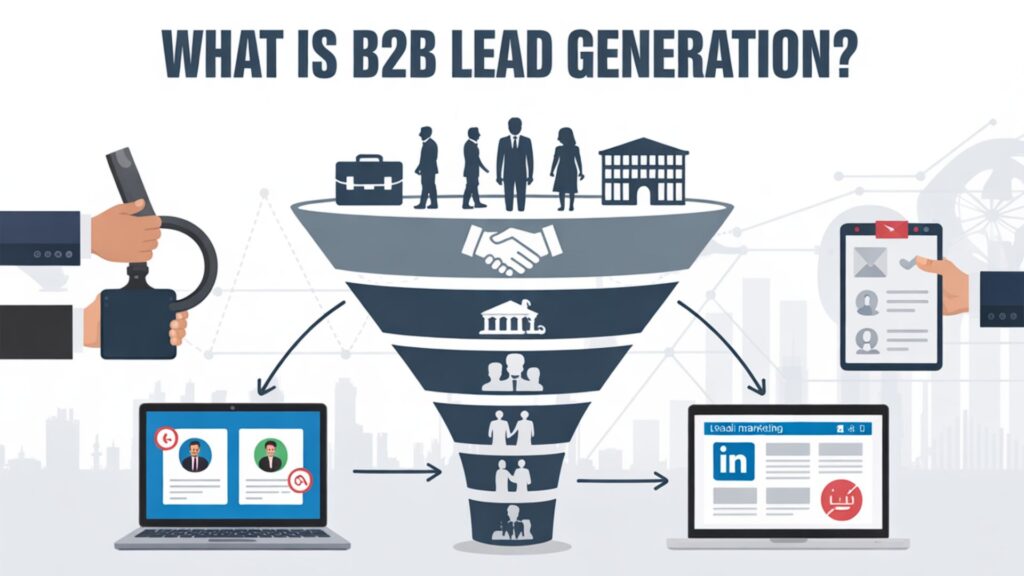

Let’s be honest. Your sales pipeline is probably running dry, and you’re tired of your team spending hours cold calling people who ghost them.
You’ve been thinking about hiring a B2B marketing agency specializing in lead generation. Smart move. But here’s the problem—most agencies will promise you the moon and deliver a handful of unqualified tire-kickers.
I’ve seen companies waste $50,000+ on the wrong agency before figuring out what actually works. You don’t have to make those same mistakes.
This guide shows you exactly what to look for, what to avoid, and how much you should actually pay. No BS, just real talk from someone who’s been in the trenches.
What Does a B2B Marketing Agency Specializing in Lead Generation Actually Do?
Here’s what you need to know. B2B marketing agencies specializing in lead generation focus on one thing: filling your calendar with qualified sales appointments.
They’re not branding agencies. They’re not running Instagram campaigns for consumer products. They live and breathe one metric—getting decision-makers on the phone with your sales team.
These agencies typically use a mix of tactics:
Outbound strategies like cold email, LinkedIn outreach, and calling. They’re proactively reaching out to your ideal customers before those prospects even know you exist.
Inbound strategies like content marketing, SEO, and paid ads. They’re creating resources that attract prospects who are already looking for solutions like yours.
The best B2B lead generation agencies combine both approaches. Why? Because relying on just one channel is risky. Email deliverability tanks, LinkedIn changes its algorithm, or Google updates its search rules—and suddenly your pipeline dries up.
Top 10 B2B Lead Generation Agencies (Ranked by Results, Not Hype)
I’ve analyzed hundreds of lead generation agencies. Here are the ten that consistently deliver results without the BS.
1. Leads Monky — Best for Multi-Channel Campaigns
Pricing: $8,000-$20,000/month Best For: Mid-market to enterprise B2B companies across 50+ industries
Leads Monky has been crushing it since 2017. They’ve helped clients generate over $2 billion in revenue with their omnichannel approach.
What makes them different? They guarantee 100-400 yearly appointments and combine email, LinkedIn, cold calling, content marketing, and SEO into one cohesive strategy.
Pros: Proven track record, full-service offering, deep industry expertise Cons: Higher investment required, enterprise-focused pricing
2. Callbox — Best for Global Reach
Pricing: $7,000-$18,000/month (custom pricing) Best For: Software, SaaS, fintech, healthcare tech companies expanding globally
With 20+ years and 10,000+ campaigns under their belt, Callbox knows what works. Their proprietary Smart Engage platform uses AI to target the right decision-makers.
They’re particularly strong for companies targeting multiple countries. Their data research team can build lists anywhere in the world.
Pros: Global capabilities, proprietary technology, own data research team Cons: Custom pricing lacks transparency, enterprise-focused
3. Abstrakt Marketing Group — Best Full-Service Partner
Pricing: $5,000-$15,000/month Best For: Growing B2B companies needing comprehensive marketing support
Abstrakt made the Inc. 5000 list for 10 consecutive years. That’s not luck—that’s consistent execution for 1,750+ clients.
They offer everything from outbound calling to digital marketing to creative services. It’s like having an entire marketing department without the overhead.
Pros: Full-service offering, strong track record, transparent process Cons: May be complex for simple needs, longer onboarding
4. Ironpaper — Best for Complex B2B Sales
Pricing: $6,000-$12,000/month Best For: Long sales cycles, technical products, enterprise buyers
Ironpaper specializes in account-based marketing and inbound strategies. They’re HubSpot Diamond Partners, which means they know their stuff.
If you’re selling enterprise software, manufacturing solutions, or complex services with 6-12 month sales cycles, these are your people.
Pros: ABM expertise, website optimization focus, content marketing strength Cons: Less outbound focus, requires content investment, slower results
5. Altitude Marketing — Best for Technical Industries
Pricing: $6,000-$15,000/month Best For: Tech-focused businesses, SaaS, manufacturing, life sciences
Twenty years serving technical clients means Altitude understands complex products. Their team is all W-2 employees based in Pennsylvania—no freelancers, no offshore teams.
They excel at creating technical content that actually converts. If your product requires buyer education, they’re worth a look.
Pros: 20+ years in business, full employee team, strong technical content Cons: Primarily inbound-focused, premium pricing
6. SevenAtoms — Best for Performance Accountability
Pricing: $5,000-$10,000/month Best For: Companies prioritizing sales qualified leads and won opportunities
SevenAtoms obsesses over one thing: getting you closed deals, not just leads. They track everything from initial contact to won opportunity.
Their data-driven approach means constant optimization. What’s working gets scaled. What’s not gets killed fast.
Pros: Performance-oriented, full-stack services, strong B2B track record Cons: Less public information on process, fewer case studies available
7. CIENCE — Best for AI-Powered Prospecting
Pricing: $6,000-$14,000/month Best For: Companies wanting human expertise plus AI efficiency
CIENCE combines human researchers with AI-powered tools for lead generation. Their Smart Engage platform identifies prospects, but humans handle the actual outreach.
They’re particularly strong at appointment setting and have their own proprietary technology stack.
Pros: AI + human hybrid model, end-to-end service, proprietary tech Cons: Can be pricey for startups, enterprise-focused
8. Martal Group — Best for Sales-as-a-Service
Pricing: $7,000-$15,000/month Best For: Companies needing outsourced sales executives
Martal Group provides 200+ sales executives who become extensions of your team. They don’t just generate leads—they close deals.
Perfect for companies that want complete sales outsourcing, not just lead generation.
Pros: Full sales team, intent data usage, custom campaigns Cons: Higher pricing, sales-focused vs pure marketing
9. Cleverly — Best Budget-Friendly Option
Pricing: $397-$897/month (transparent pricing) Best For: Startups, consultants, agencies, coaches, solopreneurs
Cleverly focuses exclusively on LinkedIn outreach. They’ve served 10,000+ clients with their productized approach.
If you’re a startup with limited budget but need qualified appointments, this is your entry point. You won’t get full-service, but you will get results.
Pros: Very affordable, transparent pricing, fast setup, LinkedIn expertise Cons: Limited to LinkedIn primarily, not full-service, less industry depth
10. Pearl Lemon Leads — Best for Small Business
Pricing: $2,500-$6,000/month Best For: SMBs testing lead generation for the first time
Pearl Lemon offers accessible pricing for smaller B2B companies. They handle multiple digital marketing channels including SEO, PPC, and social.
Good option if you’re testing the waters without committing to enterprise-level investment.
Pros: Accessible pricing, multiple services, good for testing Cons: Less specialized, limited public information, newer to market
How Much Does a B2B Lead Generation Agency Actually Cost in 2026?
Let’s talk money. Because if one more agency tells you “it depends” without giving real numbers, you’re going to lose your mind.
Here’s what you’ll actually pay for B2B lead generation services in 2025:
Monthly retainer model: $2,500 to $20,000 per month. This is the most common pricing structure. You’re paying for a dedicated team, technology, and ongoing campaigns.
Cost-per-lead pricing: $50 to $650+ per lead, depending on your industry. Legal and financial services? Expect $400-$650 per qualified lead. SaaS and tech? More like $150-$300.
Cost-per-appointment: $150 to $500+ per booked meeting. This is my favorite model because you only pay when someone actually shows up. No fluff, no vanity metrics.
Want specifics? Here’s the breakdown:
A basic program ($2,500-$5,000/month) gets you 10-30 qualified appointments monthly. Good for startups testing the waters.
A mid-tier program ($5,000-$10,000/month) delivers 30-60 appointments. This is the sweet spot for most growing B2B companies.
An enterprise program ($10,000-$20,000+/month) brings 60-150+ meetings. You need serious volume and multiple target markets to justify this investment.
The 5 Red Flags That Scream “Run Away From This Agency”
I’ve evaluated hundreds of lead generation agencies. Here are the warning signs that’ll save you months of frustration and thousands of dollars.
Red Flag #1: They Promise Guaranteed Numbers in 30 Days
“We guarantee 100 qualified leads in your first month!” Sound familiar?
Here’s the truth. Lead generation requires testing, optimization, and learning your market. Any agency promising instant results either has a crystal ball or they’re lying.
What you should hear instead: “Most clients see first appointments in 30-60 days, with consistent results by month three.”
Red Flag #2: They Won’t Tell You Who’s Actually Working on Your Account
Ask to meet your team. If they dance around this question or say “we have a global team” without specifying where, that’s a problem.
Offshore teams aren’t bad—if disclosed upfront. Hidden offshore labor usually means high turnover, language barriers, and quality issues.
Red Flag #3: They Only Report Activity Metrics
“We sent 10,000 emails this month!” Great. How many sales qualified leads did that generate?
Activity metrics (emails sent, calls made, LinkedIn connections) are meaningless. You care about pipeline value, opportunities created, and revenue generated.
Red Flag #4: No Industry Expertise
“We work with everyone from healthcare to manufacturing to SaaS!” That’s not a strength—it’s a weakness.
B2B lead generation requires deep industry knowledge. Your marketing agency needs to understand your buyers’ pain points, decision-making process, and industry-specific challenges.
Red Flag #5: They Can’t Provide References
Every successful agency has happy clients willing to talk. No references = no track record.
Ask for five. Call at least three. Ask specific questions about results, communication, and whether they’d hire the agency again.
Should You Build In-House or Hire an Agency? The Real Cost Comparison
Let’s run the numbers. Because your CFO is going to ask anyway.
Building an in-house team costs $280,000-$650,000 in year one. Here’s what you’re paying for:
Lead generation manager ($90k-$140k), two SDRs ($100k-$160k total), content marketer ($65k-$100k), technology stack ($30k-$100k), recruitment fees ($15k-$35k), training costs ($8k-$20k).
Oh, and you’ll wait 4-6 months before seeing any results.
Hiring a lead generation agency costs $30,000-$240,000 annually. You get immediate access to experts, proven technology, and results in 30-60 days.
Let’s do the math with a real example:
You’re a SaaS company with $50k average contract value and a 25% close rate. You invest $120,000 annually in an agency ($10k/month).
They deliver 960 qualified appointments over 12 months (80/month average). With a 25% qualification rate, that’s 240 opportunities. At 25% close rate, you get 60 new customers.
That’s $3 million in revenue from a $120k investment. ROI: 2,400%.
Try getting those numbers with an in-house team in year one. Spoiler alert: you won’t.
What Services Should Your B2B Lead Generation Agency Actually Provide?
Here’s what separates the pros from the pretenders. Your B2B marketing agency specializing in lead generation should deliver these core services:
Strategic Foundation (Week 1-2)
They build your ideal customer profile from scratch. Not some vague “mid-market companies” garbage. Specific titles, company sizes, industries, technologies used, and pain points.
They develop messaging that actually resonates. This means understanding why prospects buy from you versus competitors.
Multi-Channel Outreach (Week 3+)
Email sequences that don’t sound like spam. Personalized, relevant, and actually get responses.
LinkedIn outreach that builds relationships, not just connection requests. We’re talking engagement, InMails, and social selling done right.
Cold calling when appropriate. Yes, phones still work in 2025—especially for high-value deals.
Technology & Integration
CRM integration that’s seamless. All data flows into your Salesforce, HubSpot, or Pipedrive automatically.
Proper tracking and attribution. You know exactly which campaigns generate which opportunities.
Reporting That Matters
Weekly updates on qualified leads, appointment rates, and pipeline contribution. Not “we sent emails” fluff.
Monthly strategy calls to optimize what’s working and kill what’s not.
The 7-Question Agency Evaluation Framework
Use these questions to separate winners from time-wasters:
Question 1: “How many clients do you have in my specific industry?”
You want to hear “30% of our clients” or at least 5-10 case studies. Generic answers = generic results.
Question 2: “What’s your average client retention rate and longest client relationship?”
Good agencies keep clients for years. High churn (less than 12 months average) means something’s broken.
Question 3: “Can I speak with three clients in my industry who’ve been with you for 12+ months?”
If they hesitate, walk away. References should be easy to provide.
Question 4: “What’s your typical cost per qualified appointment in my industry?”
They should have benchmarks. Vague answers mean they’re guessing.
Question 5: “Who exactly will work on my account, and can I meet them?”
Names, titles, LinkedIn profiles. You’re hiring people, not a logo.
Question 6: “What happens if performance doesn’t meet expectations after 90 days?”
Look for performance guarantees or money-back options. Confident agencies back their work.
Question 7: “What tools and data sources do you use for prospecting?”
They should use platforms like ZoomInfo, Apollo, or LinkedIn Sales Navigator. If they’re vague about data sourcing, that’s a compliance red flag.
Industry-Specific Pricing: What You’ll Actually Pay
Here’s the real cost per lead data for 2025, broken down by industry:
SaaS & Technology: $188 average cost per lead. Sales cycles run 3-6 months. Best channels are LinkedIn plus email.
Financial Services: $461 average cost per lead. High-value deals justify premium pricing. Compliance requirements add costs.
Manufacturing & Industrial: $215 average cost per lead. Longer buying cycles (4-12 months) but strong close rates.
Professional Services: $450-$650 average cost per lead. Legal, consulting, and accounting need specialized expertise.
Healthcare Tech: $380 average cost per lead. HIPAA compliance and clinical validation extend timelines.
These aren’t just random numbers. They’re based on 2025 benchmark data from Sopro, First Page Sage, and industry surveys.
The Contract Terms You Need (And the Ones You Should Reject)
Let’s talk about protecting yourself. Here’s what your contract needs:
Start with 3-6 months, not 12. You need time to prove results, but not a year-long prison sentence.
Clear qualification criteria. What counts as a qualified lead? Define it in writing. Company size, titles, pain points, budget—all documented.
You own all data. Prospect lists, messaging, creative assets, campaign insights—everything is yours. Non-negotiable.
30-60 day termination clause. You can exit with reasonable notice if things aren’t working.
Performance thresholds. If results fall below X for two consecutive months, you can terminate without penalty.
What to reject:
❌ 12-month rigid contracts with 100% termination fees
❌ Vague “best efforts” language
❌ Agency owns all data and assets
❌ No defined performance metrics
❌ Automatic renewal for another year
How to Calculate Your Actual ROI (The Formula That Matters)
Here’s the only ROI calculation you need:
ROI = [(Revenue Generated – Total Investment) / Total Investment] × 100
Let’s make it real with an example:
You invest $60,000 over six months ($10k/month). The agency delivers 180 qualified appointments (30/month average).
With a 25% opportunity conversion rate, you get 45 opportunities. At 25% close rate, that’s 11 closed deals (accounting for your 4-month sales cycle).
If your average deal size is $50k, you’ve generated $550k in closed revenue plus $425k in pipeline (expected value from remaining opportunities).
Total expected revenue: $975,000
ROI: [($975,000 – $60,000) / $60,000] × 100 = 1,525%
That’s what good lead generation looks like.
When Should You Actually Hire a Lead Generation Agency?
Hire an agency when you need results in 30-90 days, not 6-12 months. When you have under $200k annual budget for lead generation. When you’re testing new markets or don’t have proven internal expertise.
Build in-house when you need 150+ meetings monthly consistently. When you have $500k+ budget for year one. When you have time to wait 6-12 months for results.
For most B2B companies, the agency route wins on speed, cost, and risk mitigation.
The Bottom Line: How to Choose Without Getting Burned
Here’s what actually matters when choosing a B2B marketing agency specializing in lead generation:
Pick industry specialists, not generalists. Demand transparent pricing and benchmarks upfront. Start with short contracts (3-6 months). Focus on qualified appointments and pipeline value, not activity metrics. Check references religiously.
Most importantly? Trust your gut. If something feels off during the sales process, it’ll be worse once you’re a client.
The right agency partnership can transform your sales pipeline and become your most valuable growth driver. The wrong one wastes months and tens of thousands of dollars.
Choose wisely.
Your Next Step
Ready to find the right B2B lead generation agency? Start by documenting your ideal customer profile, setting clear success metrics, and using the 7-question framework above to evaluate potential partners.
Want help? Download our free Agency Evaluation Scorecard to compare up to five agencies side-by-side with objective scoring.