In today’s competitive business world, knowing how to build a B2B email list is essential for driving meaningful sales and growth. A strong email list allows companies to connect with the right prospects, improve lead generation, and boost overall email list conversion.
By targeting contacts that match your Ideal Customer Profile (ICP), your outreach becomes more precise, increasing engagement and response rates. Leveraging prospecting tools and advanced AI agents for sales can simplify this process, ensuring your list is verified, enriched, and ready for effective sales outreach. Building a high-quality B2B email list is no longer optional—it’s a strategic advantage.
What is a B2B Email List and Why It Matters
A B2B email list is a collection of business contacts that are relevant to your product or service. Unlike random lists, these contacts align with your Ideal Customer Profile (ICP). Having a high-quality list allows companies to focus their outbound sales efforts on prospects who are more likely to convert. Verified lists prevent wasted time and improve lead scoring for better campaign outcomes.
Maintaining this list helps track engagement behavior, segment leads based on buyer intent, and personalize outreach for each contact. Companies that invest in email verification and email enrichment see stronger email list conversion rates. A properly built list is the backbone of any strong sales pipeline, ensuring every campaign reaches the right decision-makers.
What a B2B Email List is Not
Many businesses think an email list is just a collection of contacts from directories or purchased lists. These often contain outdated or uninterested leads. Unlike high-quality lists built through lead generation, purchased lists hurt email deliverability and increase spam risk. Only actively maintained lists with verified contacts drive real campaign optimization.

💡 Struggling with cold email deliverability?
We’ve built cold email infrastructure for 50+ B2B companies—achieving 40-60% open rates and 10-15 consultations monthly.
See how we can help →The Value of an Owned Email List vs. Buying Lists
Building your own email list is like owning property. Purchased lists might give instant access but rarely offer real value. An owned email list allows better targeted messaging, personalized outreach, and more control over campaigns. Companies that use self-built lists enjoy higher Email list conversion rates because their leads match buyer intent.
Outbound sales works best when paired with personalized email sequences. Using tools like Vector Agents, you can automate lead verification and enrichment, reducing errors while increasing engagement. A self-built list ensures proper contact list maintenance and helps you track campaign metrics efficiently.
Why Ownership Beats Shortcuts
Ownership lets you segment leads, monitor engagement behavior, and adjust campaigns for better performance. Relying on shortcuts like purchased lists often leads to low open rates and wasted resources. Building your list gives long-term value and keeps your sales pipeline strong.
Identifying Your Ideal Customer Profile (ICP)
Your Ideal Customer Profile (ICP) is the foundation of all list-building efforts. Knowing the exact company size, industry, job title, and location helps focus sales outreach. Including behavioral data like tool usage and recent growth signals improves lead scoring. By defining ICP, every lead you add has a higher chance of email list conversion.
Segmenting your contacts based on buyer intent and engagement behavior improves the effectiveness of multi-step email sequences. Combining CRM data with automated analytics from AI agents for sales allows precise campaign optimization. Companies that skip this step waste time on uninterested leads.
Tools to Define Your ICP
CRMs like HubSpot, LinkedIn Sales Navigator, and Vector Agents can help identify the most valuable contacts. Using prospecting tools, businesses can prioritize leads that match industry-specific outreach needs.
Strategies to Build a High-Quality B2B Email List
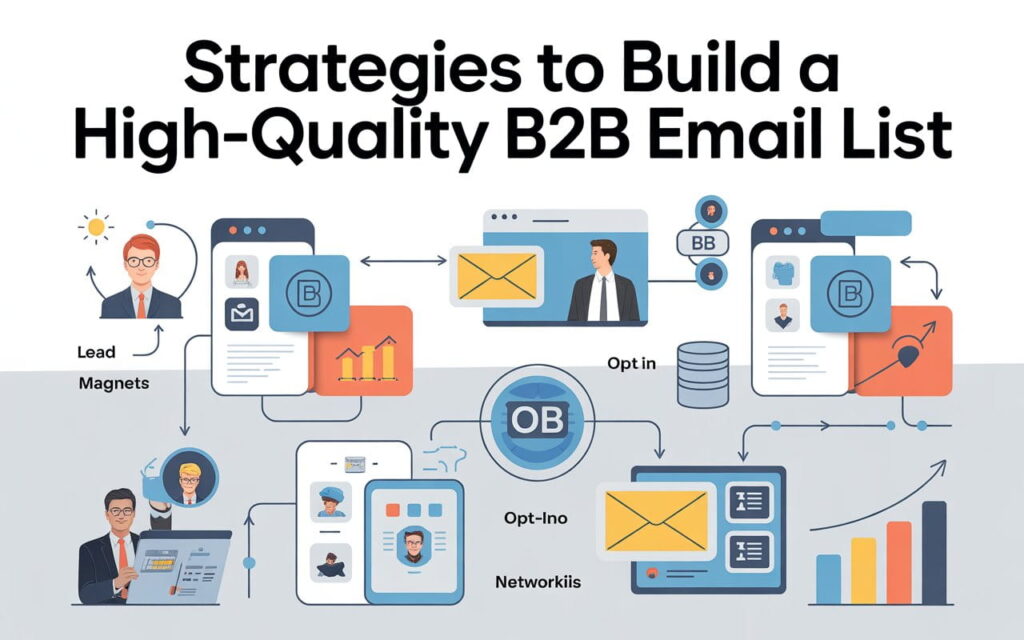
High-quality B2B lists start with lead generation tactics that attract real prospects. Offering webinars, gated content, or interactive tools ensures only interested contacts join your list. Combining this with multi-channel prospecting via LinkedIn, social media, and events improves Email list conversion.
Using email enrichment and email verification improves data accuracy. Personalized sequences that factor in job title personalization and industry trends increase engagement. Maintaining proper contact list maintenance ensures your list stays clean and ready for outreach.
Examples of Effective List-Building Tactics
A company using LinkedIn ads combined with Vector Agents automation reported a 40% higher reply rate. Lead magnets that focus on industry-specific outreach can double the opt-in rate while keeping your sales pipeline active.
Using AI and Automation to Scale Your Email List
Automation with AI agents for sales allows companies to grow their lists faster. Tools like Vector Agents can source leads, verify emails, enrich data, segment contacts, and send automated email campaigns without manual effort. This reduces errors and saves time.
AI also allows personalized email sequences that respond to engagement behavior. Multi-step sequences with automated triggers ensure each lead is nurtured according to their buyer intent. Automation makes scaling easier while maintaining high Email list conversion rates.
H3: Best AI Tools for B2B List Building
Platforms like Apollo, Hunter, Clearbit, and Vector Agents integrate with CRMs to provide real-time campaign metrics, automated follow-ups, and enhanced lead scoring.
Nurturing and Maintaining Your Email List
Once your list is built, nurturing it is critical. Segment contacts based on buyer intent, engagement levels, and role in the organization. This allows targeted messaging and better industry-specific outreach. Personalized campaigns improve email list conversion and reduce opt-outs.
Maintaining a healthy list requires regular contact list maintenance, email verification, and cleaning inactive leads. Automated systems can track campaign metrics and provide insights for campaign optimization. Companies that ignore maintenance risk losing deliverability and hurting their sales pipeline.
H3: Creating a Healthy Engagement Workflow
Implement welcome flows, drip campaigns, and multi-step email sequences to engage new leads. Monitor CRM data to adjust personalized email sequences for maximum results.
Tracking Performance and Optimizing Campaigns
Tracking is essential to understand which strategies work. Monitor campaign metrics such as open rates, click-throughs, conversions, and reply rates. Lead scoring helps prioritize contacts that show high buyer intent.
A/B testing subject lines, email copy, and send times improves campaign optimization. Using automated follow-ups, businesses can maintain engagement and boost Email list conversion. Accurate tracking keeps your sales pipeline flowing efficiently.
H3: Metrics That Matter Most
Focus on email deliverability, bounce rates, and engagement levels. Insights from CRM data help adjust personalized email sequences to improve results continuously.
Common Mistakes That Hurt Your Email List Growth
Many businesses fail by buying low-quality lists or ignoring ICP. Generic emails reduce open rates and hurt Email list conversion. Poor segmentation and lack of contact list maintenance lead to wasted effort.
Ignoring verification and enrichment increases spam reduction issues and damages sender reputation. Focusing only on quantity over quality often results in an inactive sales pipeline. Companies must prioritize high-quality leads and industry-specific outreach.
H3: Quick Fixes to Avoid Mistakes
Use email verification, enrichment tools, and proper lead scoring. Segment by buyer intent and engagement behavior to improve targeted messaging.
Tools and Resources to Build Your B2B Email List Faster
Modern B2B marketers rely on tools like Vector Agents, Apollo, Hunter, and Clearbit. These prospecting tools automate lead sourcing, verification, and enrichment. Combining AI with CRM integration makes list building fast and accurate.
Free tools like LinkedIn Sales Navigator or HubSpot CRM complement AI solutions. Using automated email campaigns ensures leads are contacted quickly. Proper contact list maintenance and campaign metrics monitoring improve long-term Email list conversion.
H3: Recommended Platforms and Software
| Tool | Function | Benefit |
| Vector Agents | AI list building | Verified leads, automation |
| Apollo | Prospecting | Multi-channel outreach |
| Hunter | Email verification | Improved deliverability |
| Clearbit | Data enrichment | Enhanced segmentation |
Conclusion: Start Building a High-Performing B2B Email List Today
Building a high-performing B2B email list in 2026 requires focus, strategy, and the right tools. From defining your Ideal Customer Profile (ICP) to using AI for automation, each step improves Email list conversion. Start small, verify leads, and automate wisely.
A clean, segmented list allows personalized email sequences, better targeted messaging, and stronger sales pipeline growth. Companies that invest in proper contact list maintenance, AI-driven outreach, and multi-step email sequences see measurable results and long-term success. The time to act is now.
H3: Your Next Steps
Implement lead generation strategies, leverage prospecting tools, track campaign metrics, and keep refining. By doing so, your email list building strategies will not only attract quality leads but also turn them into loyal customers.
Ready to Fix Your Cold Email?
🛡️ We guarantee 10 consultations in 60 days or work free.
⭐⭐⭐⭐⭐ 50+ clients | 2.4M emails sent | 3.2% reply rate
What you get:
✅ Complete infrastructure (30 emails, 10 domains)
✅ 10,000 personalized emails monthly
✅ First consultations in 5-6 weeks
2 spots left for February 2026
FAQs
1. What is the 60/40 rule in email?
The 60/40 rule suggests sending 60% educational or value-driven content and 40% promotional content. It keeps your audience engaged while driving sales effectively.
2. How much is a 1000 email list worth?
The value depends on list quality, engagement, and industry, but a highly targeted B2B email list can be worth hundreds to thousands of dollars.
3. Can you build an email list for free?
Yes, you can build a list using free tools, lead magnets, website forms, and social media without paid ads.
4. How to grow an email list organically?
Offer valuable content, use opt-in forms, host webinars, and leverage social media to attract interested subscribers naturally.
5. What is the 80/20 rule in email marketing?
It means 80% of your emails should provide value, while 20% can be promotional, keeping engagement high and trust strong.
6. What is the +1 email trick?
The +1 email trick involves sending a polite follow-up one day after your initial email to boost response rates.