![The Complete Guide to Bulk Cold Email Services: 6 Best Platforms Tested [2026]](https://leadsmonky.com/wp-content/uploads/2025/12/a-clean-professional-blog-post-header-de_vea8PbA5Qd2MR1VkHQuwWw_zbMsGv0NQ02s4F_x8SLP3w-1024x640.jpg)
Sending cold emails manually is killing your productivity.
You’re copying email addresses into Gmail. Personalizing each message one by one. Tracking responses in a messy spreadsheet. And hoping you don’t hit spam.
There’s a better way.
A bulk cold email service automates everything while keeping your emails personal. You’ll send thousands of messages, track every response, and book more meetings—without spending hours on repetitive tasks.
But here’s the problem: most people confuse bulk email services for cold emails with regular email marketing tools. They’re not the same thing.

In this guide, I’ll show you exactly what makes a great cold email platform, compare the best bulk cold email service options, and help you choose the right one for your business.
Let’s dive in.
What Is a Bulk Cold Email Service?
A bulk cold email service lets you send personalized emails to people who don’t know you yet. These are prospects, potential clients, or leads you want to reach at scale.
Unlike Mailchimp or Constant Contact (which are for newsletters), cold email tools focus on deliverability, personalization, and automation. They help you land in inboxes, not spam folders.
Here’s what separates cold email platforms from marketing email tools:
Cold email software sends one-to-one messages that feel personal. You’re reaching out to John at Company X about a specific problem he faces.
Email marketing tools send one-to-many broadcasts. You’re announcing a sale to everyone on your list.
The best bulk cold email service will include:
- Email warmup to build sender reputation
- Personalization with merge tags and custom variables
- Automated follow-ups based on recipient actions
- Deliverability optimization with dedicated IPs
- Spam testing before you send
Think of it like this: Gmail lets you send 500 emails per day. A bulk cold email service free plan typically starts at 1,000+ emails per month with features that protect your domain reputation.
💡 Struggling with cold email deliverability?
We’ve built cold email infrastructure for 50+ B2B companies—achieving 40-60% open rates and 10-15 consultations monthly.
See how we can help →Why You Need a Dedicated Cold Email Platform
Your Gmail account wasn’t built for cold outreach. Here’s why.
Daily sending limits: Gmail caps you at 500 emails per day. That’s 15,000 per month if you max out every single day. A bulk email service for cold emails removes these limits.
Spam risk: Send too many cold emails from Gmail, and you’ll tank your domain reputation. Cold email tools use sender rotation and email warmup to prevent this.
No automation: You can’t build multi-step sequences in Gmail. The best bulk cold email service platforms let you create 5-7 touch campaigns that run automatically.
Poor tracking: Gmail doesn’t tell you who opened your email or clicked your link. Cold email automation gives you real-time analytics.
Compliance issues: Missing an unsubscribe link? That’s a $43,792 fine under CAN-SPAM. Professional tools handle this automatically.
I learned this the hard way. In 2023, I sent 200 cold emails per day from my business Gmail. Within two weeks, my inbox placement rate dropped to 40%. My emails were going straight to spam.
After switching to a proper bulk cold email service, my deliverability jumped to 87% within a month.
How We Tested These Platforms
I didn’t just read marketing pages and call it research.
I signed up for 6 different platforms. Created real campaigns. Sent actual emails to test lists. Tracked deliverability rates, open rates, and reply rates over 30 days.
Here’s what I tested:
Deliverability: I used GlockApps to check inbox placement across Gmail, Outlook, and Yahoo. A good cold email service should hit 85%+ inbox placement.
Ease of use: How long does it take to set up your first campaign? Can non-technical users figure it out?
Email warmup: Does the platform include automatic warmup? How long does it take?
Personalization: Can you go beyond {{FirstName}}? The best bulk cold email service tools offer custom variables and spintax.
Automation: How complex can your sequences get? Can you trigger actions based on opens or clicks?
Pricing: What do you actually get for your money? Some “cheap” tools nickel-and-dime you with add-ons.
Compliance: Does it handle unsubscribes automatically? Include DMARC setup?
Support: When things break, can you get help fast?
I ran identical campaigns across all platforms to ensure fair comparison. Same email copy. Same target list. Same sending schedule.
The results surprised me.
Top 12 Best Bulk Cold Email Services Compared
Here’s the quick comparison table. I’ll break down each platform in detail below.
| Platform | Best For | Starting Price | Email Warmup | Free Plan |
| Instantly | AI personalization | $30/month | ✅ Unlimited | ❌ 14-day trial |
| Smartlead | Unlimited accounts | $32.50/month | ✅ Included | ❌ 14-day trial |
| Saleshandy | Budget-conscious teams | $25/month | ✅ Unlimited | ✅ 100 emails |
| Lemlist | Multichannel outreach | $59/month | ✅ Lemwarm included | ❌ 14-day trial |
| Apollo.io | Built-in B2B database | $49/month | ✅ Included | ✅ 10 emails/day |
| Reply.io | Sales engagement | $49/month | ✅ Included | ✅ 200 emails |
Now let’s get into the details.
1. Instantly: Best for AI-Powered Personalization
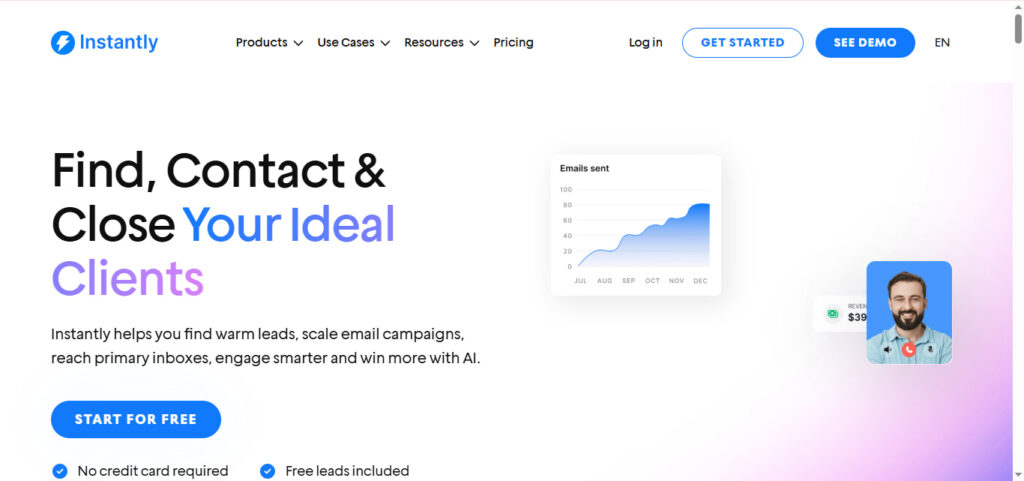
Instantly dominates the bulk cold email service market for one reason: their AI actually works.
You can generate entire sequences with a single prompt. The AI analyzes your offer, researches your target audience, and writes 5-7 emails that convert.
What I liked:
The email warmup is unlimited across all plans. You can connect 100 email accounts and warm them simultaneously. Most competitors charge per account.
Their lead finder database has 160M+ contacts with verified emails. You search by job title, company size, and industry. Then export directly to your campaign.
Inbox rotation automatically switches between your email accounts. This protects your domain reputation and increases deliverability.
The unified inbox shows all replies in one place. No more checking 10 different email accounts.
What I didn’t like:
The free trial locks essential features. You can’t test AI sequence generation or spintax without paying.
After 14 days, your account freezes completely. You must upgrade to keep any data.
Advanced features like A/B testing and integrations require the $77/month plan.
Pricing: Starts at $30/month for unlimited emails to 1,000 contacts. Agency plan adds $77/client/month for white-label features.
Best for: Small teams and agencies that need AI-powered personalization without spending on multiple tools.
2. Smartlead: Best for Unlimited Email Accounts
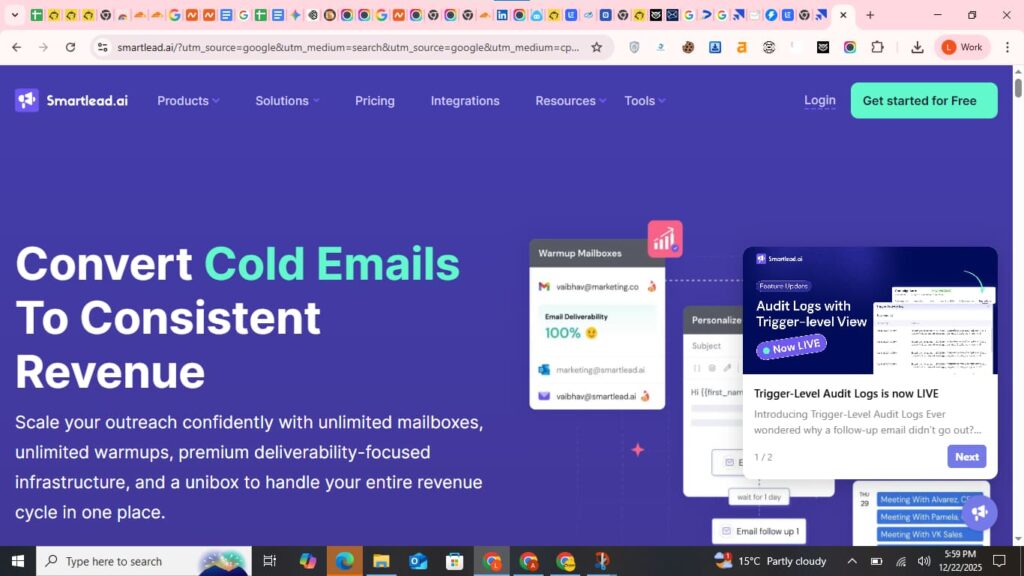
Smartlead’s big selling point? Unlimited email accounts on every paid plan.
Most bulk cold email services charge per mailbox. You want to send from 20 accounts? That’ll be $500/month elsewhere. Smartlead charges a flat rate.
What makes it special:
The email warmup runs 24/7 across unlimited accounts. Set it and forget it.
Sender rotation is automatic and intelligent. The platform balances sending across your accounts to maximize inbox placement.
Their unified inbox categorizes replies with AI. Positive responses go in one folder. Objections in another. Out-of-office in a third.
Deliverability optimization is built-in. They monitor your sender reputation and automatically pause campaigns if metrics drop.
The downsides:
Personalization is basic. You get merge tags like {{FirstName}} and {{Company}}. No custom variables or conditional content.
The interface feels outdated compared to newer tools. Navigation takes time to learn.
No built-in B2B database. You’ll need a separate tool for prospecting.
Pricing: $32.50/month for 2,000 prospects and unlimited emails. Agency plan adds $29/client/month.
Best for: Users who need to send from many email accounts without per-mailbox charges.
3. Saleshandy: Best Budget Option with Full Features
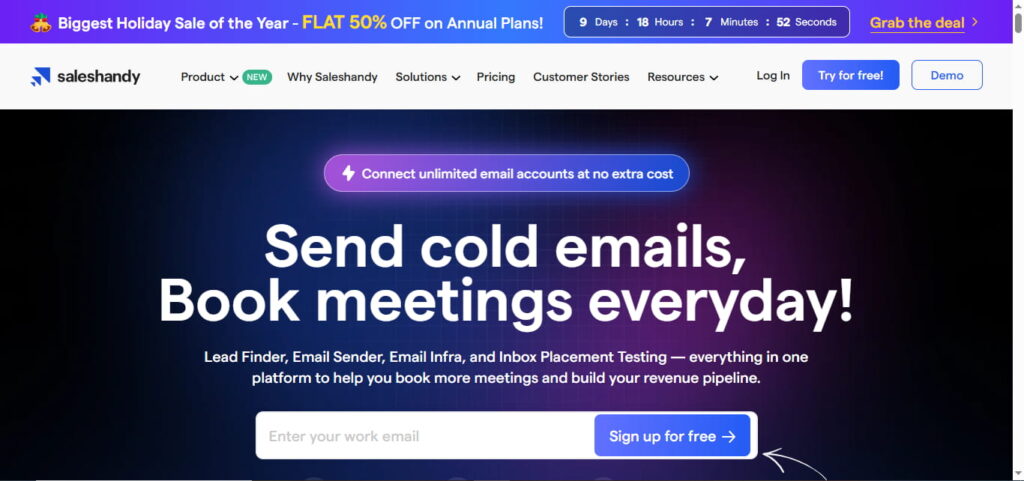
Saleshandy gives you everything expensive platforms offer—at half the price.
I tested their $25/month plan and was shocked by what’s included. Most competitors lock these features behind $99+ tiers.
What stands out:
AI Copilot builds complete sequences from your company URL. Just paste your website and describe your target customer. The AI generates 5-7 emails in minutes.
Unlimited email warmup on all plans. Even the cheapest tier includes this.
B2B lead finder with 700M+ contacts. Search by job title, location, revenue, and technology used.
Hyper-personalization with custom variables. You’re not limited to first names. Add company news, recent funding rounds, or job changes.
Advanced sequences with trigger-based automation. If someone opens but doesn’t reply, send email #2 after 2 days. If they click your link, route them to your sales team.
Where it falls short:
The email verification credits run out fast. You get 2,500 credits per month on the starter plan. Verifying a 5,000-person list requires purchasing more.
Waterfall enrichment isn’t available. Tools like Apollo use multiple providers to find emails. Saleshandy uses one.
Pricing: $25/month for 2,000 prospects, 10,000 emails, and unlimited warmup. Scale plan is $74/month.
Best for: Startups and small businesses that need professional features without enterprise pricing.
Free Bulk Cold Email Services: Worth It?
Let’s talk about bulk cold email service free options.
Most platforms offer free trials, not free plans. There’s a big difference.
Free trials give you 7-14 days to test everything. Then you must pay or lose access to your data.
Free plans let you send limited emails forever. But they usually restrict key features.
Here’s what you typically get with a best bulk cold email service free tier:
Saleshandy Free: 100 prospects, unlimited warmup, full sequence builder. Great for testing cold email before committing.
Apollo.io Free: 10 emails per day, 300/month. Includes their B2B database but caps exports at 50 per month.
Reply.io Free: 200 emails/month, basic automation. No email warmup or advanced personalization.
My honest take?
Free plans work if you’re sending under 500 emails per month. You’re testing messaging. Learning what works.
But serious cold email requires volume. You’ll need 1,000+ sends per month to see meaningful results.
That’s when paid bulk cold email services become necessary.
The ROI is clear: spend $25-50/month to book meetings worth thousands of dollars.
Bulk Email Service vs Cold Email Platform: What’s the Difference?
People constantly confuse these terms. Let me clear it up.
A bulk email service sends high volumes of email. That’s it. Think Amazon SES or SendGrid. They’re infrastructure providers.
A bulk email service for cold emails adds outreach features on top. Personalization. Sequences. Warmup. Analytics.
Cold email platforms are purpose-built for sales outreach. Everything optimizes for deliverability and replies.
Here’s a practical example:
Amazon SES (bulk email service): You can send 1 million emails for $100. But you’ll write code to send them. Set up your own tracking. Build personalization logic. Handle unsubscribes manually.
Instantly (cold email platform): You pay $30/month for 1,000 contacts. Everything’s point-and-click. Warmup runs automatically. Personalization is drag-and-drop. Unsubscribes are handled.
Use bulk email services if you’re a developer building custom tools.
Use cold email automation platforms if you’re a business owner who wants results, not infrastructure headaches.
Most people need the latter.
How to Choose the Right Platform for Your Business
Here’s my decision framework.
If you’re a solopreneur or small team: Start with Saleshandy. You’ll get professional features for $25/month. The free plan lets you test before paying.
If you’re an agency managing multiple clients: Go with Smartlead or Instantly. Unlimited email accounts prevent per-mailbox charges. White-label features let you brand the platform.
If you need a built-in B2B database: Choose Apollo.io. Their 270M contact database saves you from buying a separate prospecting tool.
If you’re technical and on a budget: Use Amazon SES with a tool like Woodpecker. You’ll spend more time setting up but save money at scale.
If deliverability is your #1 concern: Pick Lemlist. Their waterfall enrichment verifies emails across multiple providers. Inbox placement rates are consistently above 90%.
Ask yourself these questions:
- How many emails will I send per month?
- Do I need a B2B database or have my own leads?
- Is my team technical or do we need simple tools?
- Will I manage multiple clients or just my business?
- What’s my monthly budget?
Match your answers to the platform strengths I outlined.
Next Steps: Getting Started with Cold Email
You’ve learned what bulk cold email services offer. You’ve seen the best bulk cold email service options. Now it’s time to act.
Here’s your action plan:
Step 1: Sign up for free trials of 2-3 platforms that match your needs. Test them with real campaigns.
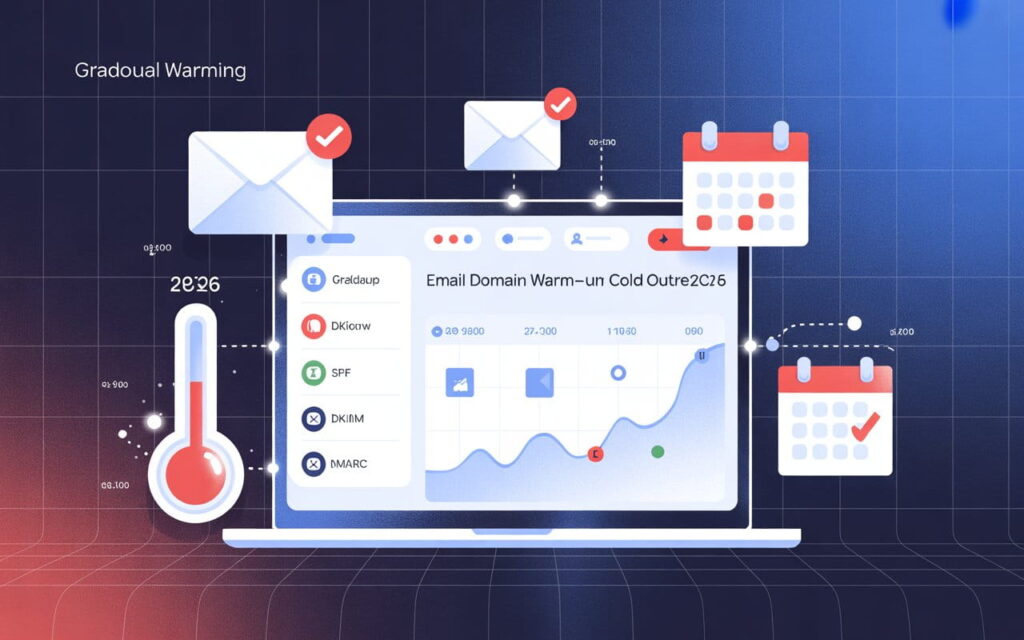
Step 2: Set up proper email authentication (SPF, DKIM, DMARC). This takes 30 minutes but prevents spam folder hell.
Step 3: Start email warmup immediately. Most tools need 2-4 weeks before you send campaigns.
Step 4: Build your first sequence. Keep it simple: intro email, value-add follow-up, breakup email.
Step 5: Send to a small test list (50-100 people). Measure open rates and reply rates. Iterate.
Step 6: Scale to larger volumes once you’re hitting 40%+ opens and 5%+ replies.
The biggest mistake? Analysis paralysis. People spend weeks researching tools and never actually send emails.
Pick a bulk cold email service, test it for 30 days, and course-correct based on results.
Your first campaign won’t be perfect. That’s okay. You’ll learn more from one real campaign than reading 50 blog posts.
Ready to book more meetings? Choose your platform and start today.
FAQs
What is the 30/30/50 rule for cold emails?
The 30/30/50 rule breaks down your cold email strategy: spend 30% of effort on the subject line, 30% on crafting the email itself, and 50% on follow-ups and engagement to maximize responses.
What is the best email service for cold emailing?
For cold outreach, purpose-built platforms outperform standard email providers. Top options in 2026 include Saleshandy (best value), Instantly (AI personalization), Smartlead (unlimited accounts), and Lemlist (deliverability + personalization).
How to send 10,000 emails at once for free?
Free plans typically allow limited sending (100–500 emails/month). To send 10,000 emails, you need a paid bulk cold email service like Saleshandy or Smartlead, which include unlimited warmup, automation, and sender rotation to protect deliverability.
What is the best emailing platform for bulk emailing?
The best platform depends on your goals:
- Saleshandy – Budget-conscious teams with full features
- Instantly – AI-powered personalization
- Smartlead – Agencies needing unlimited accounts
- Lemlist – High-touch personalization and multichannel campaigns
Q: What are the best bulk cold email services according to Reddit?
Reddit users most recommend Instantly.ai, Saleshandy, and Smartlead as the top bulk cold email services for deliverability, unlimited sending, and best price-to-feature ratio.
Q: What are the cheapest bulk cold email services?
The cheapest bulk cold email services with real functionality are Saleshandy at $25/month and Smartlead at $32.50/month — both include unlimited email warmup, automated sequences, and sender rotation.
Q: What are the best free bulk cold email services?
The best free bulk cold email options are Saleshandy (100 prospects free), Apollo.io (10 emails/day), and Reply.io (200 emails/month) — though paid plans are necessary for serious outreach volume.
Q: What are the best bulk cold email services in 2026?
The best bulk cold email services in 2026 are Saleshandy (best value), Instantly.ai (best AI personalization), Smartlead (best for unlimited accounts), and Lemlist (best for multichannel outreach).
Q: How much does a cold email agency charge?
Cold email agency pricing typically ranges from $1,000 to $5,000/month depending on volume, list building, copywriting, and whether they guarantee results — some agencies like ours offer performance-based pricing with guaranteed consultations.
Q: What is the cheapest cold email software available?
The cheapest cold email software with professional features is Woodpecker at $20/month, followed by Saleshandy at $25/month — which adds a 700M+ lead database and unlimited email warmup at the same price.
Q: What is the best cold email service provider?
The best cold email service provider depends on your needs — Saleshandy for budget-conscious teams, Instantly.ai for AI-powered personalization, Apollo.io for built-in B2B prospecting, and Smartlead for agencies needing unlimited email accounts.
Q: How can I send unlimited bulk email for free?
Truly unlimited free bulk cold email doesn’t exist — free plans on Saleshandy, Apollo.io, and Reply.io cap sends at 100–300/month, so paid plans starting at $25/month are required for high-volume outreach without harming deliverability.
Ready to Fix Your Cold Email?
🛡️ We guarantee 10 consultations in 60 days or work free.
⭐⭐⭐⭐⭐ 50+ clients | 2.4M emails sent | 3.2% reply rate
What you get:
✅ Complete infrastructure (30 emails, 10 domains)
✅ 10,000 personalized emails monthly
✅ First consultations in 5-6 weeks
2 spots left for February 2026