Most cold emails never get read. In fact, 95.9% of cold emails go completely unanswered.
That’s a brutal number. But here’s what it actually tells you — the opportunity is enormous for anyone willing to do it right.
Cold Email Best Practices 2026 isn’t dying. Bad cold email is dying. The senders who build the right system are booking more meetings than ever, with fewer emails and less effort.
We’ve seen this firsthand. Teams using services like Leads Monky’s done-for-you cold email system consistently hit 45% open rates and 3.2% reply rates — six times the industry average of 0.5%. That’s not luck. That’s a repeatable system built on the right fundamentals.
This guide covers everything your competitors refuse to talk about — including legal compliance, AI detection risks, and psychological triggers that drive real replies. Let’s get into it.

Why Cold Email Still Works in 2026
People keep saying cold email outreach is dead. The data says otherwise.
Businesses earn $42 for every $1 spent on cold email campaigns. That’s a 4,200% ROI — higher than paid search, social ads, and most content channels combined.
But here’s the catch. The old spray-and-pray approach is gone forever. Sending 10,000 generic emails hoping for 10 replies? That strategy destroys your sender reputation, kills your domain, and probably violates the law.
Modern cold email strategies work on a simple principle:To truly maximize your outreach results, you need to understand when to use email vs LinkedIn.
👉 Check this detailed guide on LinkedIn lead generation vs cold email
send fewer emails to better-qualified people, with messages that feel genuinely human. Everything in this guide builds on that foundation.
Step 1: Build Your Technical Foundation Before Sending a Single Email
You could write the perfect email. But if your technical setup is broken, it lands in spam before anyone reads it. All that effort — wasted.
Before you send anything, lock down these essentials.
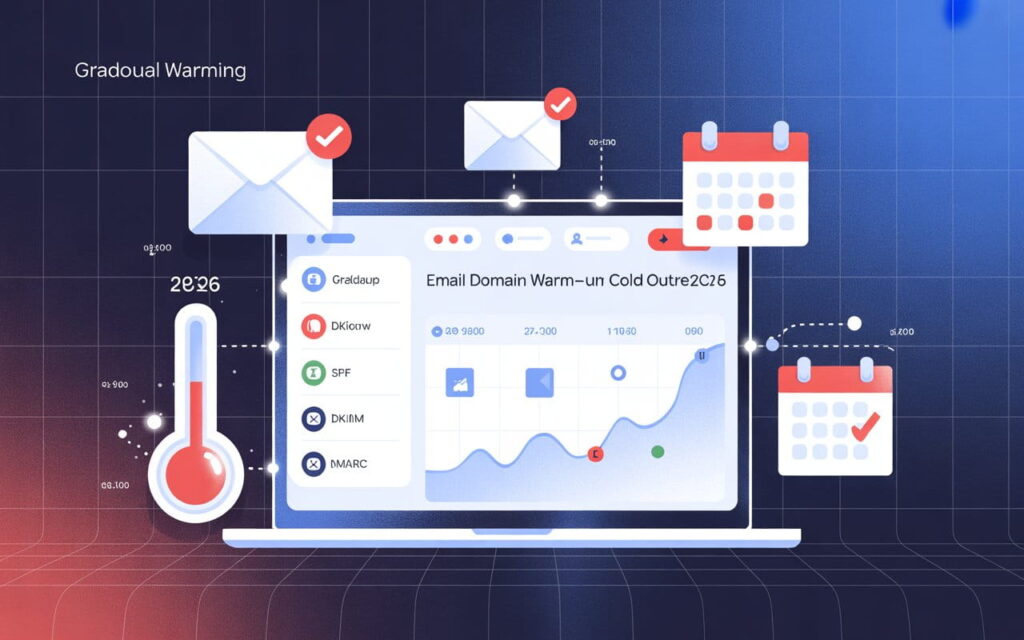
SPF, DKIM, and DMARC records are your non-negotiables. Google and Yahoo now require these for bulk senders. Without them, your emails don’t reach inboxes — full stop.
Use a dedicated sending domain — completely separate from your main business website. If a campaign underperforms, it won’t damage your primary domain’s reputation.
Warm up every new domain for 2–4 weeks before launching. You should also make sure your emails aren’t triggering spam filters — learn the exact techniques in our guide on avoiding spam filters in cold email outreach. Email warmup builds your sender reputation gradually. Skip this step and your first campaign could permanently blacklist your domain.
Verify your list before every send. Keep your email bounce rate under 2% — anything higher signals spam behavior to email providers.
One shortcut worth knowing: Leads Monky is a certified Google Workspace reseller that handles all of this for you — DKIM configuration, DMARC setup, SPF records, spam protection, and warmup — starting at just $2.50 per mailbox. For teams building cold email infrastructure from scratch, that kind of turnkey setup saves weeks of technical headaches.
💡 Need help setting up Google Workspace?
We’re certified Google partners offering 64% off + free professional setup ($2,000 value). Used by 151+ companies.
Get your quote →Quick Rule: Fix your foundation first. No subject line, no AI tool, and no template fixes a broken technical setup.
Step 2: Target Smarter, Not Harder
Here’s a number that should change how you think about cold email.
Campaigns sent to fewer than 50 recipients generate a 5.8% reply rate. Campaigns sent to 1,000+ get just 2.1%. Smaller, smarter lists win. Every time.
Start by building a sharp Ideal Customer Profile (ICP). Get brutally specific. Which industry? What company size? Which job title makes the buying decision? What problem are you solving that they genuinely care about?
Once your ICP is defined, layer in intent signals — the secret weapon most cold emailers completely ignore.
Intent signals tell you when someone is actually ready to have a conversation. Look for: recent funding rounds, new executive hires, competitor reviews, job postings in your area of expertise, and recent company announcements. These signals mean someone is already in motion. Your email arrives at exactly the right moment.
Think of it this way. Offering someone an umbrella when it’s raining is far more effective than offering one on a sunny day. Intent-based cold email targeting is your rain alert.
| List Size | Average Reply Rate |
| Under 50 recipients | 5.8% |
| 50–500 recipients | 3–5% |
| 500–1,000 recipients | 2–3% |
| 1,000+ recipients | Under 2% |
Step 3: Personalization That Feels Human (Not AI-Generated)
Here’s something your competitors aren’t telling you. AI-generated cold emails are actively getting filtered in 2026.
Google, Microsoft, and major email providers now use machine learning models trained to detect AI-written outreach. If your email reads like a pattern-matched template — even a personalized one — it gets filtered before anyone ever sees it.
The fix isn’t to stop using AI. It’s to use it differently.
Use AI for research, email list enrichment, and drafting three or four rough opening line options. Then have a human pick the best one and rewrite it in their own voice. That combination consistently outperforms both pure-AI and pure-manual approaches.
Before sending, run the cocktail party test. Read your email out loud. Would you actually say these exact words to someone you just met? If it sounds stiff, robotic, or weirdly observant — rewrite it. Real people don’t communicate like press releases.
The best email personalization in 2026 isn’t about inserting a first name. It’s about referencing something specific, timely, and relevant that proves you actually did your homework.
Step 4: Write Cold Emails That Actually Get Replies
The highest-performing B2B cold emails in 2026 share four things. They’re short (under 150 words). They’re prospect-focused, not product-focused. They’re specific. And they end with exactly one low-commitment ask.
Here’s the structure that consistently works:
Opening line — Reference a specific, timely trigger. Not a generic compliment. Something real: “Saw that [Company] just expanded into the European market.”
Bridge — Connect their situation directly to your value. “Most [their role]s in that position run into [specific pain point]. We helped [similar company] fix it and [specific measurable result].”
CTA — Make it genuinely easy to say yes. “Would a quick 10-minute call this week make sense?”
That’s it. No lengthy pitch. No feature dump. No “I’d love to explore potential synergies.” Just a clear, human, one-question close. Before sending, make sure your inbox setup supports deliverability. See our cheap inbox solutions for cold email here.
Subject Lines That Actually Get Opened
Your cold email subject lines determine whether anyone reads your carefully written email — or deletes it without a second thought. Keep them 4–7 words. Make them conversational. Make the prospect feel seen — not sold to.
These subject line formats consistently perform best in 2026:
- Trigger-based: “Congrats on the Series B, [Name]” → 42–55% open rate
- Question-based: “Quick question about your pipeline” → 38–48% open rate
- Specific value: “3 ideas for [Company]’s Q1 outreach” → 30–42% open rate
- Mutual connection: “[Name] suggested I reach out” → 45–60% open rate
Avoid clickbait entirely. Spam filters in 2026 penalize subject lines that don’t match email content. It’s not just annoying — it actively destroys your email deliverability over time.
Step 5: Follow-Up Sequences That Convert (Without Being Annoying)
80% of meetings are booked after the second or third follow-up. Yet most people either never follow up at all or send the exact same message three times. For businesses that want this entire sequence handled professionally, the best agencies delivering lifecycle email marketing manage follow-up cadences end-to-end so no lead falls through the cracks. Both approaches throw away the opportunity.
The optimal cold email sequence in 2026 is 3–5 touches spread over 14 days. Each follow-up takes a completely different angle. New data point. New case study. New question. Never just “bumping this to the top of your inbox.”
Here’s the sequence framework that works:
- Day 1 — Initial email (trigger-based, personalized opening)
- Day 2 — LinkedIn profile view (silent but visible social proof)
- Day 4 — Follow-up email (new angle: case study or relevant data)
- Day 7 — LinkedIn message (short, personal, different channel)
- Day 14 — Breakup email (explicit permission to say no)
That last email — the breakup email — is your secret weapon. It consistently generates 20–30% reply rates, often the highest of any message in the entire sequence.
The formula is simple: “I’ve reached out a few times and haven’t heard back — completely fine if the timing’s off. Should I close the loop, or would another time work better?”
Short. Human. Disarming. It works.
Step 6: Go Multichannel — Email + LinkedIn + Video
Cold email outreach that lives in isolation leaves serious pipeline on the table.
The highest-performing B2B teams in 2026 combine email with LinkedIn before they send a single message. Start engaging with a prospect’s LinkedIn content two weeks before your first email. Like their posts. Leave a thoughtful, specific comment. By the time your email lands, they already recognize your name. You’ve effectively turned cold email into warm email.
And here’s the tactic your competitors definitely aren’t talking about: video prospecting.
Record a 90-second personalized Loom video with their website visible on your screen. Mention their name. Point out one specific thing they’re doing well — genuinely. Connect it to a problem you can help solve. End with a simple yes/no question.
Video outreach consistently generates 3–5x higher reply rates than text-only emails for high-ticket B2B sales. In an inbox flooded with AI-written text, a real human face on a thumbnail is an instant pattern interrupt.
Teams that combine cold email, LinkedIn, and video routinely book 10–15 qualified meetings per month from the same list size that produces 2–3 with email alone.
Step 7: Legal Compliance — The Section Your Competitors Skip
This is the most important section in this entire guide. And it’s the one your top-ranking competitors consistently leave out.
Cold email compliance in 2026 is not optional. The fines are real, growing, and being enforced.
CAN-SPAM Act (USA): Fines reach up to $53,088 per email. You must include a physical mailing address, a working unsubscribe link, and accurate sender information. Honor every opt-out request within 10 business days.
GDPR (European Union): Fines reach €20 million or 4% of global annual revenue — whichever is larger. Emailing EU contacts requires either explicit consent or a fully documented legitimate interest assessment. You must record the data source for every single contact in your list.
CCPA and State Laws (USA): California fines range from $2,500–$7,500 per violation. Virginia, Colorado, and Texas now enforce nearly identical email marketing compliance laws.
Simple rule that covers 95% of cases: Apply the strictest applicable law to your entire list. If any contacts are in the EU, apply GDPR standards to everyone. It simplifies operations and eliminates legal guesswork completely.
One 2026-specific warning you won’t find in competitor articles: EU regulators are now actively investigating AI enrichment tools and how they collect intent signals. If your personalization tool pulls data that wasn’t made publicly available for marketing use — even if it appears on LinkedIn — you may already be non-compliant. Audit your tool’s data sourcing policies before you scale.
2026 Cold Email Benchmarks by Industry
Stop measuring your performance against meaningless generic averages. Here’s what strong results actually look like in your specific vertical:
| Industry | Good Reply Rate | Excellent Reply Rate |
| SaaS & Technology | 3–6% | 8%+ |
| Marketing & Creative Agencies | 4–8% | 10%+ |
| Recruiting & HR | 6–12% | 15%+ |
| Financial & Legal Services | 2–5% | 7%+ |
| Consulting & Professional Services | 4–9% | 12%+ |
| Healthcare & Biotech | 1–3% | 5%+ |
| E-Commerce & Retail | 2–4% | 6%+ |
If you’re consistently hitting “excellent” numbers — your targeting and messaging are genuinely dialed in. Below “good”? Fix your list quality and deliverability setup before touching a single word of copy.
Should You Build This In-House or Use a Service?
This is the question most guides never ask — but it’s the right one.
Building a cold email system in-house takes 6–8 weeks minimum: domain setup, warmup, list building, copywriting, testing, and ongoing optimization. For teams with dedicated SDRs and technical resources, it’s worth it long-term.
But for agencies, consultants, and growing B2B teams without that bandwidth, done-for-you services compress that timeline dramatically.
Leads Monky’s cold email agency service, builds and manages the entire system — 10 dedicated sending domains, 30 email accounts, 2,000 verified prospects per month, personalized 5-step sequences, and daily performance optimization. Their clients typically see first qualified consultations in weeks 5–6, with a consistent flow of 10–15 meetings per month by month three.
Frequently Asked Questions
What is a good cold email reply rate in 2026?
A strong cold email reply rate is 5–8% for well-targeted campaigns. Hyper-personalized lists under 100 prospects regularly hit 15–20%. Anything above 10% consistently means your targeting, copy, and deliverability are all working together.
How many cold emails should I send per day?
For a properly warmed domain, send 30–50 cold emails per day per inbox. With multiple dedicated inboxes across separate domains, you can safely scale to 200–500 daily sends without hurting email deliverability.
What is the best time to send cold emails in 2026?
Tuesday through Thursday, between 7–9 AM in your recipient’s local time zone. These windows consistently generate the highest cold email open rates across all industries and verticals.
Do I need Google Workspace for cold email?
You don’t strictly need it, but Google Workspace accounts on properly configured domains deliver significantly better inbox placement than free Gmail accounts. Services like Leads Monky offer Google Workspace setups specifically built for cold outreach with USA IPs, full DNS configuration, and warmup guidance starting at $2.50 per mailbox. To scale even faster, check out our cheap email inboxes for outreach page. These inboxes are pre-configured for cold email campaigns and integrate seamlessly with Workspace setups.
Can I use AI to write cold emails in 2026?
Yes — but never send 100% AI-generated emails unedited. Use AI for research, intent signal monitoring, and draft generation. Always have a human rewrite the final version. Spam filters now detect and penalize AI-written outreach patterns at scale.
The Bottom Line
Cold email best practices in 2026 come down to one clear mindset shift: precision beats volume. Every time.
Send fewer emails to better-qualified prospects. Make every message feel like a real human wrote it specifically for that person on that specific day. Stay legally compliant across GDPR, CAN-SPAM, and CCPA. Follow up strategically across multiple touches. Add video and LinkedIn to amplify your sequence.
The senders building these systems are generating extraordinary cold email ROI while their competitors blast away into spam folders and wonder what they’re doing wrong.
Whether you build it yourself or work with a team that already has it dialed in — you now have the complete playbook. The next step is yours.
Get Google Workspace at 64% Off
Same service. Better price. Professional setup included.
⭐⭐⭐⭐⭐ 151+ companies trust us
Partner Pricing:
• Business Starter: $3/month (Google: $8)
• Business Standard: $13/month (Google: $17)
• Business Plus: $20/month (Google: $26)
FREE:
Complete DNS setup + 24/7 support + USA IPs
15-user minimum | Setup in 24 hours