Sending cold emails can feel like shouting into an empty room, but when done correctly, they are one of the most powerful tools for lead generation and building professional connections. Knowing how to write cold emails that get replies is essential for anyone involved in sales outreach, networking, or pitching investors.
The key lies in crafting messages with clear email objectives, a compelling unique value proposition, and personalized touches that resonate with your target audience. By understanding best practices, avoiding email mistakes, and leveraging tools like Smartlead platform, you can dramatically increase your response rate and turn cold prospects into valuable relationships.
Why Cold Emails Still Work in 2026
Despite new channels like social media and AI chatbots, cold emails remain one of the most effective tools for lead generation. Companies report that emails offer higher ROI than most social platforms. Unlike social media, emails land directly in the prospect’s inbox. When done right, they increase engagement rate and help nurture potential clients. The key is using email personalization and clear email objectives. Crafting emails that address pain points while demonstrating your unique value proposition keeps your message relevant.
Even in 2026, the power of a well-written cold email is undeniable. For example, a study found that emails with personalized subject lines achieved a 50% higher response rate. Another factor is email segmentation, which ensures your messages reach the right audience. Using tools for email scheduling and email automation also improves efficiency. In short, cold emails are not outdated—they just require smarter strategies and modern techniques.
💡 Struggling with cold email deliverability?
We’ve built cold email infrastructure for 50+ B2B companies—achieving 40-60% open rates and 10-15 consultations monthly.
See how we can help →The Ultimate Cold Email Framework

Creating an effective cold email begins with a clear structure. Start with how to craft compelling subject lines. Your subject should be short, relevant, and spark curiosity. Next, focus on how to start a cold email effectively. Opening lines should connect with the reader’s needs. Follow with your unique value proposition, then a concise CTA. Finish with a professional email signature that reinforces your brand. Remember to keep email length under 150 words for best results.
Tables can help illustrate the structure of a cold email:
| Section | Purpose | Example |
| Subject Line | Grab attention | “Quick Question About Your Marketing Team” |
| Opening Line | Personal connection | “I noticed your recent campaign…” |
| Body | Showcase unique value proposition | “We help teams increase engagement by 30%” |
| CTA | Prompt a response | “Are you available for a 15-min call?” |
| Signature | Build trust | “John Doe, Growth Strategist” |
Following this framework ensures you address all email objectives without overwhelming your recipient.
Cold Email Outreach Best Practices
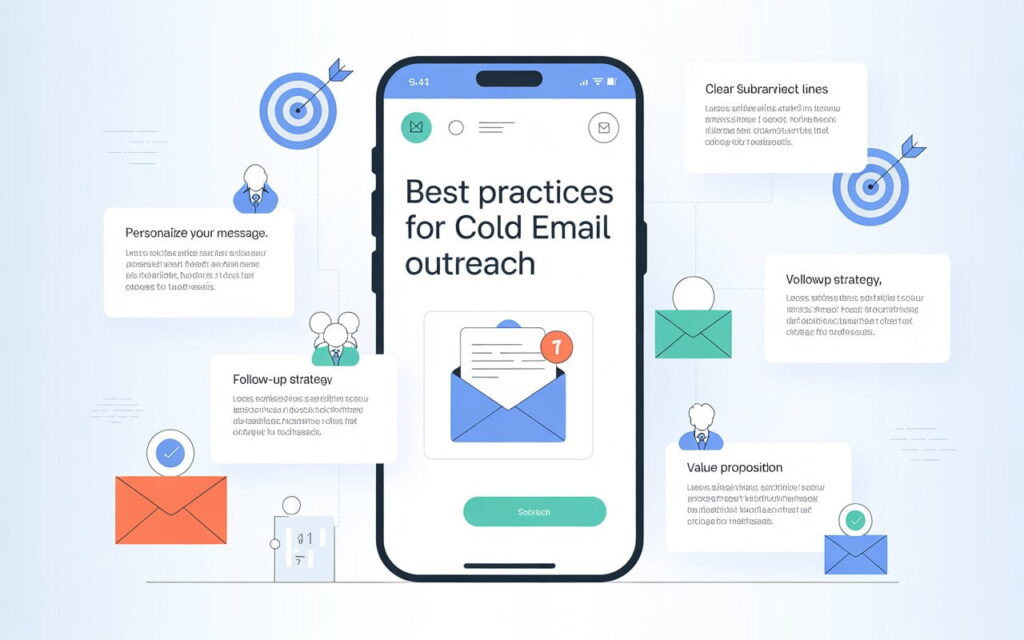
For high-performing emails, start by defining your target audience. Understand their pain points, role, and priorities. Personalize every email; avoid generic greetings. Email personalization increases engagement rate and makes your outreach more human. Tools like Smartlead platform can automate personalization without losing authenticity. Timing is crucial knowing best time to send cold emails can drastically affect response rate.
Always proofread your emails. Proofreading cold emails ensures you catch typos or grammatical mistakes. Format emails for clarity using short paragraphs. Optimize for mobile, as many users read emails on phones. Adding clear CTA and highlighting your unique value proposition makes your message actionable. Small adjustments in email format and tone can significantly improve results.
Common Cold Email Mistakes to Avoid
One common error is sending generic emails. Avoid common cold email mistakes to avoid like vague CTAs or overly long messages. Another mistake is ignoring email deliverability; emails ending up in spam will never be read. Lack of research and failing to personalize are also major pitfalls. Repetition of generic templates reduces response rate and can harm your brand reputation.
Some also skip testing. A/B testing subject lines, email length, and tone can reveal what works best. Another overlooked mistake is not tracking follow-up email tips. Following up strategically boosts engagement without annoying the recipient. Always refine your approach to avoid wasting time and resources.
Writing Cold Emails for Different Goals
Different goals require different strategies. Cold email for lead generation focuses on solving a prospect’s problem, while cold email for sales emphasizes ROI. Cold email for networking should build rapport, and cold email for investors highlights opportunities and credibility. Similarly, cold email for partnerships stresses mutual benefit. Each type needs a tailored tone and unique value proposition to resonate.
Email examples clarify this approach. For instance, a networking email may start with shared interests, while a sales outreach email jumps into metrics and results. Structuring each email according to email objectives ensures your message connects with the recipient and increases response rate across campaigns.
Follow-Up Emails That Actually Work
Following up is essential. Many successful campaigns require 2-3 emails. How to follow up after wrong recipient or missed responses can recover lost opportunities. Use follow-up email tips to maintain professionalism without being pushy. Reference previous emails and restate the unique value proposition to remind prospects why your email matters.
Timing is key. Wait 2-4 days between emails and adjust based on engagement. Each follow-up should be concise and actionable. Using email automation tools helps manage sequences efficiently while tracking which messages generate the highest engagement rate.
Tools and Software for Smarter Cold Emails
Modern cold emails benefit greatly from technology. Smartlead platform automates personalization, sequencing, and email scheduling, making campaigns scalable. Other software enhances email deliverability, tracks response rate, and manages lead nurturing. AI can even assist in using AI in cold emails for content suggestions or subject line optimization.
Combining these tools improves efficiency while maintaining a human touch. Platforms allow testing how to make cold email stand out and optimize cold emails for mobile. Email tracking ensures you know which prospects engage, helping refine your sales outreach and outreach campaigns.
Ready to Fix Your Cold Email?
🛡️ We guarantee 10 consultations in 60 days or work free.
⭐⭐⭐⭐⭐ 50+ clients | 2.4M emails sent | 3.2% reply rate
What you get:
✅ Complete infrastructure (30 emails, 10 domains)
✅ 10,000 personalized emails monthly
✅ First consultations in 5-6 weeks
2 spots left for February 2026
Conclusion
Writing cold emails that get responses requires practice, strategy, and attention to detail. Follow the steps to send cold email campaign, personalize your message, avoid common cold email mistakes to avoid, and use modern tools like Smartlead platform. Whether your goal is cold email for lead generation, networking email, or cold email for investors, these strategies help you build authority, boost engagement rate, and never get ghosted again. Start applying these tips today, refine with follow-up email tips, and watch your response rate soar.
FAQs
What is the 12 second rule?
The 12-second rule suggests giving your email a quick review within 12 seconds to check clarity and errors before sending. It helps ensure professionalism and reduces mistakes.
Is it unprofessional to send an email at 2 am?
Sending emails at 2 am isn’t inherently unprofessional if scheduled properly. Using email scheduling keeps delivery timely without disturbing recipients.
How to delay emails by 10 seconds?
Most email clients like Gmail or Outlook offer a “delay send” or “undo send” feature to hold emails for a few seconds before sending. Set it to 10 seconds to prevent immediate errors.
What are the 7 C’s of email?
The 7 C’s are Clear, Concise, Concrete, Correct, Coherent, Complete, Courteous, guiding effective and professional email communication.
What are the 4 S’s of communication?
The 4 S’s are Simplicity, Sincerity, Specificity, and Structure, ensuring messages are easy to understand and impactful.
What are the key email etiquette principles?
Key principles include using a professional email format, clear subject lines, proper greetings, avoiding slang, and proofreading for errors.
What are the 5 elements of an email?
The 5 elements are Subject Line, Greeting, Body, Call to Action (CTA), and Email Signature, forming the foundation of effective email communication.
What is a cold email template for a job application?
A structured email highlighting your skills, interest in the role, and a clear call-to-action for an interview.
Can you provide a sample of cold emails that get responses?
A short, personalized email addressing the recipient’s pain point, offering value, and ending with a clear CTA.
Where can I find free cold emails that get responses?
Free resources like HubSpot, Smartlead, and Mailshake provide ready-to-use cold email examples.
What are some examples of effective cold emails?
Emails that are personalized, concise, value-driven, and include a clear subject line and CTA.
How do I write a cold email to a professor?
Introduce yourself, state your purpose clearly, show respect for their work, and request guidance or a meeting politely.
What is a B2B cold email template?
A concise email addressing business pain points, offering a solution, and prompting the recipient for a meeting or demo.
How do I write a cold email template for new clients?
Highlight benefits, show credibility, personalize content, and include a simple, actionable CTA.
Can you provide examples of cold email templates?
Examples include outreach for leads, networking, partnerships, or job applications—each following a clear structure: subject, value, CTA, signature.