That Promising Lead Just… Disappeared
You had a great call. They were nodding along, excited, practically asking for the invoice.
Then nothing. Emails unanswered. Calls going to voicemail. Silence.
Sound familiar?
Here’s the truth: cold leads aren’t dead leads. They’re just leads that need the right message at the right moment. And Re-Engage Cold Leads with Email, done correctly, is the most reliable way to bring them back.
In this guide, you’ll get a complete, ready-to-use system including a 5-step re-engagement email sequence, copy-ready templates, subject lines, and a clear strategy for every type of cold prospect.

Let’s get into it.
What Is a Cold Lead? (And Why It Matters)
A cold lead is someone who previously engaged with your business attended a demo, jumped on a call, replied to an email but has since gone quiet.
They’re different from a cold prospect you’ve never spoken to. The relationship exists. You just need to reactivate it.
Cold lead reactivation is valuable because these people already know who you are. You’re not starting from zero. You’re reigniting a conversation and that’s a much easier ask.
Why Do Leads Go Cold? (The Real Reasons)
Before you write a single word of your re-engagement email, you need to understand why the lead disappeared. Get this wrong and your emails will miss completely.
There are five common reasons:
- Wrong timing budget freeze, internal change, or competing priorities buried your deal
- Lost internal champion the person pushing for your solution left or lost influence
- No urgency created your follow-ups were generic “just checking in” emails with zero pull
- Unaddressed objection price, integration, or ROI concern was never resolved
- Inbox overload they genuinely missed it (over 81% of emails are opened on mobile while distracted)
Knowing the why tells you exactly which email to send. That’s how you win.
💡 Struggling with cold email deliverability?
We’ve built cold email infrastructure for 50+ B2B companies—achieving 40-60% open rates and 10-15 consultations monthly.
See how we can help →The Psychology Behind Cold Prospect Reactivation
This is the section your competitors skipped and it’s the most important one.
Great dormant lead outreach doesn’t push. It pulls. It taps into how your prospect’s brain actually works.
Here are the four psychological triggers that make re-engagement emails work:
1. Loss aversion. People fear losing more than they want to gain. A well-written breakup email signals they’re about to lose your attention and that creates urgency fast.
2. Commitment consistency. When you remind prospects of something they said in a previous conversation, they feel compelled to stay consistent. Nobody wants to look flaky.
3. Social proof and competitive fear. Knowing that a direct competitor already solved the same problem is nearly impossible to ignore. It shifts the question from “should I buy?” to “can I afford not to?”
4. Reciprocity. Give value before asking for anything. Send a useful insight, a relevant case study, or a helpful resource. People naturally want to respond when they’ve received something genuine.
Use these triggers intentionally and your cold email open rates will jump.
The 5-Step Cold Lead Re-Engagement Email Sequence
This is the full sales cadence your competitors don’t publish. Copy it, personalize it, and start sending.
Timing overview: Start 3–5 days after the lead goes cold. Space each email 5–10 days apart.
Email 1 | The “I’m Confused” Email
Send: Day 3–5 Subject line: “Quick question about what we discussed”
This is the single most powerful re-engagement email you can send. It calls out the silence directly, references their exact words, and puts the ball back in their court without begging.
Hi [Name],
I’m a bit confused when we spoke on [date], you mentioned [specific pain point, e.g., “your team was losing roughly $4,000/month on manual reporting”]. You agreed [your solution] could fix it.
We planned to reconnect after you spoke with your team. Has something changed?
Happy to adjust if priorities have shifted.
[Your name]
Why it works: Specificity creates attention. Using their words activates cognitive dissonance. Asking “has something changed?” gives them a face-saving exit and you’ll be surprised how often that opens the door.
Email 2 | The New Value Email
Send: Day 10–12 Subject line: “[First name], one thing that changed since we spoke”
Bring something genuinely new. A product update, a relevant case study, or an industry stat tied directly to their problem. This signals you’ve been thinking about them, not just your pipeline.
Hi [Name],
Since we last spoke, [specific update e.g., “we released a HubSpot integration that solves the data sync issue you flagged”].
I also thought of you when I saw [relevant industry news].
Worth 15 minutes to see if this changes the picture?
[Your name]
This email leverages trigger-based email strategy delivering relevant, timely information that’s too useful to ignore.
Email 3 | The Social Proof Email
Send: Day 20–22 Subject line: “How [similar company] solved [their exact problem]”
Show proof. A brief result from a company in their industry, facing their exact challenge, is the most persuasive content type in B2B cold email sequences.
Hi [Name],
Thought this would be relevant [similar company] was dealing with [same problem] and achieved [specific result] within [timeframe].
Happy to share full details or connect you with their team directly.
[Your name]
Personalized outreach like this increases response rates by approximately 32%. Make it specific. Vague social proof does nothing.
Email 4 | The Competitor Trigger Email
Send: Day 30–32 Subject line: “[Their competitor] just did something worth watching”
This is the highest-leverage email in the sequence. Competitive intelligence is nearly impossible to ignore. Name a competitor move that’s directly relevant to their goals.
Hi [Name],
Just noticed [competitor] recently [relevant move e.g., “launched automated reporting”]. Given your goals, I thought it was worth flagging.
Our [solution] could help you stay ahead. Worth a quick chat?
[Your name]
According to Leads Monky a B2B cold email agency that has delivered 2.4 million emails with a 45% average open rate Email 4 (the breakup or competitive trigger) generates 40% of all replies in a 5-step sequence. That’s not a small number.
Email 5 | The Breakup Email
Send: Day 40–42 Subject line: “Closing your file, [First name]”
Your final email. This one triggers loss aversion and, counterintuitively, often generates the highest reply rate of the entire lead nurture sequence.
Hi [Name],
I’ve reached out a few times and haven’t heard back so I’ll assume the timing isn’t right and stop following up.
No hard feelings at all. If things change, you know where to find me.
[Helpful resource link no strings attached]
Best, [Your name]
Keep it short. Keep it warm. Never guilt-trip. This email works because it removes pressure completely.
Cold Email Subject Lines That Actually Get Opens
Your subject line is 80% of the battle. Here are the highest-performing ones for cold lead reactivation campaigns:
- “Quick question about what we discussed” curiosity + specificity
- “Closing your file, [Name]” loss aversion at its finest
- “One thing that changed since we last spoke” implies new value
- “[Competitor] just did something interesting” competitive fear trigger
- “Still relevant, [Name]?” direct, respectful, non-pushy
Avoid: “Following up”, “Just checking in”, “Touching base”. These subject lines signal low effort and they kill your cold email open rates instantly.
Email Deliverability | The Silent Deal Killer
You can write the perfect prospect re-engagement email and never get seen. Why? Because it landed in spam.
Email deliverability is the foundation everything else sits on. Without it, your entire cold email campaign is invisible.
Here’s what proper setup looks like:
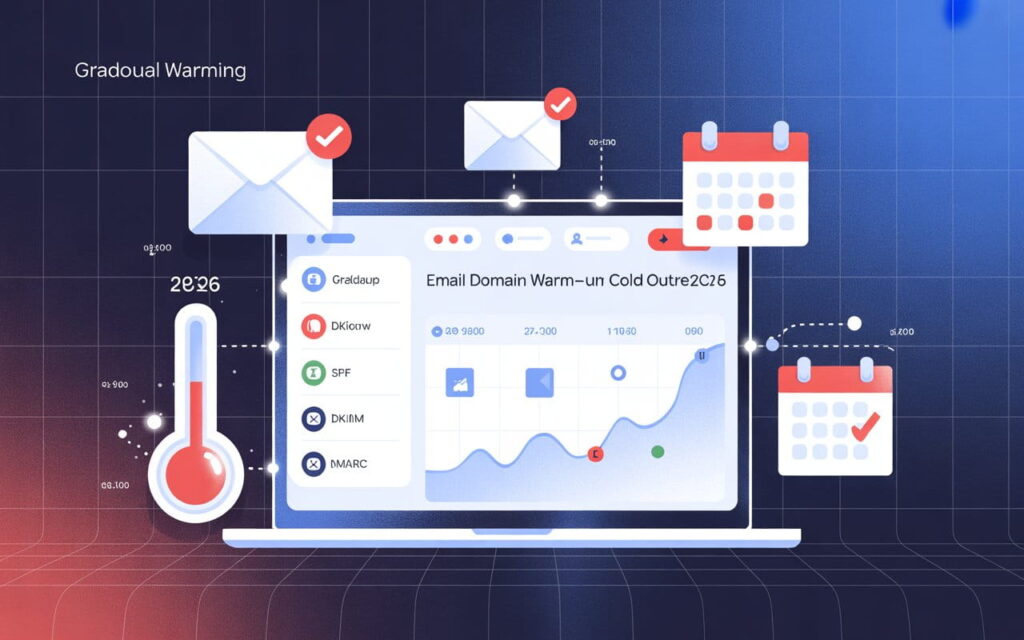
- ✅ SPF, DKIM, and DMARC authentication mandatory in 2025
- ✅ Separate sending domains (never your main business domain)
- ✅ 14-day email warmup before full volume sending
- ✅ Daily spam monitoring and blacklist checks
- ✅ Smart sending patterns that mimic manual behavior
This is exactly why agencies like Leads Monky use 10 dedicated sending domains and 30 separate email accounts per client protecting your main domain’s reputation while hitting 40–60% open rates. Their deliverability-first infrastructure is what separates a 3.2% reply rate (6x the industry average) from emails that vanish into spam folders forever.
How to Use CRM Automation and AI for Cold Lead Re-Engagement
Manual follow-ups don’t scale. Here’s how smart sales teams automate their dormant lead outreach in 2025 without losing the personal touch.
Trigger-based enrollment. Set your CRM to automatically flag leads as cold after 14–21 days of silence, then enroll them in your re-engagement sequence. HubSpot, Salesforce, and Pipedrive all support this natively.
Intent signal monitoring. Tools like Bombora and Crunchbase track behavioral signals pricing page visits, G2 competitor reviews, new funding announcements and alert you to reach out at the exact moment of relevance.
AI-powered personalization. AI tools can analyze up to 50 data points per prospect in seconds. Companies using AI-driven personalized outreach report response rates as high as 35% seven times higher than generic templates.
If you want this fully done for you, Leads Monky builds and manages complete cold email infrastructure from scratch including prospect sourcing, 5-step sequences, A/B testing, and reply management. Their system sends 10,000 personalized emails monthly per client and books 10–15 qualified consultations every month.
Cold Email Re-Engagement Stats You Need to Know (2026)
Numbers don’t lie. Here’s what the data says:
- 80% of sales require at least 5 follow-up touches before closing yet 70% of reps never send a second email
- One extra follow-up email increases reply rates by 65.8%
- Personalized subject lines boost open rates by 50% and replies by up to 140%
- Thursday mornings (9–11 a.m.) produce the highest cold email open rates followed by Tuesday and Wednesday
- Using “I never heard back” in emails drops meeting-booking rates by 12% so never use it
- Email 4 in a sequence — the competitive trigger or breakup generates 40% of all replies (Leads Monky data)
When Should You Give Up on a Cold Lead?
This is the question nobody answers. Here’s the honest framework.
Archive after: 5 unanswered touchpoints over 4–6 weeks with zero email opens.
Re-activate in 90 days if: A trigger event fires new funding, leadership change, company expansion, or a competitive move that reactivates the original problem.
Permanently remove after: 12 months of zero engagement but only after one final opt-out email giving them a clear chance to stay on your list.
Archiving is not giving up. It’s protecting your email deliverability, respecting the prospect’s time, and keeping your sales pipeline clean and focused.
FAQ: How to Re-Engage Cold Leads with Email
How to reengage cold leads?
Send a personalized 5-email sequence that references their specific pain point, delivers new value, and closes with a professional breakup email.
What is the 30/30/50 rule for cold emails?
30% of your effort goes to your subject line, 30% to personalization, and 50% to your call-to-action because a great email means nothing without a compelling next step.
How to fix cold email deliverability?
Set up SPF, DKIM, and DMARC authentication, use separate sending domains, warm up your email accounts for 14 days, and never send from your main business domain.
What is the 80/20 rule in email marketing?
80% of your emails should deliver value tips, insights, or resources and only 20% should directly pitch or sell your product or service.
What is the 3-3-3 rule in sales?
Spend 3 minutes researching the prospect, write a 3-sentence email, and follow up exactly 3 times before moving on.
What is the +1 email trick?
Add one extra follow-up email to your existing sequence research shows a single additional touchpoint increases reply rates by up to 65.8%.
What are the 3 C’s of cold calling?
Confidence, Clarity, and Conciseness deliver your message with certainty, make your value instantly clear, and never waste the prospect’s time.
What is the 60/40 rule in email?
60% of your email should be content or value, and 40% should be your pitch keeping the balance reader-first so prospects stay engaged instead of unsubscribing.
What is the 2-2-2 rule in sales?
Follow up 2 days after your first contact, again 2 weeks later, and once more 2 months after spacing touchpoints to stay top of mind without becoming annoying.
How to follow up on a cold call email?
Reference your call specifically, remind them of the problem you discussed, add one new piece of value, and include a single low-friction call-to-action like a one-click calendar link.
Final Word: Your Cold Leads Are Revenue Waiting to Happen
Cold leads aren’t lost deals. They’re deferred opportunities sitting in your CRM, waiting for the right message.
The system is simple: understand why they went cold, deliver real value at every touchpoint, use proven psychological triggers, automate where it makes sense, and know when to step back.
Done right, your cold prospect reactivation strategy becomes one of the highest-ROI activities in your entire sales process.
Start with Email 1 today. You might be surprised who replies.
Ready to Fix Your Cold Email?
🛡️ We guarantee 10 consultations in 60 days or work free.
⭐⭐⭐⭐⭐ 50+ clients | 2.4M emails sent | 3.2% reply rate
What you get:
✅ Complete infrastructure (30 emails, 10 domains)
✅ 10,000 personalized emails monthly
✅ First consultations in 5-6 weeks
2 spots left for February 2026