You’re spending $5,000 a month on LinkedIn ads.
Your cost per lead just hit $247. And your sales team says half these leads are garbage.
Sound familiar? You’re not alone. LinkedIn lead generation for SaaS got brutally harder in 2024. But here’s the thing—while most companies are struggling, a small group is crushing it at $40-$80 per qualified lead.
Let me show you exactly what they’re doing differently.
Why Your LinkedIn Strategy Stopped Working in 2026
LinkedIn changed its algorithm in August 2024. The results? Devastating for most B2B SaaS marketers.
Organic reach dropped 50%. Engagement fell 25%. Your carefully crafted posts now reach a fraction of your followers.
But here’s what nobody’s telling you: this change actually helps you if you know the new rules.
The algorithm now rewards expertise over virality. It prioritizes meaningful conversations over engagement bait. And it heavily favors mobile-first content that delivers value in 7 seconds or less.
Translation? Generic tips and recycled advice are dead. Real insights win.
The Real Cost of LinkedIn Lead Generation (And When It’s Worth It)
Let’s talk numbers. No BS.
Cost per click for B2B SaaS ranges from $5 to $20. Enterprise targeting? You’re looking at $8-$15+ per click.
Cost per lead typically lands between $75-$300 depending on your targeting. I’ve seen campaigns at $16 per lead. I’ve also seen $400+ per lead disasters.
Here’s the formula that matters:
Is LinkedIn worth it? Only if your customer lifetime value (LTV) is above $10,000. Below that, the economics don’t work.
Do this quick calculation: Take your average contract value. Multiply by your close rate. If LinkedIn’s cost per lead is less than 30% of that number, you’re good.
For example: $50,000 ACV × 20% close rate = $10,000 per customer. Your maximum acceptable cost per lead? $3,000. If you’re getting leads at $150, you’ve got plenty of margin.
The companies wasting money on LinkedIn? They’re targeting too broadly and measuring the wrong metrics.
How to Use LinkedIn Ads for SaaS Lead Generation (Step-by-Step)
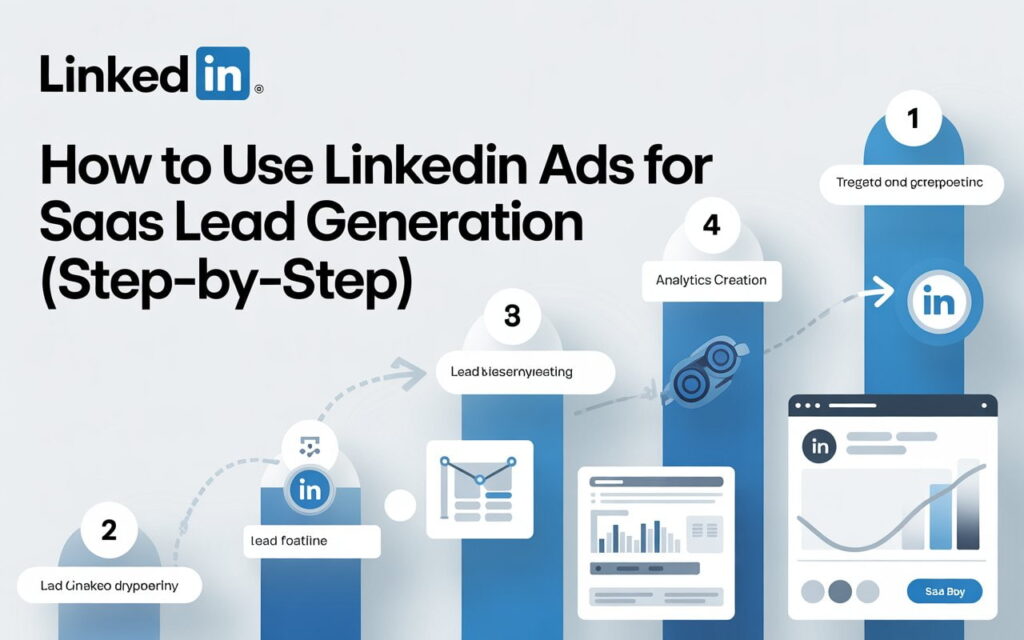
Let me walk you through the exact framework that’s working right now.
Step 1: Choose the Right Campaign Objective
Most people get this wrong immediately. They select “Lead Generation” because it sounds right.
Here’s the truth: Lead Gen Forms generate volume, not quality. We consistently see 8-12% MQL-to-SQL conversion rates from forms versus 30-40% from landing pages.
Use this decision tree:
- Want top-of-funnel awareness? Use Lead Gen Forms for downloadable guides
- Want qualified demos? Use Website Traffic and send them to a dedicated landing page
- Want both? Run them simultaneously and retarget form submitters with demo offers
The hybrid approach reduces cost per qualified opportunity by 45%.
Step 2: Target Like a Sniper, Not a Shotgun
Broad targeting kills campaigns. “All marketing managers” is worthless.
Layer your targeting options like this:
Layer 1: Company size (50-1,000 employees for mid-market sweet spot)
Layer 2: Specific job titles (“VP Revenue Operations” not “Manager”)
Layer 3: Recent job changes (people who switched roles in the past 90 days buy more)
Layer 4: Skills that indicate need (look for competitor tool skills)
Your audience should be 2,000-10,000 people. Larger than that? You’re too broad.
Step 3: Create Ads That Don’t Suck
Here’s what converts in 2025:
Single image ads outperform everything else for cold outreach. Video is great for retargeting, but expensive for prospecting.
Your image must communicate value in 3 seconds. Use:
- Data visualizations showing ROI
- Before/after screenshots
- Problem callouts in bold text
- Your founder’s face (builds trust, increases CTR by 22%)
Skip the stock photos of people shaking hands. They scream “generic SaaS company.”
Step 4: Write Copy That Speaks to Pain
Lead with the problem, not your product. Nobody cares about your “AI-powered platform with real-time analytics.”
They care that sales onboarding takes 90 days and you can cut it to 30.
Use this formula:
Line 1: Contrarian hook or shocking stat Line 2-3: Specific pain point they’re feeling right now Line 4-6: Your unique solution (outcomes, not features) Line 7: Social proof Line 8: Clear call-to-action
Keep it under 150 words. Mobile users won’t read more.
Step 5: Budget Smart
Minimum viable budget? $10,000 per month. Less than that and you won’t generate enough data to optimize.
Split it like this:
- 60% prospecting (new audiences)
- 25% retargeting (website visitors, engaged users)
- 15% testing (new creative, audiences)
Review weekly. Kill underperformers fast. Double down on winners.
Top LinkedIn Ads Strategies for Generating SaaS Leads

Let me give you the top LinkedIn ads strategies for generating saas leads that actually move the needle.
Strategy #1: The Multi-Channel Validation Loop
Don’t go all-in on LinkedIn immediately. That’s expensive.
Test your messaging on Reddit first. Run ads at $0.60-$1.80 per click. Find which value propositions resonate.
Then take the winning messages to LinkedIn and target decision-makers. You’ll cut your cost per lead by 40-60% because your messaging is pre-validated.
One client tested 5 angles on Reddit for $800. Found “40% faster deployment” crushed “enterprise security.” Launched on LinkedIn with that angle and dropped CPL from $220 to $87.
Strategy #2: Sales Navigator + Retargeting Combo
Sales Navigator is your secret weapon for finding warm leads.
Set up saved searches for your ideal customer profile. Turn on alerts for job changes and company news.
When someone changes jobs or their company raises funding, they’re in buying mode. Hit them with personalized InMail immediately.
Then retarget everyone who views your profile or engages with your content. These are warm prospects. Conversion rates are 3-5x higher than cold audiences.
Strategy #3: Employee Advocacy at Scale
Your company page has 3,000 followers. Your 20 employees have 10,000 connections combined.
Personal posts get 8-10x more reach than company pages. Do the math.
Create a weekly content library. Make it dead simple for employees to share. Give them 3-5 pre-written posts they can personalize.
One SaaS company activated 25 employees. Combined reach: 180,000 monthly impressions. Inbound leads jumped from 12 to 127 per month. Cost? $0.
Strategy #4: Intent Data Layering
This is advanced, but powerful.
Tools like Bombora and 6sense show you which companies are actively researching your category. They’re tracking content consumption across thousands of B2B sites.
Upload these high-intent accounts to LinkedIn Campaign Manager as Matched Audiences. Target them with aggressive bottom-funnel offers.
CPL might be higher ($240 vs $180), but lead-to-opportunity rate jumps from 12% to 47%. Your cost per actual opportunity drops by 60%.
Strategy #5: The Hybrid Organic + Paid Approach
Don’t choose between organic and paid. Use both strategically.
Organic builds authority and trust. Your founder posts 3-5x per week sharing real insights. This attracts your ICP organically.
Paid amplifies reach and captures demand. You’re running LinkedIn campaigns to people already searching for solutions.
The combination creates a flywheel:
- Organic content attracts engaged followers
- Paid ads convert them to leads
- Leads see organic content and trust you more
- Close rates increase 30-40%
Budget split: 70% paid, 30% time investment on organic.
Should You Hire LinkedIn Agencies for SaaS Lead Generation?
Here’s the honest answer: it depends on your situation.
LinkedIn agencies for saas lead generation typically charge $3,000-$15,000 per month. Plus ad spend.
When to DIY:
You should handle it in-house if:
- Your ad budget is under $10,000/month
- You have a dedicated marketing person with 10+ hours/week
- Your ICP is simple to target
- You’re still testing product-market fit
The learning curve is steep but manageable. LinkedIn’s interface isn’t rocket science.
When to Hire an Agency:
Consider linkedin agencies for b2b saas ad visibility lead generation when:
- You’re spending $20,000+/month on ads
- You don’t have in-house LinkedIn expertise
- You need sophisticated attribution and reporting
- Time-to-revenue matters more than saving agency fees
Good agencies bring:
- Battle-tested frameworks (they’ve run hundreds of campaigns)
- Advanced targeting strategies you won’t find in blog posts
- Creative testing at scale
- Multi-touch attribution setup
Red Flags to Avoid:
Don’t hire an agency that:
- Guarantees specific CPL numbers upfront (impossible without testing)
- Won’t show you past SaaS client results
- Wants a 12-month contract immediately
- Can’t explain their attribution methodology
- Focuses on vanity metrics (impressions, followers)
Ask to see their dashboard. If they can’t show pipeline generated and revenue attributed, run.
The Middle Ground:
Hire a consultant for 3 months to set everything up. Learn from them. Then take it in-house.
You’ll pay $5,000-$10,000 for setup and training. But you’ll avoid the ongoing agency fees and build internal expertise.
Quick Wins You Can Implement Today
Don’t wait to implement everything. Start with these three moves.
Win #1: Install LinkedIn Insight Tag Right Now
Seriously, stop reading and do this first. It tracks website visitors so you can retarget them.
Go to Campaign Manager → Account Assets → Insight Tag. Copy the code. Add it to your website header.
This one action unlocks retargeting campaigns that convert 3-5x better than cold traffic.
Win #2: Optimize Your Founder’s LinkedIn Profile
Your founder’s profile is a landing page. Treat it like one.
Update the headline with keywords. Make it outcome-focused: “Helping B2B SaaS companies cut sales cycles by 40%” beats “CEO at CompanyName.”
Add a custom background image with your value proposition. Write a summary that addresses your ICP’s pain points.
Turn on Creator Mode. Post valuable content 3x this week.
Win #3: Set Up One Retargeting Campaign
Create an audience of everyone who visited your pricing page in the past 30 days.
Create a simple image ad with one message: “Still evaluating? Book a 15-minute demo.”
Budget: $500. Run it for two weeks.
This will likely be your highest ROI LinkedIn campaign immediately.
The Bottom Line on LinkedIn Lead Generation for SaaS
LinkedIn lead generation for SaaS isn’t dead. It’s just different now.
The spray-and-pray tactics stopped working. Generic content gets ignored. Broad targeting wastes money.
But if you target precisely, create valuable content, and measure what actually matters? LinkedIn remains the best platform for reaching B2B SaaS buyers.
Focus on these priorities:
First: Get your targeting razor-sharp. Audience size under 10,000.
Second: Test messaging cheap (Reddit) before scaling expensive (LinkedIn).
Third: Combine organic authority-building with paid demand capture.
Fourth: Measure cost per opportunity, not cost per lead. Half your leads might be junk.
Fifth: Consider hiring expertise if you’re spending $20K+/month. The ROI justifies it.
The SaaS companies winning on LinkedIn in 2025 aren’t the ones with the biggest budgets. They’re the ones providing real value, targeting precisely, and optimizing relentlessly.
Follow this framework, and you’ll join them.
Ready to Fix Your LinkedIn Lead Gen?
Start with the three quick wins above. Implement them this week.
Track your results for 30 days. Measure cost per qualified opportunity (not just leads).
If you’re spending $20,000+ per month and want expert help, book a strategy call. We’ll audit your current setup and show you exactly where you’re leaving money on the table.
Either way, stop treating LinkedIn like it’s 2023. The game changed. Time to adapt.
FAQs
Q: What’s a good cost per lead for B2B SaaS on LinkedIn?
A: It depends on your ACV. For $50,000+ contracts, $200-$300 CPL is solid. For $10,000 contracts, aim for $75-$150. Formula: Target CPL should be less than 30% of (ACV × close rate).
Q: Should I use Lead Gen Forms or send traffic to my website?
A: Use both. Lead Gen Forms for top-of-funnel content offers. Landing pages for demo requests. The hybrid approach reduces cost per qualified opportunity by 45%.
Q: How long until I see results from LinkedIn ads?
A: Expect 30-60 days to exit the learning phase and gather meaningful data. Full optimization takes 90-120 days. Budget accordingly.
Q: Is organic LinkedIn worth the time investment?
A: Yes, but only if you commit to 3-5 quality posts per week for at least 90 days. Sporadic posting gets zero traction. Consistency builds authority that compounds over time.