Here’s something most salespeople get wrong.
They think cold email and spam are the same thing. They’re not and confusing the two can get your domain blacklisted, your emails rejected, and your entire outreach operation shut down overnight.
In 2026, Google and Yahoo don’t just filter bad emails. They reject them entirely before your prospect ever sees them. One wrong setup and every email you send, including your regular business emails, lands in the junk folder.
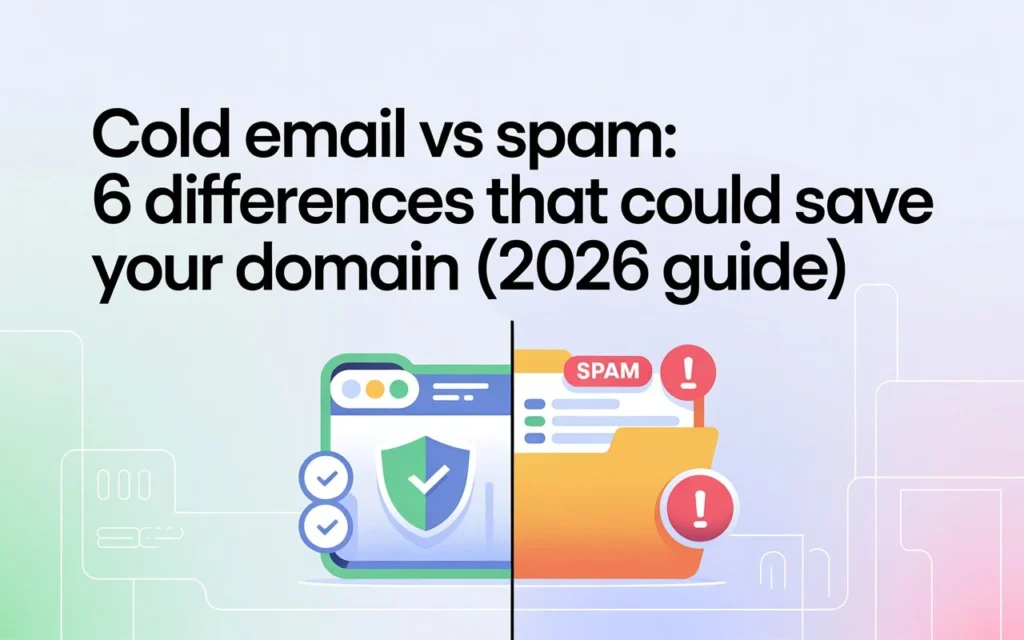
So let’s get this straight in Cold Email vs Spam.
What Is Cold Email, Exactly?
Cold email is a one-to-one outreach message you send to a specific person you’ve never spoken to before. But here’s the key that person fits your ideal customer profile. You’ve done the research. You have a real reason to reach out.

Think of it like introducing yourself at a networking event. It’s unsolicited, yes. But it’s relevant, respectful, and purposeful.
Done right, cold email is one of the most effective sales channels on the planet. Research from McKinsey found email is up to 40x more effective than social media for winning new customers.
What Is Spam?
Spam is the opposite.
It’s bulk, generic, mass-blasted email sent to anyone and everyone regardless of whether they’d ever care about your offer. No research. No personalization. No legitimate reason to reach out.
Spam ranges from annoying promotional blasts to outright illegal phishing attacks. Either way, it destroys your sender reputation, gets your domain blacklisted, and exposes you to serious legal fines.
Here’s a number that should wake you up: under the CAN-SPAM Act, you can be fined up to $46,517 per non-compliant email. Not per campaign. Per. Email.
Cold Email vs Spam: The 6 Real Differences
1. Intent Why Are You Sending It?
Cold email has a clear, legitimate business purpose. You’re reaching out because you genuinely believe you can help this specific person.
Spam? The goal is pure volume. Blast enough people and hope someone bites. There’s no intent to help only to sell.
Your intent shows up in every word you write. Prospects can feel it immediately.
2. Targeting Who Gets Your Email?
With cold outreach, you’ve vetted every contact. They match your ICP (ideal customer profile). You can explain exactly why you’re emailing them.
Spam uses purchased lists, scraped data, and unverified contacts. Sending to bad addresses causes bounce rates to spike and a bounce rate above 2% starts triggering major deliverability damage.
Bad data kills deliverability. Full stop.
3. Personalization Does It Feel Human?
A real cold email references something specific. The person’s company, their role, a recent news item, a problem you noticed. It feels like it was written for them.
Spam feels like a mail merge gone wrong. Generic opener, generic pitch, generic sign-off. No one feels special. No one replies.
In 2026, Gmail’s AI-powered spam filters are trained on billions of emails. They detect templated language patterns automatically. If your email reads like a template even a well-written one it gets filtered.
4. Legal Compliance CAN-SPAM vs Cold Email Rules
This is where things get serious.
CAN-SPAM vs cold email compliance is the line between legal outreach and illegal spam. Here’s what every country requires:
| Region | Law | Consent Needed? | Key Rule |
| USA | CAN-SPAM Act | No (B2B) | Opt-out link + real physical address |
| EU/UK | GDPR / PECR | Yes (B2C) | Legitimate interest for B2B |
| Canada | CASL | Yes | Express or implied consent required |
| Germany | UWG | Yes (always) | Consent required even in B2B |
Cold email follows all of these. It includes accurate sender info, a simple opt-out, and honest subject lines. Spam ignores them making it technically illegal in most jurisdictions.
5. Technical Setup Are You Authenticated?
This is the biggest gap competitors don’t cover and it’s now the most critical factor.
As of late 2026, Google and Microsoft reject emails outright from domains without proper authentication. Not filtered. Rejected. Your email never arrives.
Cold email senders configure three non-negotiable technical records:
- SPF (Sender Policy Framework) tells email servers you’re authorized to send
- DKIM (DomainKeys Identified Mail) adds a digital signature verifying your identity
- DMARC (Domain-based Message Authentication) tells servers what to do if SPF/DKIM fail
Spam skips all of this. Which is exactly why spam lands in junk or gets rejected before delivery.
6. Opt-Out Can People Easily Leave?
Cold email makes unsubscribing effortless. A simple “reply ‘not interested’ and I’ll never bother you again” is enough. And you honor it immediately.
Spam buries the unsubscribe link, makes you jump through five screens to opt out, or ignores your request entirely.
Here’s the kicker: Gmail counts every “Report Spam” click as a complaint against your domain not just an unsubscribe. Keep your spam complaint rate above 0.1% and Google starts throttling every email you send. Above 0.3%, you’re in serious trouble.
When Cold Email Accidentally Becomes Spam
Even good-faith cold emailers cross the line without realizing it. Watch out for these:
- Sending too many emails per inbox. The safe zone is 30–50 per inbox per day. Need more volume? Add more inboxes never push past this limit.
- Using deceptive subject lines. Writing “Re: our conversation” when there was no conversation? That’s illegal under CAN-SPAM and instantly triggers spam reports.
- Including links in your first email. Spam filters treat links as suspicious. Keep your first touch clean add links in follow-ups only.
- Using HTML templates with images. Plain text emails land in the inbox. HTML-heavy emails land in promotions or spam.
- Tracking pixels. Open-tracking pixels are flagged by modern email spam filters. Disable them for cold outreach.
2026 Cold Email Benchmarks Know Your Numbers
If your numbers are lagging, it’s a deliverability, targeting, or content problem. Here’s what healthy looks like:
| Metric | Healthy Range | Red Flag |
| Open rate | 45–65% | Below 30% |
| Reply rate | 5–15% | Below 2% |
| Bounce rate | Under 2% | Above 3% |
| Spam complaint rate | Under 0.1% | Above 0.1% |
| Meeting booked rate | 1–3% | Below 0.5% |
The Cold Email Infrastructure Problem Nobody Talks About
Here’s the truth most guides skip.
You can write the most personalized, perfectly legal, beautifully crafted cold email in the world. But if your email deliverability infrastructure is broken, it never reaches anyone.
Setting up SPF, DKIM, and DMARC correctly is technical. Most people get it wrong. And one misconfigured DNS record can silently destroy your entire campaign’s deliverability for months.
This is exactly why serious cold emailers don’t DIY their infrastructure setup.
💡 Need help setting up Google Workspace?
We’re certified Google partners offering 64% off + free professional setup ($2,000 value). Used by 151+ companies.
Get your quote →How Leads Monky Solves This (At a Fraction of the Cost)
If you’re running cold email outreach at any real scale, you need Google Workspace and you need it configured correctly from day one.
Leads Monky is a certified Google Workspace reseller and authorized partner trusted by 151+ companies globally. And they’ve built their entire service around one thing: making sure your cold emails actually land in the inbox.
Here’s what makes them different.
Complete technical setup, done for you. When you sign up, Leads Monky configures your full cold email infrastructure DKIM, DMARC, SPF records, spam protection, and email warmup. Everything that most people spend weeks trying to figure out, they handle in hours.
Only USA-based IPs. Every account runs on US-based IP addresses a critical trust signal for major email providers. Most cheap resellers skip this entirely.
Pricing that makes sense for outreach teams. Google Workspace directly from Google costs significantly more. Leads Monky offers it starting at just $2.50 per mailbox per month that’s 50–60% cheaper with zero setup fees.
Here’s the pricing breakdown:
- $2.99/user/month for 15 to 200 email accounts (minimum 15)
- $2.50/user/month for 200+ accounts (perfect for agencies scaling cold email)
- Full infrastructure setup included at every tier
And if you’re wondering what’s actually included DKIM configuration, DMARC setup, SPF records, spam protection, and email warmup guidance all come standard. You don’t pay extra for the technical foundation that makes your emails deliverable.
That’s exactly what good email deliverability looks like in practice.
Quick Pre-Send Checklist: Cold Email vs Spam Self-Audit
Before you hit send on your next campaign, run through this:
Technical:
- ✅ SPF record configured and verified
- ✅ DKIM enabled and tested
- ✅ DMARC policy active
- ✅ Sending from a secondary domain (not your primary business domain)
- ✅ Domain warmed up for 4–6 weeks
Content:
- ✅ Plain text only no images or HTML in first email
- ✅ No links in first touch
- ✅ Subject line matches the email body no fake “Re:” openers
- ✅ Personalized to the specific recipient
- ✅ Easy opt-out included
List:
- ✅ Email addresses verified (NeverBounce, ZeroBounce, or Bouncer)
- ✅ Contacts match your ICP
- ✅ Suppression list maintained and up to date
If you can check every box you’re sending cold email, not spam.
FAQs
What is the 30/30/50 rule for cold emails?
Spend 30% on your subject line, 30% on your opening line, and 50% on your call-to-action because if any one of the three fails, the whole email fails.
Is cold email illegal?
No cold email is completely legal in the US under CAN-SPAM, but countries like Canada and Germany require consent before you hit send.
Why should you never delete spam emails?
Deleting spam confirms your inbox is active to spammers always mark it as spam instead so your email provider learns to block it automatically.
What is the 60/40 rule in email?
Keep your email 60% personalized value and 40% pitch flip that ratio and you sound like a salesperson, not a problem-solver.
What is the 4 email rule?
Never send more than 4 follow-up emails in a cold sequence after that, you’re not persistent, you’re just annoying.
Do cold emails actually work?
Yes when targeted and personalized correctly, cold email delivers an average ROI of $36 for every $1 spent, making it one of the highest-performing outreach channels available.
What is the 5 email rule?
Keep your cold email under 5 sentences short emails get read, long emails get deleted.
How to send cold emails without getting spammed?
Authenticate your domain with SPF, DKIM, and DMARC, warm up your inbox, personalize every message, and never send more than 50 emails per inbox per day.
What’s the safest email account to have?
Google Workspace with proper SPF, DKIM, and DMARC configuration is the gold standard it gives you enterprise-grade security with full deliverability control.
How do I stop getting 100s of spam emails?
Never unsubscribe from emails you didn’t sign up for mark them as spam, use a strong spam filter, and never share your primary email on public websites.
Do spammers know if you open their email?
Yes most spam emails contain invisible tracking pixels that fire the moment you open them, confirming your address is active and inviting even more spam.
The Bottom Line
Cold email vs spam isn’t a gray area. It comes down to six clear things: intent, targeting, personalization, legal compliance, technical setup, and opt-out ease.
Get all six right and cold email is one of the most powerful revenue channels available to you. Get even one wrong and you’re sliding into spam territory with real legal and deliverability consequences.
The technical side SPF, DKIM, DMARC, domain warmup is where most people struggle. If you want it handled correctly from day one, without overpaying for Google Workspace, Leads Monky is worth a serious look.
Starting at $2.50 per mailbox with full infrastructure setup included, it’s the smartest cold email foundation you can build.
Get Google Workspace at 64% Off
Same service. Better price. Professional setup included.
⭐⭐⭐⭐⭐ 151+ companies trust us
Partner Pricing:
• Business Starter: $3/month (Google: $8)
• Business Standard: $13/month (Google: $17)
• Business Plus: $20/month (Google: $26)
FREE:
Complete DNS setup + 24/7 support + USA IPs
15-user minimum | Setup in 24 hours