You’re scrolling through LinkedIn wondering why your competitors are booking meetings while you’re getting crickets. Here’s the truth: they’re not smarter than you. They just know how the LinkedIn algorithm works in 2025.
Generating organic leads on LinkedIn isn’t about spamming connection requests or posting motivational quotes. It’s about strategy, consistency, and understanding what actually works right now.
Let me show you exactly how to get organic leads on LinkedIn using free tactics that deliver real results.
What Are Organic Leads on LinkedIn and Why Should You Care?
Organic leads on LinkedIn are potential customers who discover your business naturally through your profile, content, and networking activities—without paid advertising.
Unlike paid leads, organic LinkedIn leads come from authentic relationship building. They trust you before you ever pitch them. That’s powerful.

Here’s why this matters: LinkedIn generates 277% more leads than Facebook and Twitter combined. And B2B lead generation on this platform has a 3x higher conversion rate than other social networks.
But there’s a catch. The LinkedIn algorithm 2025 has changed dramatically. Organic reach dropped 50% for most users this year.
Don’t panic. The opportunity for meaningful engagement is actually stronger than ever if you know the new rules.
The 2026 LinkedIn Algorithm: Your Competitive Edge
Most marketers are still using 2023 tactics. That’s why they’re failing.
The LinkedIn algorithm now operates in five distinct phases. Understanding this is your secret weapon for LinkedIn organic growth.
Phase 1: Quality Control (First 60 Seconds)
When you post, LinkedIn’s AI immediately scans for spam signals and engagement bait. Posts using phrases like “Comment YES if you agree” get flagged instantly.
Here’s what kills your reach: AI-generated content with recognizable patterns sees a 47% reduction in organic reach. The algorithm can smell generic, soulless content from a mile away.
Phase 2: The Golden Hour (First 30-60 Minutes)
Your post gets shown to a small segment of your immediate network. This is make-or-break time.
Posts that get engagement in this window receive exponentially more distribution. Those that don’t get buried forever.
Phase 3: Quality Ranking
Not all engagement is created equal. Here’s what actually moves the needle:
- Saves (highest algorithmic weight)
- Thoughtful comments with 10+ words (2x boost)
- Detailed comments with 20+ words (2.5x boost)
- Reshares with commentary (very high weight)
- Simple likes (lowest value)
Phase 4: Long-Tail Distribution
Unlike Instagram where posts die in 24 hours, LinkedIn now keeps valuable content circulating for 2-3 weeks. Your best posts continue generating leads long after you publish them.
This is why evergreen LinkedIn content strategy matters more than ever.
Strategy 1: Transform Your LinkedIn Profile Into a Lead Magnet
Your LinkedIn profile isn’t a resume. It’s your digital storefront, sales page, and credibility builder rolled into one.
Most people completely waste this opportunity. Don’t be most people.
The Power Headline Formula
Stop listing job titles. Start solving problems.
Bad: “Marketing Manager at XYZ Company”
Good: “Helping B2B SaaS Companies Generate 50% More Qualified Leads Through Strategic LinkedIn Content | Marketing Director at XYZ”
This formula works because it immediately answers: “What can this person do for me?”
Your Featured Section: The Conversion Zone
Your Featured section appears before anyone scrolls. Use it strategically.
Include lead magnets, case studies, your best content, and social proof. Most people leave this empty. That’s leaving money on the table.
About Section: Tell Your Story
Your About section serves two critical functions: LinkedIn SEO and human connection.
Include keywords your ideal clients search for. But more importantly, tell a story that shows you understand their challenges.
Use this structure: Hook with a problem. Share your journey. Provide proof of results. End with a clear call-to-action.
Enable Creator Mode
Turn on Creator Mode in your settings. This unlocks the Follow button, topic hashtags, LinkedIn Live access, newsletter features, and creator analytics.
These tools are gold for organic lead generation.
The Profile Optimization Checklist
Want to rank higher in LinkedIn’s internal search? Here’s your checklist:
✅ Customize your LinkedIn URL (linkedin.com/in/yourname)
✅ Use industry keywords naturally in headline and about section
✅ Get 5-10 skills endorsements from colleagues
✅ Secure 3-5 recommendations highlighting specific outcomes
✅ Add a professional headshot (14x more profile views)
✅ Complete all profile sections to 100%
A complete, optimized LinkedIn profile is your foundation. Everything else builds on this.
Strategy 2: Master Content That Actually Converts
Not all LinkedIn posts are created equal. Some formats consistently outperform others in 2025.
Here’s what the data shows.
Text Posts: Still the King
Plain text posts remain the most stable format (58% of all content). But structure matters.
Your first three lines determine everything. They appear before the “see more” button.
Hook patterns that work:
- Bold statement: “90% of LinkedIn posts fail because of this one mistake.”
- Contrarian take: “Everyone tells you to post daily. That’s terrible advice.”
- Personal story: “I lost my biggest client last month. Here’s what I learned.”
Keep posts between 700-900 characters (120-150 words). Use short paragraphs with lots of white space.
End with open-ended questions that invite discussion. “What’s your experience with this?” generates more engagement than “Agree?”
Carousel Posts: The Lead Generation Weapon
Document posts (carousels) are criminally underused. They keep viewers on LinkedIn longer, position you as an expert, and get shared frequently.
Create slides in Canva (1080x1080px), export as PDF, and upload to LinkedIn. Add a compelling caption with your hook.
Carousel ideas for B2B:
- “7 LinkedIn Profile Mistakes Costing You Leads”
- “LinkedIn Algorithm Cheat Sheet for 2025″
- “Case Study: How We Generated 50 Leads in 30 Days”
Video Content: Short and Valuable
Video content on LinkedIn saw a 69% year-over-year increase. But format matters.
Vertical, mobile-first videos under 60 seconds perform best. Always add captions—85% watch without sound.
Your first three seconds must stop the scroll. Hook them immediately.
LinkedIn Newsletters: Build Your List
LinkedIn Newsletters let you build subscribers directly on the platform. When someone subscribes, they get notified every time you publish—bypassing the algorithm entirely.
Choose a specific niche topic. Publish weekly or bi-weekly. Promote your newsletter in your Featured section.
This is how you own your audience on LinkedIn.
Strategy 3: The Engagement Strategy That Works
Strategic engagement isn’t about randomly liking posts. It’s a sophisticated lead generation tactic.
The Pre-Connection Warm-Up
Before sending connection requests to cold prospects, warm them up first.
Spend two weeks liking and commenting on their posts. Leave thoughtful comments (10+ words minimum) that reference specific points they made.
Then send your connection request with a personalized note. Your acceptance rate jumps from 30% to 80%+.
High-Value Comments That Generate Leads
Generic comments do nothing. “Great post!” and “Thanks for sharing!” are invisible.
Use this formula instead:
1. Acknowledge: Reference a specific part of their post
2. Add value: Share a related insight or example
3. Extend: Ask a question or continue the conversation
This positions you as knowledgeable and opens dialogue naturally.
Target the Right Posts
Don’t engage randomly. Strategic engagement means:
- Comment on posts from your ideal clients
- Engage with industry leaders (their audience sees your comments)
- Focus on posts with 10-50 comments (visibility sweet spot)
- Avoid posts with 500+ comments (you’ll get buried)
The Reactivation Hack
Comment on your own posts at the 8-hour and 24-hour mark. This pushes them back into the feed and extends reach by 5-10%.
Strategy 4: Connection Strategy That Builds Your Pipeline
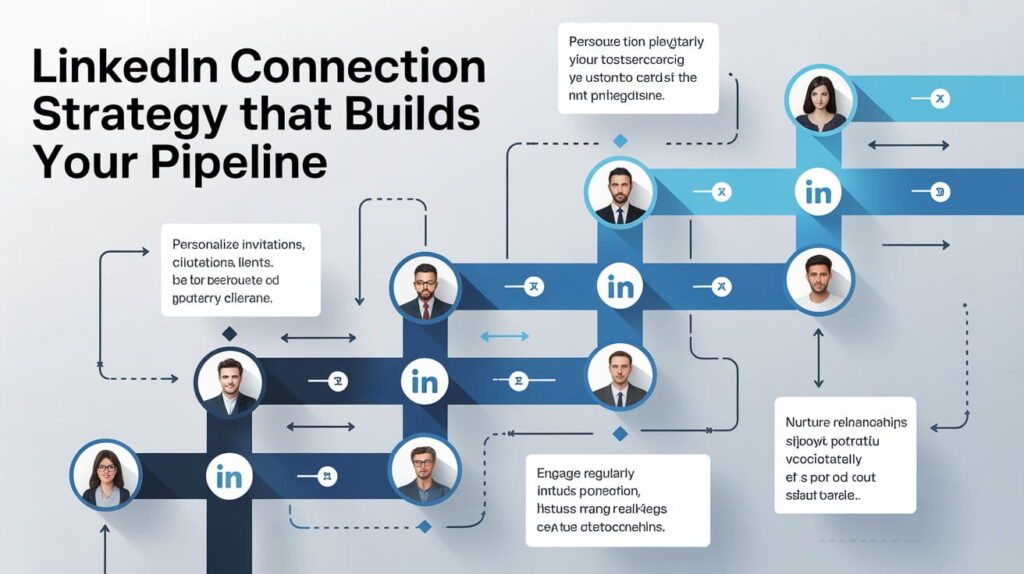
LinkedIn connections aren’t a numbers game. Quality beats quantity every single time.
Who to Connect With
Tier 1: Dream Clients – People who fit your ideal customer profile and are active on LinkedIn (posted in last 30 days)
Tier 2: Referral Sources – People who serve your audience but aren’t competitors
Tier 3: Industry Influencers – People whose audience overlaps with yours
The Connection Request That Gets Accepted
Generic requests get 30% acceptance. Personalized ones get 80%+.
The formula (200 character max):
“Hi [Name], I saw your post on [specific topic] and loved your take on [specific point]. I work with [audience type] on [related topic]. Would love to connect!”
This shows you read their content, finds common ground, and expresses genuine interest—no pitch.
Quality Over Quantity
Send 10-20 highly personalized connection requests per day. Not 100 copy-paste messages.
LinkedIn’s algorithm throttles aggressive connecting and flags spam behavior. Slow and strategic always wins.
Optimize Your Follower-to-Connection Ratio
Aim for a follower-to-connection ratio of at least 1.5:1. If you have 1,000 connections, target 1,500+ followers.
Higher follower ratio means better content distribution. It signals you create valuable content worth following.
Strategy 5: The Messaging Sequence That Converts
Getting the connection is step one. Converting to a lead requires strategic follow-up.
The Fatal Mistake
Sending a sales pitch immediately after connecting kills your opportunity. People come to LinkedIn for professional development, not aggressive sales tactics.
The 3-Step Framework
Message 1 (Day 1): Gratitude + Value
Thank them for connecting and provide immediate value—no ask.
“Thanks for connecting, [Name]! I saw you’re focused on [their focus]. I recently put together a guide on [related topic] that many [their role] found helpful. Want me to send it over?”
Message 2 (Day 4-5): Engagement
Share a relevant insight related to their industry.
“I noticed you worked on [project from profile]. That’s impressive. We’ve been seeing [relevant trend]. How has that been impacting your [area]?”
Message 3 (Day 8-10): Transition
After establishing value and rapport, transition naturally.
“Based on our conversation, it sounds like [pain point] might be a challenge. That’s actually what we specialize in. Would it make sense to hop on a quick call?”
Follow-Up Timing
Space messages 3-5 days apart. This shows you’re not desperate, you respect their time, and you’re building a relationship—not just chasing a sale.
Strategy 6: LinkedIn Groups—The Hidden Opportunity
LinkedIn Groups are where your ideal clients gather to discuss challenges. Most marketers ignore them completely.
That’s your opportunity.
Finding the Right Groups
Search for groups with 1,000-10,000 members. Look for daily posts and active discussions.
Check which groups your ideal clients have joined. Request to join 5-10 relevant groups.
The Group Engagement Strategy
Don’t post promotional content. Don’t drop links immediately. Don’t pitch your services.
Instead, answer questions comprehensively. Share valuable insights. Start meaningful discussions. Help other members solve problems.
The value loop works like this:
You answer someone’s question thoroughly → They check out your optimized profile → They send you a connection request → You have a warm lead without cold outreach.
Strategy 7: Measure What Matters
You can’t improve what you don’t measure. LinkedIn Analytics provides robust data—use it.
Key Metrics That Actually Matter
For content: Saves (highest value), comment rate, follower conversion, click-through rate.
For profile: Profile views, search appearances, follower growth rate.
Ignore vanity metrics like total impressions and likes. They mean nothing without context.
The Weekly Analytics Review
Every Monday, review your top 3 performing posts from the previous week. Identify patterns in format, topic, and timing.
Note your bottom 3 performers. Adjust your content calendar accordingly.
A/B Testing Framework
Test one variable at a time:
Week 1: Different hooks (same content) Week 2: Different posting times (same content type)
Week 3: Different formats (same topic) Week 4: Different CTAs (same structure)
Document results and double down on what works.
The Daily Lead Generation Routine
Consistency beats intensity. A 15-minute daily routine generates more leads than sporadic 3-hour sessions.
Your Morning Routine (15 Minutes)
Minutes 1-5: Comment thoughtfully on 3-5 posts from your target audience.
Minutes 6-10: Send 5 personalized connection requests. Respond to new connection acceptances.
Minutes 11-15: Draft your next post OR engage with comments on your recent posts.
Weekly Content Schedule
Monday: Industry insights and trends Tuesday: Personal story or lesson learned Wednesday: How-to tutorial Thursday: Question or poll Friday: Weekly roundup or case study
Batch create content on Sunday for the entire week. This keeps you consistent without daily stress.
Common Mistakes That Kill Your Results
Mistake 1: The Immediate Pitch
Sending “Let me tell you about my services” right after connecting gets you ignored or blocked. Follow the 3-step framework instead.
Mistake 2: Inconsistent Posting
Posting 10 times one week, then nothing for a month kills algorithm favor and audience trust. Post 3-5x per week minimum.
Mistake 3: Broadcasting, Not Engaging
Only posting your own content without engaging with others makes you invisible. Spend 2x as much time engaging as creating.
Mistake 4: Generic Content
“5 Marketing Tips” posts with no unique perspective get ignored. Share specific examples and personal experiences.
Mistake 5: Ignoring Analytics
Flying blind means repeating mistakes. Review analytics weekly and adjust based on data.
Your Action Plan: What to Do Right Now
Don’t just read this and do nothing. Here’s your immediate action plan.
Today (60 minutes):
- Optimize your LinkedIn profile using the checklist above
- Enable Creator Mode
- Update your headline with the power formula
- Fill your Featured section with lead magnets
This Week:
- Create your first value-driven post
- Send 10 personalized connection requests daily
- Comment thoughtfully on 5 posts daily
- Join 3 relevant LinkedIn Groups
This Month:
- Post 3-5x per week consistently
- Implement the 3-step messaging sequence
- Review analytics weekly
- Adjust strategy based on what’s working
Six months from now, you’ll wish you had started today. So start today.
Final Thoughts
Generating organic leads on LinkedIn isn’t a hack or shortcut. It’s a system built on authentic relationship building, genuine value creation, and strategic consistency.
The strategies in this guide work because they align with how the LinkedIn algorithm 2025 actually operates—not how it operated two years ago.
Most people quit before the compound effect kicks in. Every post builds your content library. Every connection expands your network. Every conversation builds relationships.
Start with profile optimization. Add consistent content. Layer in strategic engagement. Follow up with authentic messaging.
The leads will come.
Now over to you: Which strategy will you implement first? What’s working (or not working) for your LinkedIn lead generation efforts right now?
Q: What are the optimal LinkedIn post specs for organic reach?
A: Text posts: 700-900 characters, images: 1200x627px, carousels: 1080x1080px PDF, videos: vertical 1080x1920px under 60 seconds with captions.
Q: What’s the ideal LinkedIn post length for engagement?
A: 700-900 characters (120-150 words) with short paragraphs, strategic white space, and a clear hook in the first 3 lines before “see more.”
Q: What image size works best for LinkedIn posts?
A: 1200×627 pixels for single images and 1080×1080 pixels for carousel/document posts to ensure crisp display on both desktop and mobile.
Q: How do I increase my LinkedIn post reach organically?
A: Post during your audience’s active hours, engage in the first 60 minutes after posting, use 3-5 relevant hashtags, and encourage saves/comments over likes.
Q: What makes a LinkedIn post go viral organically?
A: Strong hooks in the first 3 lines, content that sparks thoughtful discussion, posts that get saved for reference value, and authentic personal stories with actionable insights.
Q: When is the best time to post on LinkedIn for maximum reach?
A: Tuesday-Thursday between 7-9 AM or 12-1 PM in your audience’s timezone, but more importantly, when YOU can engage with comments in the first hour.
Q: Why is my LinkedIn organic reach dropping?
A: The 2025 algorithm prioritizes saves and detailed comments (10+ words) over likes, penalizes AI-generated content by 47%, and flags engagement bait like “Comment YES.”