You’re staring at your inbox, wondering why your cold emails keep landing in spam. Or worse—they’re not landing anywhere at all.
Here’s the thing: your email provider makes or breaks your cold outreach. Pick the wrong one, and you’re shouting into the void. Pick the right one, and you’ll actually start booking meetings.
Let’s cut through the noise and figure out which provider works best for cold email in 2026.
Why Your Email Provider Actually Matters
Most people think all email services are the same. They’re not.
Google Workspace sends your emails through Google’s trusted servers. Microsoft 365 uses Outlook’s infrastructure. And specialized cold email providers like Mailforge? They’re built specifically for outreach.

Your deliverability rate—whether emails hit inboxes or spam—depends almost entirely on your provider’s reputation. This isn’t theory. It’s math.
The Hard Truth About Deliverability Rates
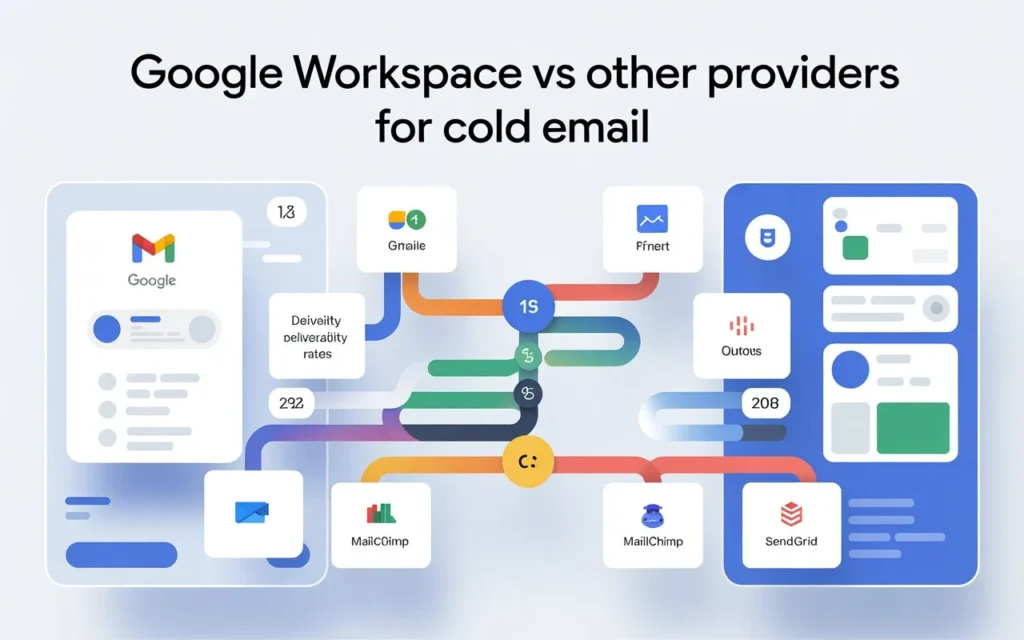
Here’s what the data shows for 2025:
Google Workspace: 94.18% inbox placement
Microsoft 365: 78-85% inbox placement
Amazon SES: 40.30% inbox placement
That’s not a typo. Using the wrong provider means half your emails vanish.
Think about it this way. You send 10,000 cold emails this month. With Google, 9,418 people see them. With Microsoft, maybe 8,250. With Amazon SES? Only 4,030.
Which provider would you choose?
Google Workspace for Cold Email: The Industry Standard
Let’s talk about why everyone recommends Google Workspace for cold outreach.
First, the deliverability is unmatched. When you send from a Gmail address, email servers trust you more. It’s like showing up to a party with the host—everyone assumes you belong.
Second, setup is simple. You don’t need to be a tech wizard. Buy your domain, connect Google Workspace, and you’re mostly ready to go.
Third, it integrates with every cold email tool on the market. Instantly, Smartlead, Lemlist—they all work seamlessly with Google.
The Sending Limits You Need to Know
Google Workspace officially lets you send 2,000 emails per day. But here’s what they don’t tell you.
For cold email, you should stay way below that limit. We’re talking 300-500 emails per day, maximum.
Why? Because sudden volume spikes trigger spam filters. Even if you’re technically within limits.
Start slow. Send 20-50 emails per day for the first two weeks. Gradually increase from there. This is called email warmup, and skipping it is the fastest way to tank your sender reputation.
What Google Workspace Actually Costs
The pricing seems straightforward at first. $6 per user per month for Business Starter. $12 for Standard. $18 for Plus.
But that’s not your total cost for cold email infrastructure.
You’ll also need:
- Domain registration: ~$12/year
- Email warmup tool: $20-50/month
- Verification service: $10-40/month
- Cold email automation: $50-300/month
Real monthly cost for one inbox: $140-200
That adds up fast when you’re scaling. And here’s where smart businesses save money.
The Google Workspace Reseller Secret
Most people don’t know this, but you can get the same Google Workspace features for 60-70% less through authorized resellers.
Companies like Leads Monky offer legitimate Google Workspace accounts at massive discounts. Same features. Same reliability. Way cheaper.
We’re talking $2-3 per user instead of $6-12. For agencies running 10-20 inboxes, that’s $1,000+ saved annually.
💡 Need help setting up Google Workspace?
We’re certified Google partners offering 64% off + free professional setup ($2,000 value). Used by 151+ companies.
Get your quote →Pro tip: Use premium Google accounts for your main domain. Use reseller accounts for your outreach domains. Best of both worlds.
Microsoft 365 for Cold Email: Higher Limits, Lower Delivery
Microsoft 365 (formerly Office 365) looks tempting on paper. You get 10,000 recipients per day—way more than Google.
But there’s a catch. A big one.
The 2025 Deliverability Problem
Microsoft 365 saw a significant drop in inbox placement last year. We’re talking 78-85% compared to Google’s 94%.
Part of the problem is Outlook’s new “Sweep” feature. It automatically moves bulk emails to a separate folder. Your carefully crafted cold email? Never seen.
Translation: More volume doesn’t matter if nobody reads your emails.
When Microsoft 365 Makes Sense
Don’t write off Microsoft completely. It works well in specific situations.
You’re already deep in the Microsoft ecosystem. Your team uses Office apps daily. You’re targeting other Microsoft 365 users (there’s a slight deliverability boost when sender and recipient match).
The pricing is similar to Google—$6-22 per user depending on the plan. But remember, lower inbox placement means lower ROI.
Specialized Cold Email Providers: The Budget Alternative
Here’s where things get interesting. Companies like Mailforge, Infraforge, and Mailpool built their entire business around cold email infrastructure.
Why They’re Different
These platforms use distributed or dedicated infrastructure specifically optimized for cold outreach. They automate the technical stuff—SPF, DKIM, DMARC setup happens in minutes, not hours.
Mailforge costs $3 per inbox monthly. Infraforge runs $4+ per inbox with dedicated IPs. That’s 50-75% cheaper than Google Workspace.
But here’s the question: Does cheaper mean worse deliverability?
The Deliverability Reality
According to user reports and testing, specialized providers achieve 90-95% inbox placement. That’s close to Google’s gold standard.
They’re not quite at 94.18%, but the difference is minimal. And when you’re saving hundreds of dollars monthly, that trade-off often makes sense.
The catch? These platforms require more technical knowledge. You’re managing domains, rotation strategies, and sender reputation yourself.
When to Choose Specialized Providers
You’re sending 1,000+ cold emails daily. You need 10+ inboxes and Google’s pricing becomes prohibitive. You have technical expertise (or someone on your team does).
For agencies and high-volume senders, this is the move.
The Hybrid Strategy Nobody Talks About
Here’s what smart operators do: they don’t choose just one provider.
Use Google Workspace for your main domain (company.com). This protects your brand reputation. Use Mailforge or similar for outreach domains (outreach-company.com, reach-company.com).
Total setup:
- 2 Google inboxes for high-value prospects: $12/month
- 8 Mailforge inboxes for volume outreach: $24/month
- Combined cost: $36/month for 10 inboxes
Compare that to $60-120/month for all Google Workspace accounts. You’re saving $300-1,000 annually while maintaining strong deliverability.
The Email Warmup Process (Don’t Skip This)
Every cold email provider requires warmup. No exceptions.
Week 1: Send 10-20 emails daily to people who know you. Friends, colleagues, past clients. Get real replies.
Week 2: Increase to 30-50 emails. Mix warm contacts with verified prospects.
Week 3: Ramp to 75-150 emails. Start introducing cold prospects gradually.
Week 4+: Stabilize at 200-400 emails per inbox. Monitor your spam complaint rate like a hawk (keep it under 0.1%).
Skip this, and you’re begging for spam folder placement. Or worse—account suspension.
Compliance Requirements for 2026
The rules changed in 2025, and they’re stricter now.
You need SPF, DKIM, and DMARC configured correctly. These authenticate your emails and prove you’re legitimate. Every email provider requires this.
You need one-click unsubscribe for bulk sending. Gmail and Yahoo enforce this for anyone sending 5,000+ emails daily. Microsoft followed suit in May 2025.
Keep your spam complaint rate under 0.3%. Anything higher, and providers will throttle or block you.
Bottom line: Compliance isn’t optional anymore. Budget 1-2 hours for proper setup, or pay someone who knows what they’re doing.
So Which Email Provider Should You Choose?
Let’s make this simple.
Choose Google Workspace if:
- You’re just starting with cold email
- You send less than 500 emails daily
- Maximum deliverability matters most
- Budget isn’t your primary concern
Choose Microsoft 365 if:
- You’re already using Microsoft tools
- You need higher sending limits (500-1,000/day)
- You target other Microsoft users primarily
Choose specialized providers (Mailforge/Infraforge) if:
- You send 1,000+ cold emails daily
- Cost efficiency matters more than 2-3% deliverability difference
- You have technical expertise or team support
- You’re managing multiple clients (agencies)
Choose the hybrid approach if:
- You want to protect your brand domain
- You need both quality and scale
- You’re willing to manage multiple systems
The Real Secret to Cold Email Success
Here’s what most people miss: your email provider is just the foundation.
Deliverability gets your foot in the door. But reply rates? Those come from targeting the right people, writing compelling copy, and providing actual value.
You can have perfect infrastructure and still fail if your message sucks. Or if you’re emailing the wrong audience.
Focus on this instead:
- Verify every email address (keep bounces under 2%)
- Research your prospects thoroughly
- Personalize beyond just first names
- Lead with value, not features
- Follow up consistently (most replies come after touch 3-5)
Your Next Steps
Pick your email provider based on your volume and budget. Set up proper authentication (SPF, DKIM, DMARC). Start your warmup process today—don’t wait.
If you’re going with Google Workspace, check out authorized resellers like LeadsMonky to save 60-70%. Same product, way cheaper.
And remember: cold email still works in 2026. But only if your emails actually reach inboxes.
Now go send some emails.
Get Google Workspace at 64% Off
Same service. Better price. Professional setup included.
⭐⭐⭐⭐⭐ 151+ companies trust us
Partner Pricing:
• Business Starter: $3/month (Google: $8)
• Business Standard: $13/month (Google: $17)
• Business Plus: $20/month (Google: $26)
FREE:
Complete DNS setup + 24/7 support + USA IPs
15-user minimum | Setup in 24 hours