
Your Business Email Got Hacked. Now What?
Here’s a scary thought. Right now, someone might be reading your emails.
They’re not breaking down doors or cracking codes like in the movies. They’re using your actual login credentials. And you won’t know until it’s too late.
Account compromise happened to 58% of organizations last year. Most didn’t see it coming.
But here’s the good news. Google Workspace security solutions can stop these attacks before they start. You just need to know which ones actually work.
💡 Need help setting up Google Workspace?
We’re certified Google partners offering 64% off + free professional setup ($2,000 value). Used by 151+ companies.
Get your quote →What Is Account Compromise (And Why Should You Care)?
Let’s keep this simple.
Account compromise happens when bad actors gain access to your legitimate Google Workspace account. They’re not guessing passwords anymore. They’re way smarter than that.
They steal authentication tokens. They trick you with fake OAuth apps. They hijack your sessions with stolen cookies.
Once they’re in, they can read your emails, steal your files, and access every third-party service connected to your account. Dropbox. Slack. Your banking apps. Everything.
The damage? Companies lose an average of $200,000 per breach. And that’s just the money. Your reputation takes years to rebuild.
The Threat Landscape Just Got Worse
Here’s what happened in 2024 that you need to know about.
Credential theft and phishing now drive 37% of successful attacks. That’s up significantly from previous years.
But the real shocker? There was an 84% increase in infostealer malware delivered through email. These programs steal your saved passwords, browser cookies, and session tokens.
Even scarier: 83% of organizations reported insider threats in 2024. That’s up from 60% in 2023.
Google discovered a vulnerability in June 2024 that compromised 5,000 Workspace accounts. Attackers bypassed email verification completely. They created fake accounts and used them to access third-party services.
Google fixed it in 72 hours. But it shows you something important: even Google isn’t bulletproof.
What Google Workspace Security Solutions Help Prevent Account Compromise?
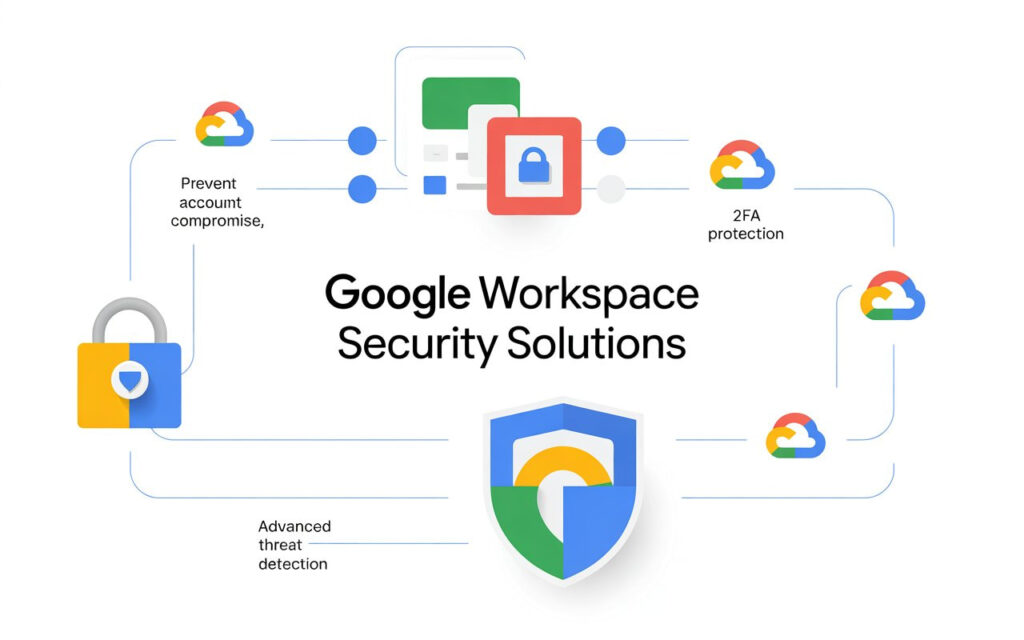
You’re probably wondering which features actually protect you. Let’s break down Google Workspace security solutions that work.
Multi-Factor Authentication (Your First Line of Defense)
Here’s a stat that’ll blow your mind. Accounts with multi-factor authentication are 99% less likely to get hacked.
99%. That’s not a typo.
But not all MFA is created equal. SMS codes? Attackers can intercept those. You’ll want to use:
- Security keys (physical devices like YubiKey)
- Passkeys (built into your phone or computer)
- Google Authenticator app
Turn it on today. Seriously. Stop reading and enable it right now for your admin accounts.
Passkeys: The Future Is Here
Passkeys are Google’s answer to password problems. They’re 40% faster than typing passwords and completely phishing-resistant.
Here’s how they work. Your device creates a unique cryptographic key. Nobody can steal it because it never leaves your device. Even if attackers trick you into visiting a fake login page, they get nothing.
Over 11 million Workspace customers now use passkeys. You should be one of them.
Device Bound Session Credentials (DBSC)
This one’s new and super important.
Remember those infostealer attacks I mentioned? They steal your session cookies. Normally, attackers can use stolen cookies to access your account from anywhere.
DBSC stops this cold. It ties your session to your specific device using cryptographic keys. Stolen cookies become useless.
There was an 84% increase in these attacks last year. DBSC is your defense. Turn it on in your admin console under Google session control.
Context-Aware Access (Zero Trust in Action)
Context-aware access checks every login attempt against multiple factors:
- Is this the user’s normal device?
- Are they in an expected location?
- Is the device encrypted and updated?
- Does the risk level match the data sensitivity?
You can block access from unmanaged devices. Require extra verification from new locations. Restrict sensitive data to company-owned hardware.
This is zero-trust security in practice. Never trust, always verify.
Your Priority Action Plan
Let’s get practical. Here’s what you need to do this week to prevent account compromise.
Week 1: The Foundation
Day 1-2: Enable MFA for Everyone
Start with admin accounts. Then roll it out organization-wide. Give people a two-week deadline. No exceptions.
Disable SMS verification. It’s too easy to hack.
Day 3-4: Fix Your Email Authentication
Set up SPF, DKIM, and DMARC. This stops attackers from sending fake emails that look like they’re from your domain.
Your IT person knows how. If you don’t have IT, Google’s setup wizard walks you through it.
Day 5: Clean Up Third-Party Apps
Go to your admin console. Check which OAuth applications have access to your data. Revoke anything suspicious or unused.
Attackers love to sneak in malicious apps. Do this monthly.
Week 2: Level Up Your Security
Deploy passkeys for your team. Start with willing early adopters. Track who’s using them.
Enable DBSC to block session hijacking attacks. It only works in Chrome, so communicate that clearly.
Set up your security dashboard. Review it every morning. It takes five minutes and can save your business.
The Biggest Mistakes (And How to Avoid Them)
You know what kills me? Most breaches happen because of simple mistakes.
Mistake #1: Enabling MFA but Not Enforcing It
Don’t give people a choice. Make it mandatory. One unprotected account can compromise your entire organization.
Mistake #2: Using Your Admin Account for Regular Work
Create a separate admin account. Use it only for admin tasks. Your daily email account shouldn’t have super admin privileges.
This one mistake led to countless breaches in 2024.
Mistake #3: Ignoring Your Security Dashboard
Google tells you when something’s wrong. Failed login attempts. Suspicious locations. Unusual downloads.
Check it daily. Set up alerts. Respond immediately.
What About Third-Party Security Tools?
Google’s built-in security solutions are excellent. But you might need more if you:
- Handle sensitive healthcare or financial data
- Face sophisticated attackers
- Need advanced threat detection
- Want independent backups against ransomware
Email security gateways like Proofpoint add extra phishing protection. CASB solutions give you multi-cloud visibility. Backup tools protect against ransomware.
But start with Google’s native tools first. They’re powerful and already included in your subscription.
Your Account Got Compromised. Now What?
Act fast. Every minute counts.
First 15 Minutes:
- Suspend the compromised account immediately
- Reset the password
- Revoke all OAuth tokens
- Alert your security team
Next Hour:
- Review login logs for suspicious activity
- Check email forwarding rules
- Investigate file access and sharing
- Identify what data was accessed
Within 24 Hours:
- Clean the account completely
- Enable Advanced Protection Program for that user
- Register security keys
- Restore access with enhanced monitoring
Document everything. You’ll need it for your incident report.
The Bottom Line
Account compromise prevention isn’t optional anymore. It’s survival.
The good news? Google Workspace security solutions give you everything you need. You just have to use them.
Start with MFA. Add passkeys. Enable DBSC. Monitor daily.
Do these four things, and you’ll stop 99% of attacks.
The question isn’t whether you’ll get targeted. It’s whether you’ll be ready when they come.
Where to Buy Google Workspace: Top Authorized Resellers
You can purchase Google Workspace through authorized resellers, which often provide local support, setup assistance, and flexible billing options for businesses. Buying from a trusted reseller ensures you get professional guidance and additional services alongside your subscription.
Top 5 Google Workspace Resellers:
- Leads Monky ( Enjoy up to 64% off with promo code PARTNER2026(Redeem Here) – Plus free setup and support)
- Agosto (Save up to 10% off on Google Workspace plans with expert migration support)
- Onix (Get up to 5% off on Google Workspace with enterprise-level deployment and support)
- Cumulus Global (Enjoy up to 20% off Google Workspace plans with certified reseller support)
- GsuiteReseller (USA) (Get up to 10% off on Google Workspace plans with dedicated support)
FAQs
What is the disadvantage of Google Workspace?
The main drawbacks are limited offline functionality, less advanced features compared to desktop Microsoft Office, and potential costs for third-party security tools if you need enterprise-grade protection beyond native features.
What is the best CRM for Google Workspace?
HubSpot, Salesforce, and Copper CRM integrate seamlessly with Google Workspace, with Copper being specifically built for Gmail users who want native integration without leaving their inbox.
How do you secure your Google Workspace?
Enable multi-factor authentication for all users, configure email authentication (SPF, DKIM, DMARC), deploy passkeys or security keys, enable DBSC, set up Context-Aware Access policies, implement DLP rules, and monitor your security dashboard daily.
Does Google Workspace have antivirus protection?
Yes, Gmail automatically scans all emails and attachments for viruses and malware, blocking over 99.9% of threats before they reach your inbox using AI-powered detection.
What are Google Workspace solutions?
Google Workspace solutions include Gmail, Drive, Meet, Calendar, Docs, Sheets, Slides, along with built-in security features like MFA, DLP, advanced threat protection, endpoint management, and compliance tools for business collaboration.
Does Google Workspace have a CRM system?
No, Google Workspace doesn’t include a native CRM, but it integrates seamlessly with popular CRM platforms like Salesforce, HubSpot, Copper, and Zoho CRM through APIs and the Google Workspace Marketplace.
Q: What are Google Workspace security solutions for admins?
A: Enable MFA, passkeys, DBSC, Context-Aware Access, DLP, and monitor the security dashboard daily.
Q: How do I contact my Google Workspace administrator?
A: Reach out via the Admin Console or your organization’s internal directory/email.
Q: What is the Google Workspace Security Center?
A: A dashboard in the Admin Console providing alerts, threat reports, device management, and security insights.
Q: What is a Google Workspace Super Admin?
A: A user with full administrative privileges to manage all users, security, and organizational settings.
Q: How do I log in to the Google Admin Console?
A: Go to admin.google.com and sign in with your admin account credentials.
Q: How do I log in as a Google Workspace administrator?
A: Use your assigned admin account at admin.google.com to access management features.
Q: How do I log in as a Google Workspace Super Admin?
A: Sign in at admin.google.com using your super admin account to manage all users and security settings.
Q: What is a Google Workspace admin account?
A: An account with elevated privileges to configure, monitor, and secure your organization’s Workspace environment.
Get Google Workspace at 64% Off
Same service. Better price. Professional setup included.
⭐⭐⭐⭐⭐ 151+ companies trust us
Partner Pricing:
• Business Starter: $3/month (Google: $8)
• Business Standard: $13/month (Google: $17)
• Business Plus: $20/month (Google: $26)
FREE:
Complete DNS setup + 24/7 support + USA IPs
15-user minimum | Setup in 24 hours