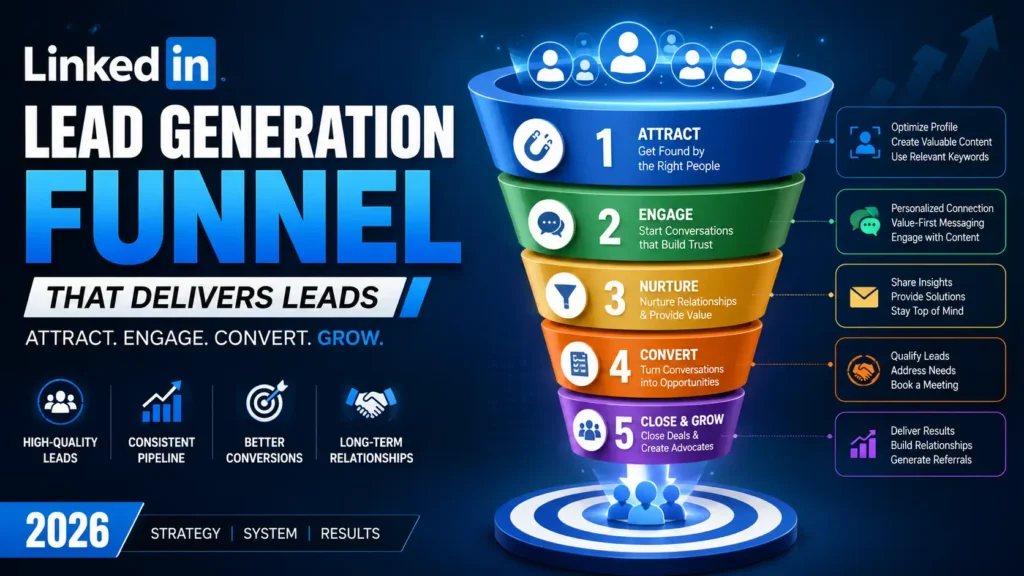
A LinkedIn lead generation funnel converts at 13 percent compared to just 2 percent for traditional landing pages. That is a 550 percent difference and most B2B marketers are leaving it entirely on the table.
The problem is not LinkedIn itself. It is the absence of a structured three stage system that takes prospects from first impression to signed contract.
This guide covers every stage, every tactic, and every tool top B2B companies use to generate 1000 plus qualified leads per month on LinkedIn in 2026.
Quick Answer
A LinkedIn lead generation funnel converts at 13 percent versus just 2 percent for traditional landing pages. The system runs in three stages. Awareness through optimized profile and consistent content. Consideration through personalized outreach and value driven message sequences. Conversion through LinkedIn Lead Gen Forms or demo booking pages. Post 3 to 5 times per week, send 30 to 50 personalized connection requests weekly, and follow up with at least 7 touchpoints before expecting a conversion.
What Is a LinkedIn Lead Generation Funnel?
A LinkedIn lead generation funnel is a systematic process that attracts, engages, and converts professionals on LinkedIn into paying customers. Think of it like a real funnel wide at the top, narrow at the bottom.
You start by attracting many people at the top. Then you guide interested prospects down through the funnel until they become customers.
Here’s why LinkedIn specifically works so well: you’re reaching 900 million professionals who are already in a business mindset. When someone’s browsing LinkedIn, they’re thinking about work, solutions, and growth.
The platform offers incredible B2B targeting capabilities. You can filter by job title, company size, industry, and seniority level. This means you’re not wasting money on unqualified traffic.
Why LinkedIn Funnels Crush Other Platforms
Let’s talk numbers. LinkedIn delivers results that other platforms can’t match for B2B lead generation.
LinkedIn Lead Gen Forms convert at 13%. Compare that to Facebook’s 9.21% or Google Ads’ 3.75%. Traditional landing pages? Just 2%.
But it’s not just about conversion rates. It’s about lead quality.
40% of B2B marketers say LinkedIn delivers their highest quality leads. These aren’t tire-kickers they’re decision-makers with real budgets and purchasing authority.
The platform also delivers 2x higher conversion rates than other social platforms. Why? Professional context creates higher purchase intent.
When someone clicks your ad on Facebook, they’re distracted by vacation photos and memes. On LinkedIn, they’re focused on business solutions.
The 3-Stage LinkedIn Funnel Framework
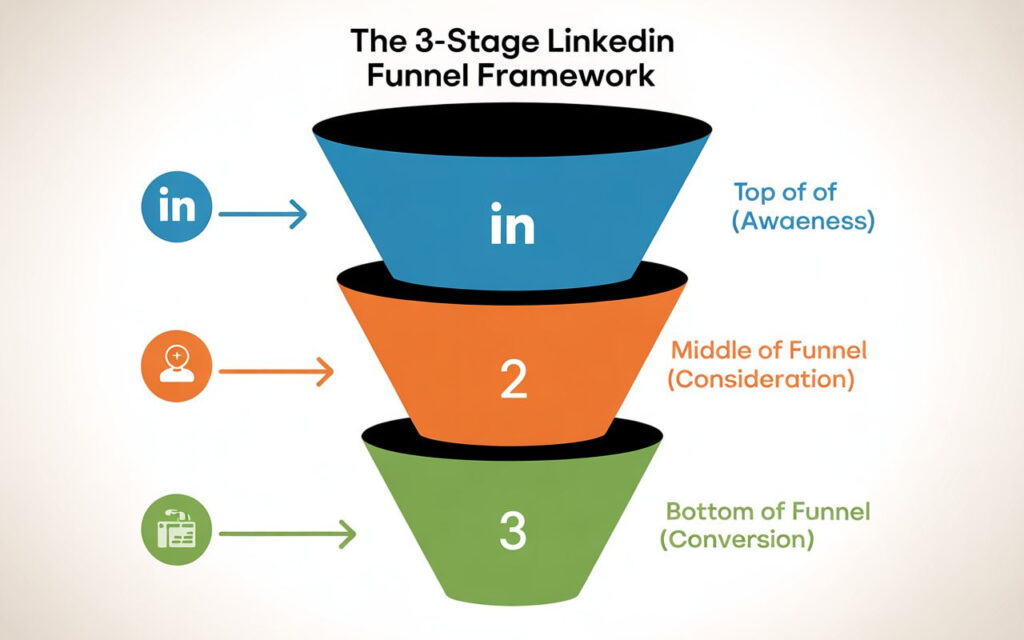
Every successful LinkedIn lead generation funnel follows three core stages: Awareness, Consideration, and Conversion.
Think of it as a journey. First, you get noticed. Then you build trust. Finally, you convert.
Here’s what to expect at each stage:
- Top of funnel (Awareness): 0.5-1% engagement rate
- Middle of funnel (Consideration): 3-6% conversion to qualified lead
- Bottom of funnel (Conversion): 10-15% conversion to sales conversation
Let’s break down each stage with specific tactics you can implement today.
Stage 1: Awareness (Attract Your Ideal Prospects)
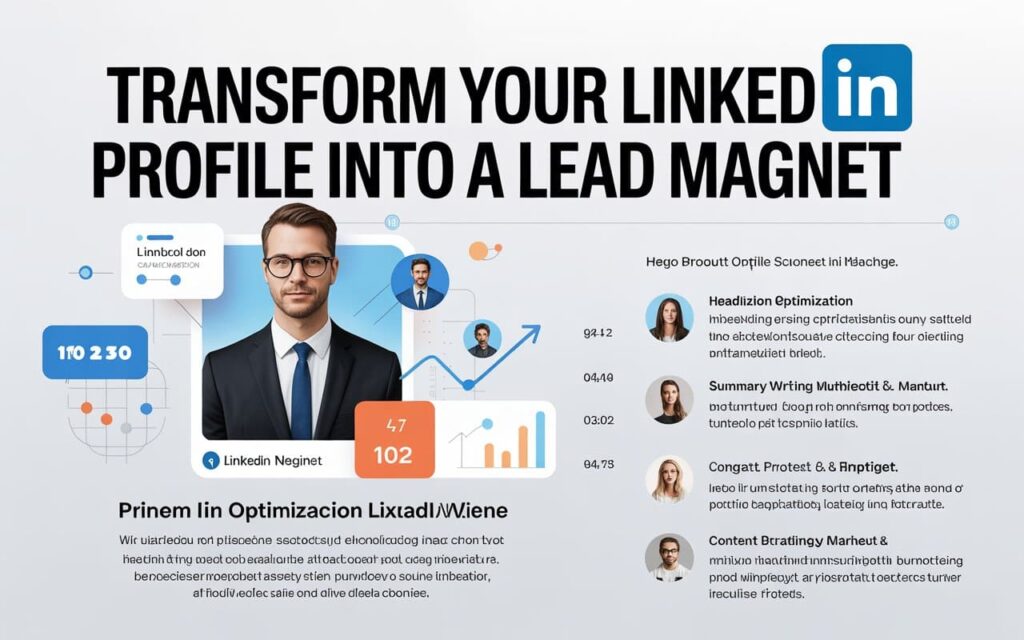
The first stage is all about visibility. You need to get in front of your target audience and make a strong first impression.
Optimize Your Profile for Conversions
Your LinkedIn profile is your storefront. When prospects visit, they decide in seconds whether to engage or bounce.
Start with your headline. Don’t just list your job title. Include keywords that prospects search for and highlight the value you deliver.
Your banner image should have a clear call-to-action. Think “Download Our Free Guide” or “Book a Strategy Call.”
The About section is prime real estate. Tell a story that resonates with your target audience. Focus on their problems and your solutions.
Here’s the game-changer: use your Featured section strategically. Pin your best content, case studies, and lead magnets here. When someone visits your profile, they’ll see your value immediately.
Content Strategy That Works
LinkedIn content is the fuel for your funnel. Post 3-5 times per week for optimal reach without overwhelming your audience.
What type of content performs best? Industry insights, personal stories, infographics, and short-form videos (30-90 seconds) get the highest engagement.
Don’t just broadcast. Engage with others’ posts too. Comment thoughtfully on content from your target audience. This builds relationships and increases your visibility.
LinkedIn carousels and PDF posts get insane engagement. They’re native to the platform, so the algorithm loves them.
Organic Prospecting Tactics
You can send 50-100 connection requests per week safely. Go beyond that and you risk getting flagged.
Personalize every connection request. Reference something specific from their profile. Generic requests get ignored.
Use LinkedIn’s advanced search filters to find your ideal prospects. Filter by job title, company, location, and industry.
Join relevant groups where your target audience hangs out. Participate in discussions and provide value before pitching.
Paid Awareness Campaigns
Organic reach is great, but paid ads accelerate everything. Start with a minimum budget of $500-1,000 monthly.
Video ads work exceptionally well for brand awareness. They generate 2.3x more engagement than static image posts.
Sponsored content puts your best posts in front of precisely targeted audiences. Use this to amplify your top-performing organic content.
Thought leader ads leverage your personal profile, not your company page. They feel more authentic and get higher engagement.
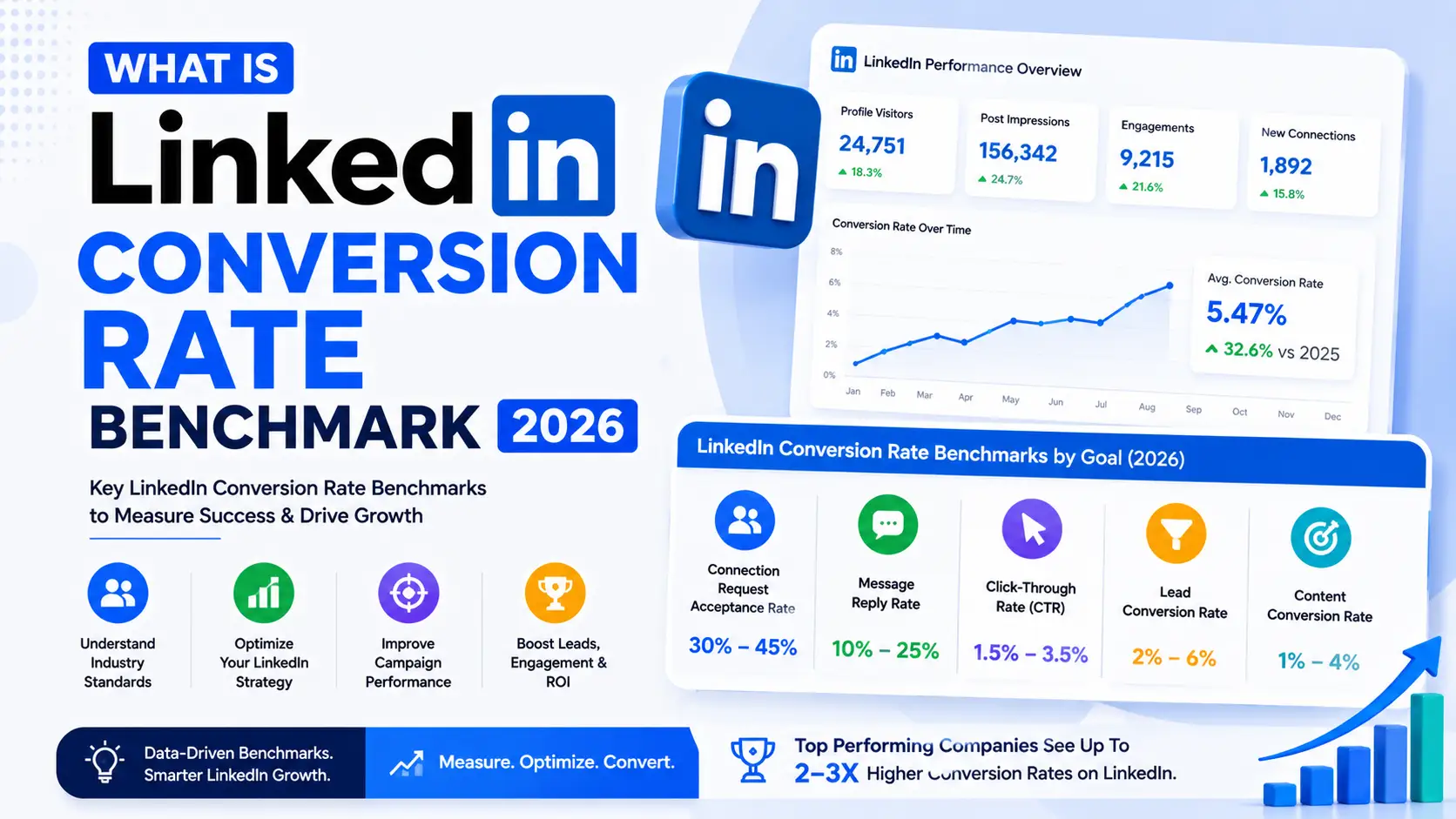
Benchmarks for this stage:
- Profile views: 200-500 weekly
- Connection acceptance rate: 30-50%
- Post impressions: 1,000-5,000 per post
- Engagement rate: 1-3%
Stage 2: Consideration (Engage and Nurture)
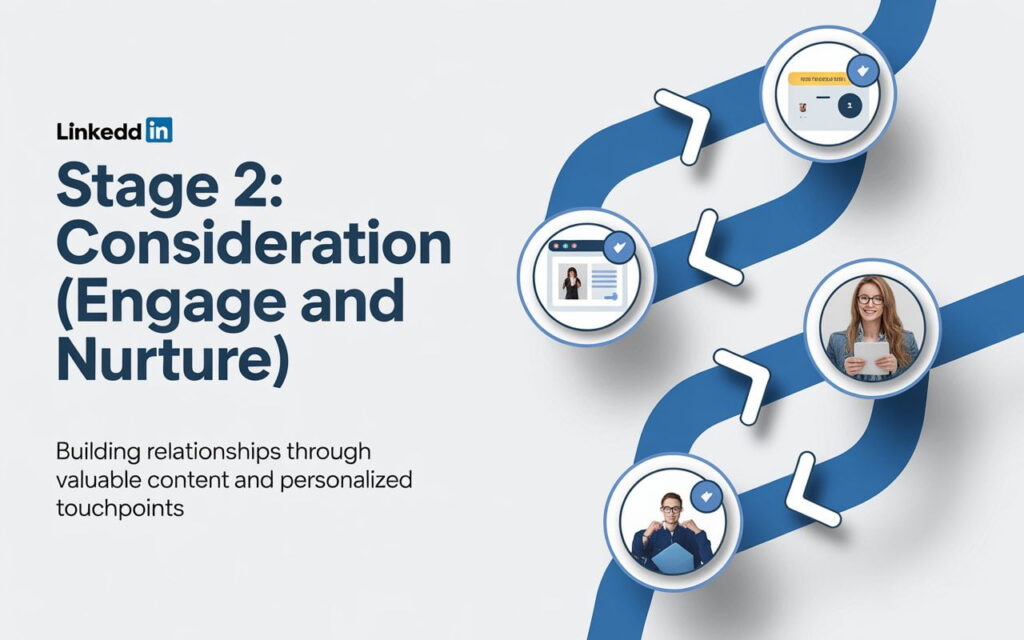
Now you’ve got their attention. Time to build trust and demonstrate value.
Warm Outreach Strategies
Wait 24-48 hours after someone accepts your connection request before sending a message. Don’t pitch immediately—that’s the kiss of death.
Start with value. Share a relevant article, comment on something from their profile, or ask a thoughtful question.
If someone engaged with your post, that’s your opening. Reference their comment in your outreach message.
Here’s a template that works:
“Hey [Name], I noticed you commented on my post about [topic]. I thought you might find [resource] helpful since you’re working on [their challenge]. No strings attached—just wanted to share.”
Content Nurturing Sequence
Create a content drip strategy. Share educational content consistently that addresses your audience’s pain points.
Case studies and social proof work incredibly well at this stage. Show real results you’ve delivered for similar clients.
LinkedIn newsletters turn connections into subscribers. You can message subscribers directly without connection limits.
Polls and engagement posts keep you top-of-mind. They’re low-commitment ways for prospects to interact with your brand.
Retargeting Campaigns
This is where paid and organic strategies merge beautifully.
Upload your email list to LinkedIn as a matched audience. Target these warm contacts with specific offers.
Retarget website visitors who didn’t convert. They already know you now show them why they should act.
Create engagement-based audiences. Target people who viewed your videos or visited your profile in the past 90 days.
Retargeting CTR averages 0.8-1.5%, significantly higher than cold traffic.
Email Integration
Don’t keep everything on LinkedIn. Sync your LinkedIn outreach with email sequences for multi-channel nurturing.
When someone downloads your lead magnet from LinkedIn, add them to an email sequence. You’ve now got two touchpoints.
The average B2B buyer needs 7-12 touchpoints before converting. Use LinkedIn and email together to hit that number faster.
Benchmarks for this stage:
- Message response rate: 20-30%
- Content engagement rate: 5-10%
- Lead magnet download rate: 8-15%
- Retargeting CTR: 0.8-1.5%
Stage 3: Conversion (Turn Leads into Customers)
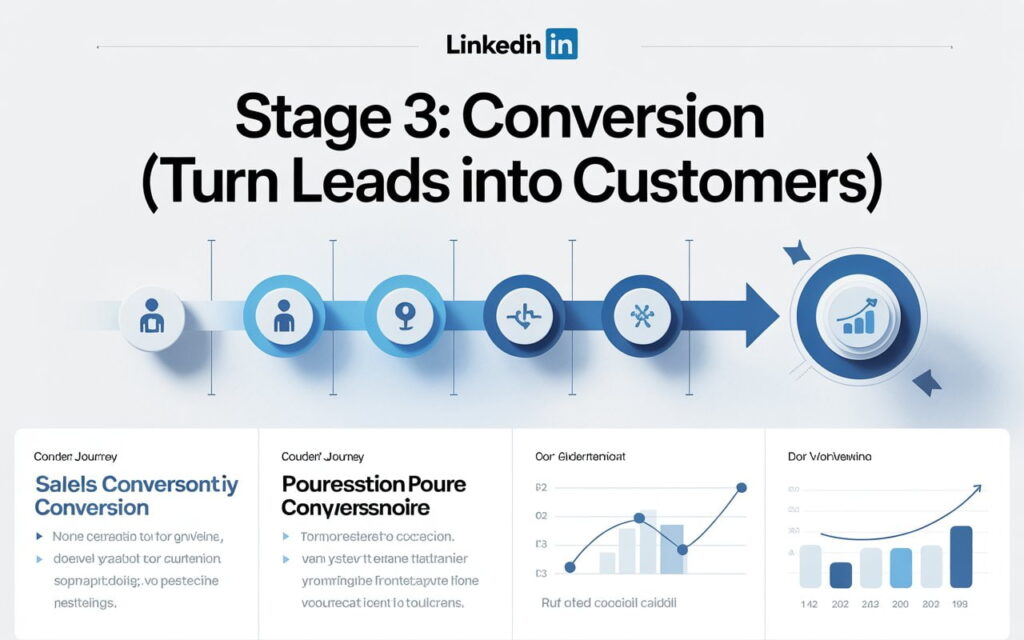
You’ve attracted them and nurtured them. Now it’s time to convert.
LinkedIn Lead Gen Forms vs Landing Pages
LinkedIn Lead Gen Forms are absolute game-changers. They pre-fill with the user’s LinkedIn data, making conversion frictionless.
The numbers don’t lie: Lead Gen Forms convert at 13% versus 2-3% for external landing pages. They also cost 15% less per lead.
When should you use Lead Gen Forms? For top and middle funnel offers like ebook downloads, webinar signups, and newsletter subscriptions.
Landing pages work better for bottom-funnel offers where you need more qualification questions. Think demos, consultations, and high-ticket services.
Setting up a Lead Gen Form takes 5 minutes. Go to Campaign Manager, create a new campaign with the “Lead generation” objective, and build your form.
High-Intent Conversion Offers
What you offer matters as much as how you offer it. Tailor your conversion offer to your audience’s stage in the buying journey.
Product demos work for SaaS and tech products. Offer a personalized walkthrough, not a generic video.
Free consultations convert well for professional services like consulting, legal, and accounting.
ROI calculators and assessment tools provide instant value while qualifying leads.
For SaaS, free trials let prospects experience your product firsthand. Just make sure onboarding is smooth.
Sales Handoff Process
Your funnel doesn’t end at form submission. The sales handoff is critical.
Set up instant notifications when someone submits a Lead Gen Form. Your sales team should respond within 5 minutes for maximum conversion.
Integrate LinkedIn with your CRM (HubSpot, Salesforce) so leads flow automatically into your sales workflow.
Use lead scoring to prioritize hot leads. Score based on job title, company size, engagement level, and form responses.
Qualify leads using frameworks like BANT (Budget, Authority, Need, Timeline) or MEDDIC before passing to sales.
Benchmarks for this stage:
- Form completion rate: 10-13%
- Demo booking rate: 15-25%
- Sales qualified lead rate: 30-40%
- Lead-to-opportunity conversion: 15-20%
Essential Tools and Automation
You can’t scale manually forever. Here’s your tech stack for LinkedIn lead generation.
LinkedIn Native Tools
Sales Navigator ($99/month) is worth every penny. Advanced search filters, lead recommendations, and unlimited InMail credits pay for themselves.
Campaign Manager is free for running ads. The interface isn’t as polished as Facebook, but the targeting is unmatched.
Safe Automation Tools
Automation is powerful but risky. Use cloud-based tools, never browser extensions.
Expandi ($99/month) is the gold standard. Cloud-based, mimics human behavior, and has smart daily limits.
Dripify ($59/month) offers great value for small teams. User-friendly with solid safety features.
We-Connect ($49/month) is perfect for solopreneurs. Simple setup, safe limits, and reliable performance.
Stay within daily limits: 100 connection requests and 200 messages maximum. Going over risks account restrictions.
Analytics and Tracking
Install the LinkedIn Insight Tag on your website. It enables conversion tracking and provides audience insights.
Integrate LinkedIn with Google Analytics 4 to track the full customer journey. See which LinkedIn campaigns drive website conversions.
Use UTM parameters on all external links. Track which posts and ads drive the most valuable traffic.
Measuring Success: Key Metrics
You can’t improve what you don’t measure. Here are the metrics that matter most.
Awareness Metrics
Track impressions, profile views, connection growth rate, and post engagement rate. These show if you’re reaching the right people.
Consideration Metrics
Monitor message response rates, content downloads, email engagement, and time in funnel. These indicate if you’re building trust.
Conversion Metrics
Watch Lead Gen Form completion rates, cost per lead, lead quality scores, and demo booking rates. These reveal funnel effectiveness.
ROI Calculation
Here’s the simple formula: (Revenue from LinkedIn Leads – Total Cost) / Total Cost × 100
Example: 100 leads at $50 CPL = $5,000 cost. 10 customers at $5,000 average deal = $50,000 revenue. ROI: ($50,000 – $5,000) / $5,000 × 100 = 900%
Track your numbers monthly. Optimize based on data, not hunches.
Common Mistakes to Avoid
Let’s talk about what kills most LinkedIn funnels.
Mistake #1: Pitching too early. Build relationships first. Provide value before asking for anything.
Mistake #2: Ignoring profile optimization. Your profile is your first impression. Make it count.
Mistake #3: Over-automation. Tools are helpful, but personalization wins. Always customize your outreach.
Mistake #4: Wrong ad objective. Don’t run conversion campaigns to cold traffic. Match your objective to the funnel stage.
Mistake #5: Weak follow-up. Most deals happen after the 7th touchpoint. Have a systematic follow-up process.
Your Next Steps
Building a LinkedIn lead generation funnel isn’t optional in 2025—it’s essential for B2B growth.
Start with these three actions today:
First, optimize your LinkedIn profile. Update your headline, banner, and About section. Add lead magnets to your Featured section.
Second, create a simple content calendar. Plan 3-5 posts weekly that address your audience’s challenges.
Third, set up your first awareness campaign. Start with $500-1,000 and test different ad formats.
Remember: LinkedIn funnels convert at 13% versus 2% for traditional landing pages. The platform delivers 277% more effectiveness than Facebook or Twitter for B2B lead generation.
The data is clear. The opportunity is massive. The only question is: when will you start
FAQs
Q: Is there a LinkedIn lead generation funnel template I can use?
A: Yes. A basic LinkedIn funnel template covers three stages: awareness through profile optimization and content, consideration through personalized outreach and nurturing, and conversion through Lead Gen Forms or landing pages.
Q: What is a good LinkedIn lead generation funnel example?
A: A strong example is posting educational content three times per week, sending 30 to 50 personalized connection requests weekly, following up with a value driven message sequence, and converting with a LinkedIn Lead Gen Form at 13 percent.
Q: What is the best free LinkedIn lead generation tool?
A: LinkedIn’s native search, connection requests, and organic content are the best free tools. Sales Navigator at $99 per month is worth it once you are ready to scale.
Q: Can I build a LinkedIn lead generation funnel for free?
A: Yes. Use organic content, personalized connection requests, and LinkedIn Lead Gen Forms at zero cost. Paid ads accelerate results but are not required to start generating leads.
Q: How does a LinkedIn lead generation funnel work for B2B?
A: A B2B LinkedIn funnel attracts decision makers through content, nurtures them through personalized outreach and value driven messages, and converts them through Lead Gen Forms or demo booking pages.
Q: How much does LinkedIn lead generation price out at?
A: LinkedIn lead generation costs $5 to $20 per click via ads and $75 to $300 per lead depending on targeting. Organic outreach costs nothing but time and converts at 9 to 13 percent when done correctly.
Q: Is there a LinkedIn lead generation course worth taking?
A: LinkedIn Learning offers official courses on lead generation. For hands on practical frameworks, blogs and guides covering real campaign data deliver faster and more actionable results than most paid courses.
Q: What are LinkedIn Lead Gen Forms and how do they work?
A: LinkedIn Lead Gen Forms are pre-filled contact forms inside LinkedIn ads that capture prospect details without leaving the platform. They convert at 13 percent versus 2 percent for external landing pages.