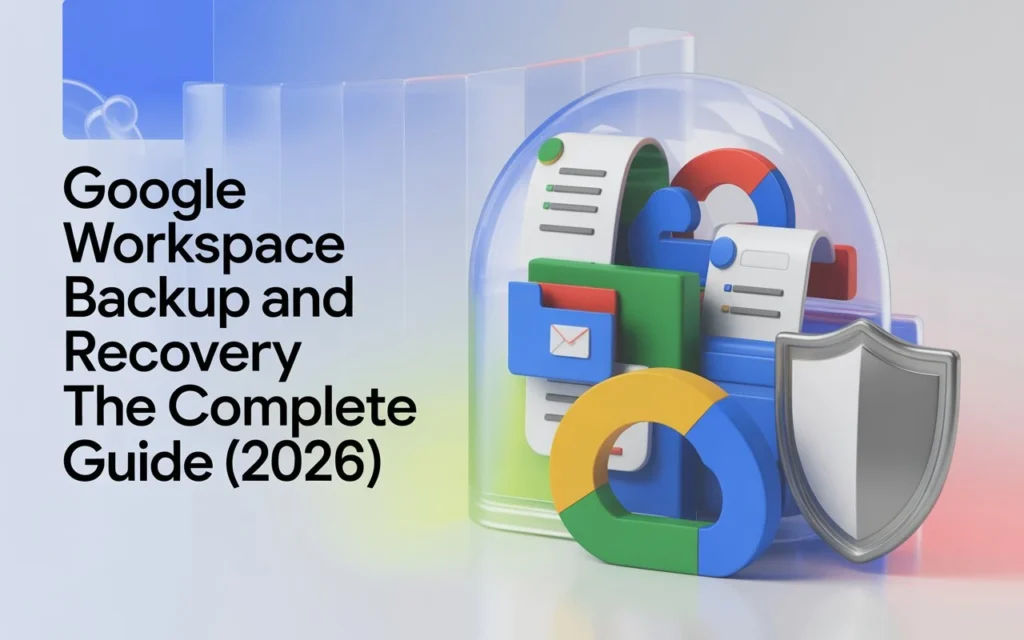
Google does NOT automatically back up your data. It protects its infrastructure not your files. If you accidentally delete an email, lose a Drive folder, or face a ransomware attack, you have a maximum of 55 days to recover it through Google’s native tools. After that, it’s gone forever that’s Why Google Workspace Backup and Recovery is important
Does Google Actually Back Up Your Data?
Here’s something most businesses get completely wrong.
They assume Google is backing up their Google Workspace data the same way it backs up its own servers. It’s not. Google uses what’s called a Shared Responsibility Model. Google protects the platform you’re responsible for protecting your data on it.
Think of it like renting office space. The building owner maintains the structure, electricity, and security cameras. But if you leave your laptop on your desk and it gets stolen? That’s on you.
Google’s infrastructure is rock solid. But accidental deletions, malicious insiders, ransomware attacks, and human errors? Those are your problem to solve.
💡 Need help setting up Google Workspace?
We’re certified Google partners offering 64% off + free professional setup ($2,000 value). Used by 151+ companies.
Get your quote →The 55-Day Recovery Cliff Nobody Talks About
This is the single biggest loophole in Google Workspace data protection and most businesses only discover it after it’s too late.
Here’s how Google’s native recovery window works:
- Deleted items stay in Trash for 30 days
- After that, admins get 25 additional days to recover data
- Total maximum recovery window: 55 days
After day 55, your data is permanently gone. No exceptions.
Now imagine an employee deleted a critical project folder in January. You only notice in March during a client audit. That folder? Unrecoverable. That scenario happens to businesses every single day.
According to the Cloud Security Alliance, 60% of businesses have experienced a data loss event in the past two years. Only two-thirds of those companies were able to fully restore their lost data.
What Data Is Actually at Risk?
Your Google Workspace stores more critical business data than most people realize. Here’s what’s vulnerable without a proper backup and recovery plan:
- Gmail years of client conversations, contracts, and decisions
- Google Drive documents, spreadsheets, presentations, project files
- Shared Drives team collaboration files that multiple people can delete
- Google Calendar meeting records and scheduled commitments
- Google Contacts your entire client and vendor database
- Google Meet recordings stored in Drive, deletable in seconds
Any of these can be wiped out by one careless click, one disgruntled employee, or one successful phishing attack.
Google Vault Is NOT a Backup Here’s Why
This is one of the biggest myths in Google Workspace administration.
Google Vault is an eDiscovery and archiving tool built for legal compliance. It’s designed to help you find and hold data for legal investigations — not restore it after a disaster.
Here’s the critical difference:
| Feature | Google Vault | True Backup |
| Restores accidentally deleted files | ❌ No | ✅ Yes |
| Point-in-time recovery | ❌ No | ✅ Yes |
| Granular file-level restore | ❌ Limited | ✅ Yes |
| Ransomware recovery | ❌ No | ✅ Yes |
| Covers Calendar & Contacts fully | ❌ No | ✅ Yes |
If you’re relying on Google Vault as your backup plan, you’re driving without a seatbelt and thinking you’re safe because the car has airbags.
Is There a Free Google Workspace Backup and Recovery Option?
This is one of the most searched questions and the honest answer is: sort of.
Google Takeout lets you export your Workspace data manually. It’s free. You can download Gmail, Drive, Calendar, and Contacts as archive files. But here’s the problem it’s completely manual. There’s no automation, no scheduling, and no easy way to restore individual files. It’s a one-time snapshot, not a backup and recovery solution.
For basic personal use, Google Takeout works fine. For a business with 10, 50, or 500 employees? It’s not even close to sufficient.
Free Google Workspace backup and recovery downloads from third-party tools do exist, but most free tiers cap storage at minimal levels, exclude key apps, and don’t offer automated backup scheduling the single most important feature you need.
The bottom line: free options are a starting point, not a strategy.
Top 4 Threats Making Backup Non-Negotiable in 2026
The risk landscape has changed dramatically. Here’s what’s targeting your Google Workspace data right now:
1. AI-Powered Ransomware Modern ransomware doesn’t just lock your local files it targets cloud data directly through compromised accounts. Rubrik recently launched air-gapped Google Workspace backup specifically to address this 2026 threat.
2. Accidental Deletion The most common cause of data loss. An employee permanently deletes a folder. A shared drive gets cleared out. It happens in seconds and without backup, recovery isn’t possible after 55 days.
3. Deprovisioned User Accounts When an employee leaves and their Google Workspace account gets deleted, all their Drive files, emails, and data go with it unless you’ve explicitly transferred or backed them up first.
4. Malicious Insider Activity A disgruntled employee with admin access can systematically delete critical business data before walking out the door. By the time you notice, the recovery window may have already closed.
How to Choose the Right Backup Solution: RTO and RPO Explained Simply
Before picking any Google Workspace backup tool, you need to understand two key numbers:
RPO (Recovery Point Objective) How much data can you afford to lose? If your RPO is 24 hours, you need backups at least once a day. If it’s 4 hours, you need more frequent backups.
RTO (Recovery Time Objective) How fast do you need to be back up and running after a disaster? A 2-hour RTO means your backup solution must restore data within 2 hours.
For most small and mid-sized businesses, aim for:
- RPO: 24 hours or less (daily automated backups minimum)
- RTO: Under 4 hours (granular restore capability required)
Compliance: Why Your Industry Makes Backup Mandatory
This isn’t optional for regulated industries. Google Workspace data backup is legally required under several major frameworks:
- HIPAA Healthcare organizations must maintain retrievable copies of electronic Protected Health Information (ePHI). Google offers a Business Associate Agreement (BAA), but you’re still responsible for backup. HIPAA Section §164.308(a)(7) explicitly requires a data backup plan.
- GDPR Non-compliance fines reach up to €20 million or 4% of annual turnover. Your backup must also support the “right to erasure” meaning old backup files must expire according to your retention policy.
- FINRA Financial services firms must retain business communications for a minimum of 3 years, with the first 2 years in an easily accessible format.
Google’s infrastructure is HIPAA-eligible and GDPR-ready but that compliance only covers Google’s side. Your backup and recovery strategy is your responsibility entirely.
Google Workspace Backup Solutions Compared (2026)
Here’s a neutral comparison of the top Google Workspace backup and recovery tools available today:
| Tool | Backup Frequency | Key Strength | Starting Price |
| IDrive | 3x daily | 10TB storage/seat, immutable backups | $20/seat/year |
| Acronis | 3x daily | Built-in malware scanning | Contact for pricing |
| Backupify (Datto) | 3x daily | SOC 2 Type II compliance | Contact for pricing |
| Afi.ai | Multiple daily | AI-driven ransomware detection | ~$3/user/month |
| Spanning Backup | Daily + on-demand | Easy setup, AI deletion monitoring | Contact for pricing |
| CubeBackup | Daily | Affordable, on-premises option | $5/user/year |
Key features to prioritize: automated backup scheduling, point-in-time recovery, granular restore (file-level, not just full restore), AES-256 encryption, and immutable backup storage.
Step-by-Step: Setting Up Google Workspace Backup
Once you’ve chosen your backup tool, here’s the standard setup process:
- Connect your Google Workspace admin account to the backup platform via OAuth (secure, no password sharing)
- Select which users and data types to include Gmail, Drive, Shared Drives, Calendar, Contacts
- Set your backup schedule minimum once daily, ideally 3x daily for critical data
- Configure your retention policy how long to keep backup versions (30 days minimum, 1 year+ for compliance)
- Set geographic storage region important for GDPR data residency requirements
- Run your first manual backup and verify it completes successfully
- Test a restore pick a random file and restore it. If you can’t do this step, your backup isn’t real yet
How to Test Your Backup Recovery (The Step Everyone Skips)
Here’s the uncomfortable truth: a backup you’ve never tested isn’t a backup it’s a hope.
According to compliance experts, you should run a full restore test at least once per quarter. Document the results. If auditors come calling for HIPAA, GDPR, or SOC 2 they’ll want proof that your backup actually works, not just that you have it configured.
Your test should confirm:
- Individual file restore works (pick a random Gmail thread or Drive document)
- Full account restore is possible for a sample user
- Recovery time meets your RTO target
- Data integrity is intact files open and match the original
Need Help Setting Up Your Google Workspace First?
Before you can back anything up, you need a properly configured Google Workspace environment. And that’s where a lot of businesses quietly struggle DNS misconfigurations, security gaps, and poor setup can actually increase your data loss risk before backup even enters the picture.
Leads Monky is a certified Google Workspace reseller and authorized partner trusted by 151+ companies globally including brands like Mitsubishi, Oracle, and VMware. They offer Google Workspace plans starting at just $2.50/mailbox/month, with complete setup included: DKIM, DMARC, SPF configuration, spam protection, and admin access with 100% ownership.
Whether you’re setting up fresh for your team or migrating from an existing provider, Leads Monky handles the entire technical stack so your foundation is solid before you layer backup on top of it. That’s the right order of operations, and they’ve spent over a decade perfecting it.
Frequently Asked Questions
What does Google Workspace Essentials Starter include?
It includes Google Meet, Drive, Docs, Sheets, Slides, and Chat but no Gmail or custom email address.
Does Google Workspace Essentials include Gmail?
No, Gmail is not included in Essentials Starter you only get Meet, Drive, and collaboration apps.
Is Google Essentials free?
Yes, Google Workspace Essentials Starter is free for up to 25 users with 15GB storage per user.
What is Google Workspace Starter Plan?
It’s the entry-level paid plan at $6/user/month offering Gmail, Meet, Drive, and 30GB storage per user.
Why use Google Workspace instead of Gmail?
Google Workspace gives you a professional branded email (you@yourcompany.com), admin controls, team management, and more storage than free Gmail.
What is the Google 20% rule?
It’s Google’s internal policy allowing employees to spend 20% of their work time on personal passion projects Gmail and Google News were born from it.
What is the disadvantage of Google Workspace?
The biggest disadvantage is that Google doesn’t back up your data accidental deletions, ransomware, and account loss are entirely your responsibility.
How much does Google Workspace cost per month?
Plans start at $6/user/month (Starter), $12 (Standard), and $18 (Plus) or as low as $2.50/user/month through authorized resellers like Leads Monky.
Is there a better alternative to Google Workspace?
Microsoft 365 is the closest alternative, but Google Workspace leads in real-time collaboration, simplicity, and cross-device accessibility.
How to avoid paying for Google Workspace?
Use the free Essentials Starter tier for basic collaboration, or buy through an authorized reseller like Leads Monky to get up to 50-60% off standard Google pricing.
Why are people leaving Google Docs?
Some users cite concerns about privacy, lack of advanced formatting features, and Google’s history of discontinuing products without
Conclusion
Google Workspace backup and recovery isn’t a nice-to-have. It’s the difference between a bad day and a business-ending disaster.
Google protects its platform. You protect your data. That’s the deal whether you knew it or not.
Start with a properly configured Google Workspace environment (Leads Monky makes that part easy and affordable), layer on a third-party automated backup solution with daily scheduling and point-in-time recovery, and test your restore process every quarter.
The 55-day clock is always ticking. The best time to set up backup was yesterday. The second best time is right now.
Get Google Workspace at 64% Off
Same service. Better price. Professional setup included.
⭐⭐⭐⭐⭐ 151+ companies trust us
Partner Pricing:
• Business Starter: $3/month (Google: $8)
• Business Standard: $13/month (Google: $17)
• Business Plus: $20/month (Google: $26)
FREE:
Complete DNS setup + 24/7 support + USA IPs
15-user minimum | Setup in 24 hours