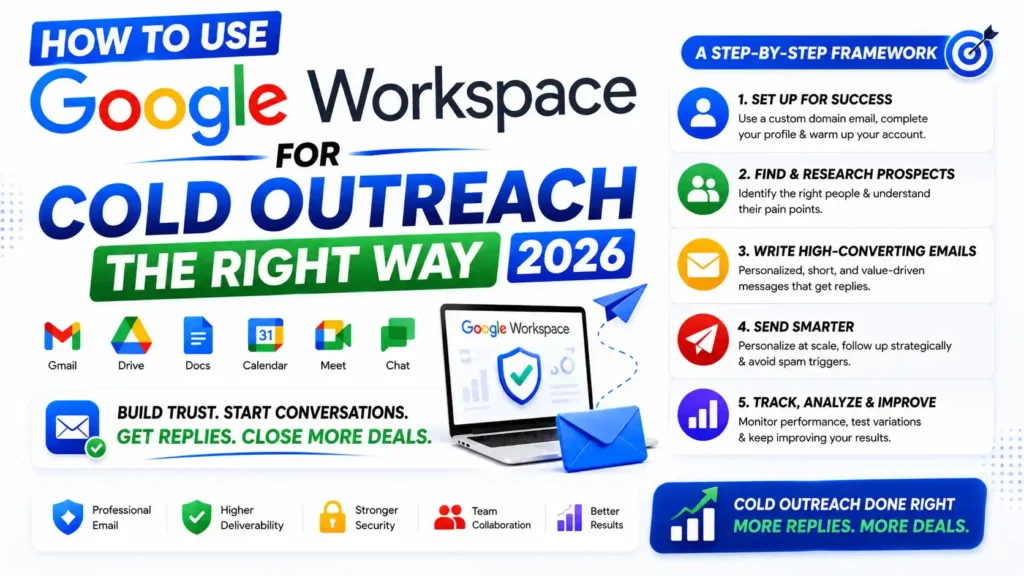
Google Workspace for cold outreach is still one of the strongest infrastructure choices available, but only when you set it up the right way.
The teams getting suspended are not failing because Google blocks cold email. They are failing because they send from their primary domain, skip DNS authentication, or scale before warming up their mailboxes.
Done correctly, Google Workspace delivers strong inbox placement through any major sending platform like Instantly, Smartlead, or Lemlist.
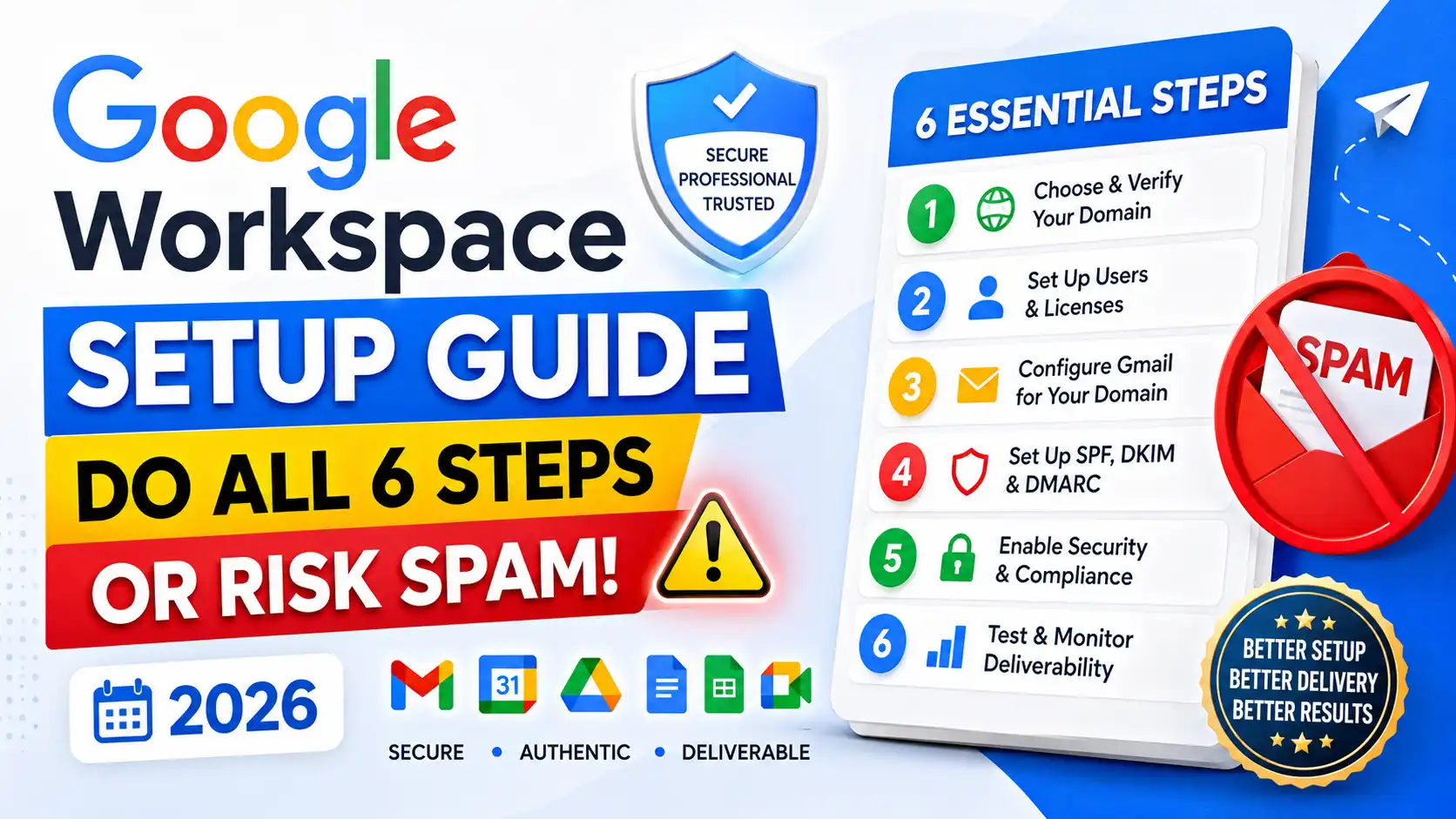
This guide walks through the exact setup that protects your sender reputation: secondary domains, full SPF, DKIM, and DMARC authentication, a 21 day warm up sequence, and the scaling structure that keeps your accounts safe.
Quick Answer
Google Workspace works well for cold outreach when you send from a secondary domain, not your primary business domain. Configure SPF, DKIM, and DMARC authentication before sending a single email. Warm up each mailbox over 21 days starting at 5 to 10 sends per day. Keep daily volume at 30 to 50 cold emails per mailbox and monitor your sender reputation in Google Postmaster Tools weekly.
Why Google Workspace Is Still the #1 Choice for Cold Outreach
Every ISP, spam filter, and mail server on the planet trusts Google’s infrastructure.
When your email arrives from a Google Workspace account, receiving servers see a sender with a 20-year reputation behind it. That trust is worth more than any technical trick.
Here’s what makes Google Workspace email stand out for outreach:
- Custom domain emails like sarah@yourbrand.com look professional and build instant credibility
- Google’s servers deliver exceptional email deliverability rates compared to unknown providers
- Native integration with every major cold email sending platform Instantly, Smartlead, Lemlist, Apollo
- Simple admin controls to manage multiple cold email accounts from one dashboard
The truth is this: Google Workspace doesn’t fail cold emailers. Poor setup fails cold emailers.
The #1 Mistake That Gets People Banned (Avoid This First)

Before anything else, you need to understand one rule.
Never send cold outreach from your primary business domain.
Your main domain — the one on your website and business cards is irreplaceable. One spam complaint, one Google policy flag, and your entire company’s email could go dark.
The solution is simple: use secondary domains for all cold outreach.
These are domains closely related to your brand. For example, if your business is brandname.com, your outreach domain might be getbrandname.com or trybrandname.com.
This one decision protects everything you’ve built.
How to Set Up Google Workspace for Cold Outreach (Step-by-Step)
Let’s walk through the exact setup process. Follow these steps in order each one builds on the last.
Step 1: Register Your Secondary Domain
Buy a clean domain from Namecheap, Cloudflare Registrar, or Google Domains. Enable privacy protection during checkout — exposed registrant details can trigger spam filters.
Pro tip: Register your domain 4–6 weeks before your campaign launch. Aged domains have better sender reputation than brand-new ones.
Step 2: Get Your Google Workspace Plan
Go to workspace.google.com and choose the Business Starter plan. It gives you everything you need for cold email outreach — custom Gmail, full admin access, and authentication tools at the lowest price point.
Want to save 64% on Google Workspace licenses? Leads Monky is a certified Google Workspace reseller offering Business Starter at just $2.50/mailbox/month compared to Google’s standard $6. That’s more than half your infrastructure cost back in your pocket, with zero setup fees and full admin ownership.
Step 3: Create Natural-Sounding Mailboxes
Set up 2–3 mailboxes per domain using real human names.
Good: james.miller@trybrandname.com Bad: info@trybrandname.com, admin@, newsletter@
Role-based addresses pattern-match to mass emailers. Human names build trust with both spam filters and real recipients.
Step 4: Write a Professional Email Signature
Every cold outreach mailbox needs a complete signature: full name, title, company name, and website. This signals legitimacy to spam filters and gives recipients a reason to trust you.
SPF, DKIM, and DMARC: The Three Records That Make or Break Deliverability
Most cold email failures trace back here.
DNS authentication tells the internet that your emails are real, authorized, and tamper-free. Without it, even perfectly written emails go straight to spam.
Here’s what each record does and how to set it up.
If you want a deeper, step-by-step breakdown of how to achieve near-perfect inbox placement with Google Workspace, including advanced deliverability optimization techniques,
SPF (Sender Policy Framework)
SPF tells receiving mail servers which services are authorized to send email on your behalf.
Add this TXT record to your DNS:
| Field | Value |
| Name | @ |
| Type | TXT |
| Value | v=spf1 include:_spf.google.com ~all |
Use ~all (soft fail) not -all. Soft fail is safer for cold email deliverability when you’re building reputation.
DKIM (DomainKeys Identified Mail)
DKIM adds a digital signature to every email you send. It proves the message wasn’t altered in transit.
To activate it in Google Workspace:
- Go to Admin Console → Apps → Gmail → Authenticate Email
- Click Generate New Record
- Copy the TXT record and add it to your DNS
- Click Start Authentication
Give it 24–48 hours to activate. Verify it’s working at MXToolbox.com — it’s free.
DMARC (Domain-based Message Authentication)
DMARC is the final layer. It tells receiving servers what to do if SPF or DKIM fail, and sends you weekly reports on your domain’s email activity.
Start with this record:
| Field | Value |
| Name | _dmarc |
| Type | TXT |
| Value | v=DMARC1; p=none; rua=mailto:dmarc@yourdomain.com; fo=1 |
Start with p=none (monitor mode). After 3–4 weeks of clean sending, move to p=quarantine, then p=reject.
All three records — SPF, DKIM, and DMARC are included in every setup done by Leads Monky. Zero technical headaches.
The 21-Day Email Warm-Up Protocol
Skipping warm-up is how good domains die fast.
A brand-new Google Workspace mailbox has no sending history. Mail servers don’t know if you’re a legitimate sender or a spammer. Warm-up builds that trust gradually before your campaigns go live.
Week 1 (Days 1–7): Send 5–10 emails per day. These should be real conversations reply to newsletters, exchange messages with colleagues. Focus on getting replies. A reply rate above 20% signals strong engagement to mail servers.
Week 2 (Days 8–14): Increase to 20–25 emails per day. Mix warm conversations with a handful of highly targeted cold emails. Monitor your sender reputation in Google Postmaster Tools (more on this below).
Week 3 (Days 15–21): Scale to 30–50 emails per day. You’re now ready for systematic cold outreach campaigns.
Keep automated warm-up running in the background even after you launch. Tools like Warmup Inbox or Instantly’s built-in warm-up maintain your inbox reputation while you send.
Google Postmaster Tools: Your Free Deliverability Dashboard
Here’s a tool almost nobody in cold email talks about and it’s completely free.
Google Postmaster Tools (postmaster.google.com) gives you direct data from Google’s servers about how your domain is performing.
You can track:
- Domain reputation (high, medium, low, or bad)
- Spam rate (critical keep this below 0.10%)
- Authentication status for SPF, DKIM, and DMARC
- Delivery errors and bounce data in real time
Set this up the moment your domain is verified. It takes 10 minutes and gives you the early warning system every cold emailer needs.
If your spam rate creeps above 0.10%, stop sending immediately, audit your list, and reduce volume by 50% for two weeks.
How to Scale Cold Outreach Without Burning Domains
Scaling isn’t about sending more emails from one account. It’s about adding infrastructure intelligently.
Here’s a simple scaling roadmap:
| Monthly Target | Domains | Mailboxes | Daily Per Mailbox |
| Up to 1,000 emails | 1 | 2 | 20–25 |
| 1,000–5,000 emails | 2–3 | 2–3 each | 25–35 |
| 5,000–10,000 emails | 4–6 | 3 each | 35–50 |
| 10,000+ emails | 8–12 | 3–4 each | 40–50 |
The key principle is inbox rotation spreading your sends across multiple mailboxes and domains. Most cold email platforms (Instantly, Smartlead, Lemlist) handle this automatically once you connect your Google Workspace accounts.
If one domain has a deliverability issue, the rest of your infrastructure keeps running. No single point of failure.
How Leads Monky Makes This 64% Cheaper (And Way Easier)
Let’s talk numbers.
Google charges $6 per mailbox per month for Business Starter. If you’re running 20 mailboxes for a mid-scale campaign, that’s $120/month just for the mailboxes.
Leads Monky is a certified Google Workspace reseller and authorized partner offering the same Business Starter plan at $2.50–$2.99/mailbox/month. That’s a saving of over 64% on your license costs alone.
But the pricing isn’t even the biggest advantage.
Every Leads Monky setup includes:
- ✅ DKIM configuration — proper email authentication from day one
- ✅ DMARC setup — domain protection and reputation monitoring
- ✅ SPF records — authorized sending, fewer spam flags
- ✅ Spam protection filters — clean domain health maintained
- ✅ Warm-up guidance — so your accounts are outreach-ready fast
- ✅ USA-based IPs only — trusted, clean sending infrastructure
- ✅ Full admin access — 100% ownership of your accounts
- ✅ 24/7 support — real experts who understand cold email
You get the full cold email infrastructure setup with zero setup fees. No extra charges. No surprises.
For agencies and outbound teams running 15+ accounts, the savings compound fast. 200+ mailboxes? The rate drops to $2.50/mailbox making it the most cost-effective Google Workspace cold email solution available.
Quick Troubleshooting: Why Your Emails Might Be Going to Spam
Even with the right setup, things sometimes go wrong. Here’s how to diagnose the most common issues fast.
Emails landing in spam?
Check your SPF, DKIM, and DMARC at MXToolbox. Check your domain blacklist status. Reduce send volume by 50% for two weeks and audit your email copy for spam trigger words like “free,” “guarantee,” or “click here.”
Bounce rate above 3%?
Clean your list with ZeroBounce or NeverBounce before every campaign. Remove role-based addresses (info@, contact@). Verify your MX records are correctly propagated.
Low open rates (under 25%)?
Switch from HTML to plain-text emails for cold outreach. Plain text bypasses Gmail’s Promotions tab. Use a real human name in your “From” field not a company name.
FAQs
Can you use Google Workspace for cold email?
Yes. Google Workspace is one of the best foundations for cold email outreach when set up with secondary domains, proper DNS authentication, and a structured warm-up period.
How many cold emails can I send per day with Google Workspace?
Send 20–50 cold emails per day per mailbox for safe, sustainable outreach. Google’s technical limit is 2,000/day, but exceeding 50 cold emails risks your domain reputation.
What’s the cheapest way to get Google Workspace for cold email?
Through a certified Google Workspace reseller like Leads Monky, you can get Business Starter at $2.50/mailbox/month saving over 64% versus buying directly from Google.
How long does email warm-up take?
Allow 21 days minimum before launching full campaigns. Start at 5–10 emails per day and build to 30–50 gradually.
Do I need separate domains for cold outreach?
Absolutely. Always send cold email campaigns from secondary domains never your primary business domain.
Is Google Workspace free for NGOs?
Yes, eligible nonprofits can receive free email services through the Google Workspace for Nonprofits program provided by Google.
How to send 10,000 emails at once?
To send 10,000 cold emails safely, distribute the volume across multiple domains and inboxes using cold email tools like Instantly or Smartlead while keeping each mailbox under 40–50 emails per day.
Is cold email outreach dead?
No, cold email outreach is still highly effective in 2026 when combined with proper targeting, personalization, and strong deliverability infrastructure.
Does Gmail allow cold emails?
Yes, Gmail allows cold emails as long as senders follow anti-spam policies, maintain low spam complaint rates, and avoid bulk unsolicited messaging.
What is the 30/30/50 rule for cold emails?
The 30/30/50 rule suggests keeping cold emails under 50 words, spending 30% on personalization, and 30% on value or problem relevance to improve response rates.
Is Gmail or Outlook better for cold emails?
Most outreach experts prefer Google Workspace over Microsoft 365 because Gmail infrastructure often delivers higher inbox placement and stronger sender reputation.
Who is the king of cold email?
There is no official “king” of cold email, but marketers often credit experts like Waqas Ahmed CEO of Leads Monky for popularizing modern cold outreach strategies.
How much is a 1000 email list worth?
The value of a 1,000-email list varies by niche and engagement but can range from $100 to several thousand dollars if the audience is highly targeted and responsive.
Why don’t Gen Z respond to emails?
Many Gen Z users prefer faster communication channels like messaging apps and social media instead of traditional email, which reduces response rates for email outreach.
The Bottom Line
Google Workspace for cold outreach isn’t just viable — it’s the smartest infrastructure choice in 2025 when set up correctly.
Use secondary domains. Authenticate with SPF, DKIM, and DMARC. Warm up your accounts for 21 days. Scale gradually with inbox rotation. Monitor everything in Google Postmaster Tools.
And if you want to skip the setup headaches and cut your costs by 64%, Leads Monky handles the entire infrastructure for you — from domain verification to warm-up guidance — at the best price available anywhere.
Your cold outreach engine is one setup away. Let’s build it right.
Get Started with Leads Monky →
Get Google Workspace at 64% Off
Same service. Better price. Professional setup included.
⭐⭐⭐⭐⭐ 151+ companies trust us
Partner Pricing:
• Business Starter: $3/month (Google: $8)
• Business Standard: $13/month (Google: $17)
• Business Plus: $20/month (Google: $26)
FREE:
Complete DNS setup + 24/7 support + USA IPs
15-user minimum | Setup in 24 hours