Quick Answer
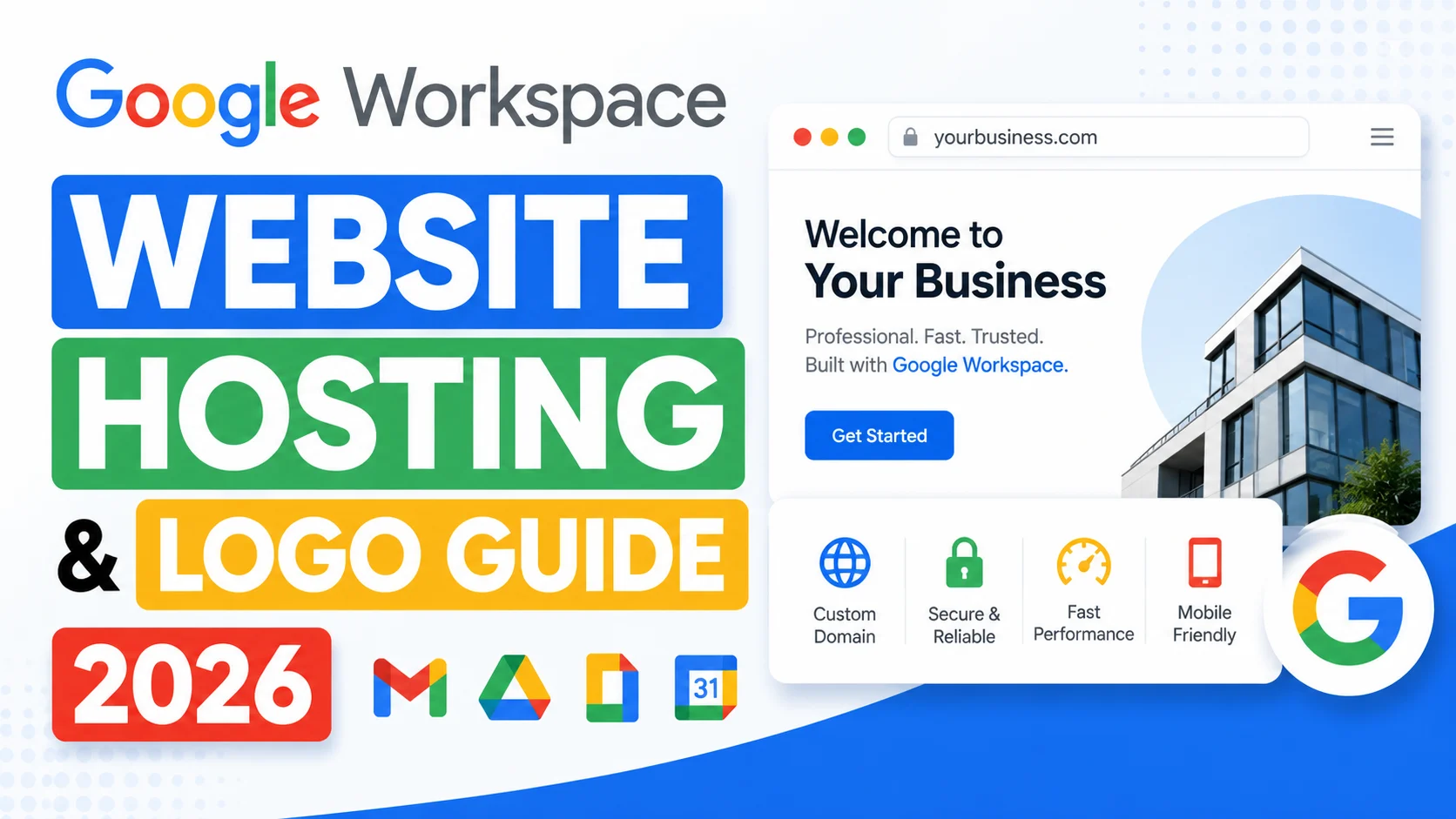
Google Workspace can host a website through Google Sites, which is included free on every paid Workspace plan. Google Sites lets you build and publish a static site using a drag-and-drop builder with no coding required, and you can map it to a custom domain. It does not support dynamic websites, e-commerce, WordPress, or server-side code. For adding your company logo to Workspace apps, use the Admin console under Account → Account Settings → Personalization.
Two questions come up regularly once businesses set up Google Workspace: can it host their website, and how do they add their company logo to their apps? Both have clear answers, and both are easier to execute than most guides suggest. This covers website hosting through Google Sites — what it does, what it doesn’t, and how to connect a custom domain — plus the Admin console logo upload process that puts your branding across Gmail, Drive, Calendar, and Meet.
Does Google Workspace Include Website Hosting?

Yes, Google Workspace includes a website builder and hosting tool called Google Sites, available at no extra cost on every paid Business plan. It is not a traditional web hosting service with FTP access, a control panel, or a server you configure — it is a browser-based, drag-and-drop site builder that publishes pages directly to Google’s infrastructure.
The distinction matters because it shapes what you can and cannot do with it. Google Sites is purpose-built for simple, informational websites: company pages, team intranets, project portals, portfolio sites, and service listings. If your website needs to do anything beyond publishing static content, Google Sites is not the right tool.
What it handles well is genuinely useful for a lot of small businesses: building a professional-looking website in hours without a developer, collaborating on site content with team members the same way you’d collaborate on a Google Doc, and hosting it all without a separate hosting bill.
What Google Sites Can and Cannot Do
Google Sites builds and hosts static websites only. Static means the pages are the same for every visitor — there’s no user login system, no database querying content dynamically, and no server-side processing.
What Google Sites handles without issues: contact forms powered by Google Forms (with responses saved in Sheets), embedded Google Maps, Google Calendar integrations for appointment scheduling, image carousels, embedded YouTube videos, and Google Analytics tracking. For a service business, consultancy, or portfolio, these cover most genuine needs.
What it cannot do matters equally. There is no FTP access, no ability to upload custom PHP, CSS, JavaScript, or Perl files, no WordPress installation, no plugin support, and no e-commerce checkout. You cannot build a blog with categories and tags, a membership site with paywalled content, or a product catalogue with a shopping cart. Third-party script embeds are not supported beyond basic iframe embeds.
The honest comparison: Google Sites sits in the same category as Squarespace’s most basic tier or a simple Wix free site — good for an online presence, not adequate for a full-featured business website. For teams with complex website requirements, the right architecture is Workspace for email and collaboration alongside a dedicated hosting provider for the website.
💡 Need help setting up Google Workspace?
We’re certified Google partners offering 64% off + free professional setup ($2,000 value). Used by 1000+ companies.
Get your quote →How to Build and Publish a Website With Google Sites
You start at sites.google.com, not in the Admin console. The Admin console is only involved when you want to map a custom domain — the actual site building happens directly in Google Sites, accessible from any Workspace account.
The basic publishing sequence looks like this:
- Go to sites.google.com and click the plus icon to create a new site.
- Choose a layout and theme from the prebuilt options.
- Add pages, text, images, embedded Google content, and navigation using the drag-and-drop editor.
- Click Preview at any point to see how the site looks on desktop and mobile.
- When ready, click Publish. Your site goes live at a URL like sites.google.com/yourdomain.com/sitename.
- To use a custom domain instead, follow the Admin console process in the next section.
Pages in Google Sites don’t count against your Drive storage quota, and there are no bandwidth limits — you don’t pay more if traffic spikes. The site can have up to 10,000 pages.
How to Map a Custom Domain to Google Sites
Without custom domain mapping, your Google Sites URL looks like sites.google.com/yourdomain.com/company-site. With it, visitors reach your site at yourdomain.com or a subdomain like site.yourdomain.com. The mapping is done in the Admin console and requires access to your domain’s DNS settings.
Step-by-step:
- Sign into the Admin console at admin.google.com.
- Go to Apps → Google Workspace → Sites.
- Scroll down to the Custom URL section and click it.
- Click the + icon to add a new custom URL.
- Select New Sites (unless you specifically built your site in Classic Sites) and click Continue.
- Enter your site’s URL in the format: sites.google.com/yourdomain.com/sitename — do not include https:// or a trailing slash, as either will trigger an “invalid site” error.
- In the next screen, enter the subdomain you want mapped. For example, entering “website” maps your site to website.yourdomain.com.
- Google then shows you the CNAME record to add at your domain registrar. The CNAME alias is the subdomain you entered, and the destination is ghs.googlehosted.com.
- Go to your domain registrar (GoDaddy, Namecheap, Squarespace Domains, or wherever your domain is registered), find the DNS management section, and add that CNAME record.
- Return to the Admin console and click Add Custom URL.
DNS changes typically propagate within a few hours, sometimes up to 48 hours. Once propagated, your Google Sites page loads at the custom domain.
One practical note: the custom domain path maps to a subdomain (website.yourdomain.com), not the root domain (yourdomain.com). If you want the root domain to redirect to your Google Sites page, you need to set up a redirect at your domain registrar separately. Most registrars have a straightforward URL forwarding or redirect option for the root domain.
How to Add Your Company Logo to Google Workspace
The Workspace Admin console includes a Personalization section where you upload your company logo, and once uploaded it appears across Gmail, Drive, Calendar, Meet, and other Workspace apps for everyone on your domain. This replaces the default Google branding with your organization’s identity.
The path in the Admin console:
- Sign in at admin.google.com.
- Go to Account → Account Settings → Personalization.
- Under the Logo section, click Select file and upload your logo image.
- Click Save after uploading.
Logo requirements: Google recommends a 320 x 132 pixel image in PNG or GIF format (no JPG). The file size limit is 800KB. Transparent backgrounds work well since the logo appears against both light and dark app interfaces.
The logo appears in the upper-left corner of supported Workspace apps when users are signed into your organization’s account. It does not replace the Google logo on Google.com or in personal Gmail accounts — it only applies to accounts on your Workspace domain.
One thing that surprises some administrators: the change can take a few hours to propagate to all users after saving. If you upload the logo and it doesn’t appear immediately, wait a few hours before assuming something went wrong.
When Google Sites Is Not Enough
Google Sites is a strong zero-cost starting point, but it has clear limits that matter as a business grows. The most common situations where teams move beyond it include needing a blog with SEO control and custom metadata, running an online store, capturing leads through forms that integrate with a CRM (beyond basic Google Sheets), and needing custom page layouts that Google Sites themes don’t support.
When Google Sites stops being enough, the practical next step is a dedicated hosting provider or website platform running alongside Workspace — not instead of it. Workspace handles email, calendar, documents, and collaboration. The website sits on a separate platform like WordPress, Squarespace, or Webflow, connected to the same domain but hosted independently. The two don’t conflict, and running them alongside each other is the standard setup for most businesses beyond the very early stage.
If you’re evaluating Workspace primarily because you want to combine email and website hosting in one subscription, that’s worth knowing upfront: Workspace’s email and collaboration tools are industry-leading, but its website hosting (via Google Sites) is best treated as a bonus tool for simple use cases rather than a full web hosting replacement.
Conclusion
Google Workspace hosts websites through Google Sites, which is included free on every paid plan and works well for simple, static business sites. Custom domain mapping takes about 15 minutes if you’re comfortable editing DNS records. For adding your company logo to Gmail, Drive, Calendar, and other apps, the Admin console Personalization section handles that in under five minutes. If your website needs anything beyond static pages — a blog, a shop, dynamic content, or deep SEO control — Workspace is best paired with a dedicated web hosting solution rather than relying on Google Sites alone.
For businesses setting up Workspace for the first time, Leads Monky, an authorized Google Workspace reseller, offers the same official Business plans at lower per-user rates with full DNS setup and domain configuration included in the onboarding.
FAQs
Does Google Workspace include website hosting?
Yes, through Google Sites, which is included free on every paid Workspace plan. Google Sites is a drag-and-drop static website builder — it does not support WordPress, e-commerce, or server-side code.
Can I use a custom domain with Google Sites?
Yes. You map a custom subdomain in the Admin console under Apps → Google Workspace → Sites → Custom URL, then add a CNAME record at your domain registrar pointing to ghs.googlehosted.com.
Can I host a WordPress site on Google Workspace?
No. Google Sites only supports static websites. WordPress requires server-side PHP and a database, neither of which Google Sites supports. WordPress needs a separate hosting provider.
Is Google Sites free with Google Workspace?
Yes. Google Sites is included at no extra cost on all paid Workspace plans. There are no bandwidth charges and site pages do not count against your Drive storage quota.
How do I add my company logo to Google Workspace?
Sign into the Admin console, go to Account → Account Settings → Personalization, and upload your logo under the Logo section. The recommended size is 320 x 132 pixels in PNG or GIF format.
What are the limitations of hosting a website on Google Workspace?
Google Sites only supports static content. It does not support custom CSS or JavaScript uploads, plugins, e-commerce, CMS platforms like WordPress, or server-side code. It is best suited for simple portfolio, service, or informational sites.
Ready to Fix Your Cold Email?
What you get:
- ✓ Complete infrastructure: 30 emails + 10 domains
- ✓ 10,000 personalized emails monthly
- ✓ First consultations in 5–6 weeks